

This morning, we still had not made any decisions about where to go next, so Béné again tried calling Benoit of the Rwanda Development Board (Rwanda’s tourist agency). Again, no response, so Béné called Mary to complain and Mary finally got Benoit to call us about an hour later. Béné explained that we were looking for information on the main trail and the Tyazo-Kigaga Trail. Specifically, we wanted to know where the trail went, the towns the trail passed through. Benoit did not know the towns, but told us that there is no lodging between Tyazo and Kigaga, as it’s a mountain bike trail, not a hiking trail. (So, it turned out to be good that we did not take the dirt trails, as they were long distances for mountain bikers, not hikers, and we would have found no places to stay.) Benoit explained that the hiking portion of the Trail is on the paved road. When we told him that we did not want to hike on the busy road, he suggested that we take a bus to the large Gishawa Genocide Memorial, where there were two lodges and we could do a day hike there.
Benoit also explained that RDB has published a new trail map, but that it won’t be available to the public for some months. When we complained about the paved road hiking trail portion of the Congo Nile Trail, he said that RDB is designing another trail for hikers with distances that won’t be so far between lodging availability. Of course, that didn’t help us today, and he could not tell us when the trail would be started or completed.
So, today, based on Benoit’s advice, we took a bus to the Gishawa Genocide Memorial. Our goal was to take a bus on the road to move us further south and then to do a day hike after we got off the bus and found a place to stay.
However, when we got off the bus at the Gishawa Genocide Memorial, there was nothing but the large memorial. No village, no shops, no inn, no other buildings of any sort and no people. Perplexed, we walked up to the genocide memorial, which was closed. There, we talked to the two guards using a mix of English and Kinyarwanda, but they were unaware of any place to stay. So, Béné, undaunted, called Benoit to tell him that there was nothing here, other than the closed memorial. Apparently, he didn’t believe us, so Béné put one of the guards on the line to explain that to him in Kinyarwanda.
Out of nowhere, a police officer arrived in a car, and the guard, Béné and I told him our plight. Fortunately, he said that he knew of a very good place to stay in Busenge, a town not far from here, and he insisted on driving us the 3 kilometers to the inn. He was extremely nice. When he let us off at the inn, which was named something like the Hotel Twigama, I took a quick look around and had a creepy feeling, but I said it was fine because we had no other choice. The room that the manager, Martin, showed me was very large with a private bath for 10,000 francs (less than $12).

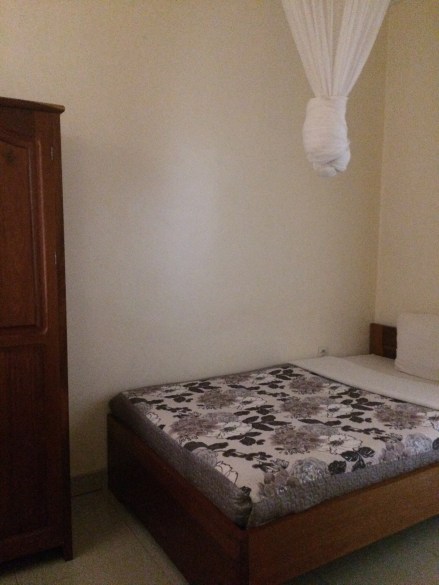
On closer examination, after we checked in, our creepy feelings intensified. We found the rooms to be quite dirty. When I looked at the guest register, it appeared that no guests had checked in for months, which seemed eerily strange. We were the only guests. Béné and I each got our own large rooms, since I was still coughing at night. Each room had a king-sized bed, which also seemed weird, as nowhere else had we seen a king-sized bed in Rwanda. Neither room was clean. The bathrooms appeared not to have been cleaned after the last several careless guests had departed. There were no toilet seats, no towels. The floors were dirty. The sheets looked slept in, and Béné’s bed had no mosquito net. Not to worry, Martin said, as he would add a mosquito net to her room, as well as bring towels and clean our rooms and bathrooms. Still feeling queasy about our rooms, but confident that they would be cleaned and properly outfitted, we left the quiet grounds and went out to explore the town and enjoy a day hike for a few hours.
Our first stop was at a very tiny shop for our daily cup of mukara. However, bees were flying everywhere, including one that landed in Béné’s cup. The proprietress promptly gave her another cup. There were so many bees that the proprietress escorted us to a second shop to sit. However, the bees followed us, surrounding us there, too. So, we stood outside gulping our tea and, when finished, continued our walk through town.
The focal point of Busenge (pronounced Boo-sen-jay) is the large sprawling district hospital, which takes up most of the left side of the main street of the town. The outer walls of the buildings are very dirty. There were many people all over the grounds of the hospital. We looked for a pharmacy in town so I could buy cough drops, but there was none. We continued our hike past the hospital and through town and then chose a road that looked like it would be fun to hike, and it was.

We walked past small houses and farms. The scenery was beautiful. 

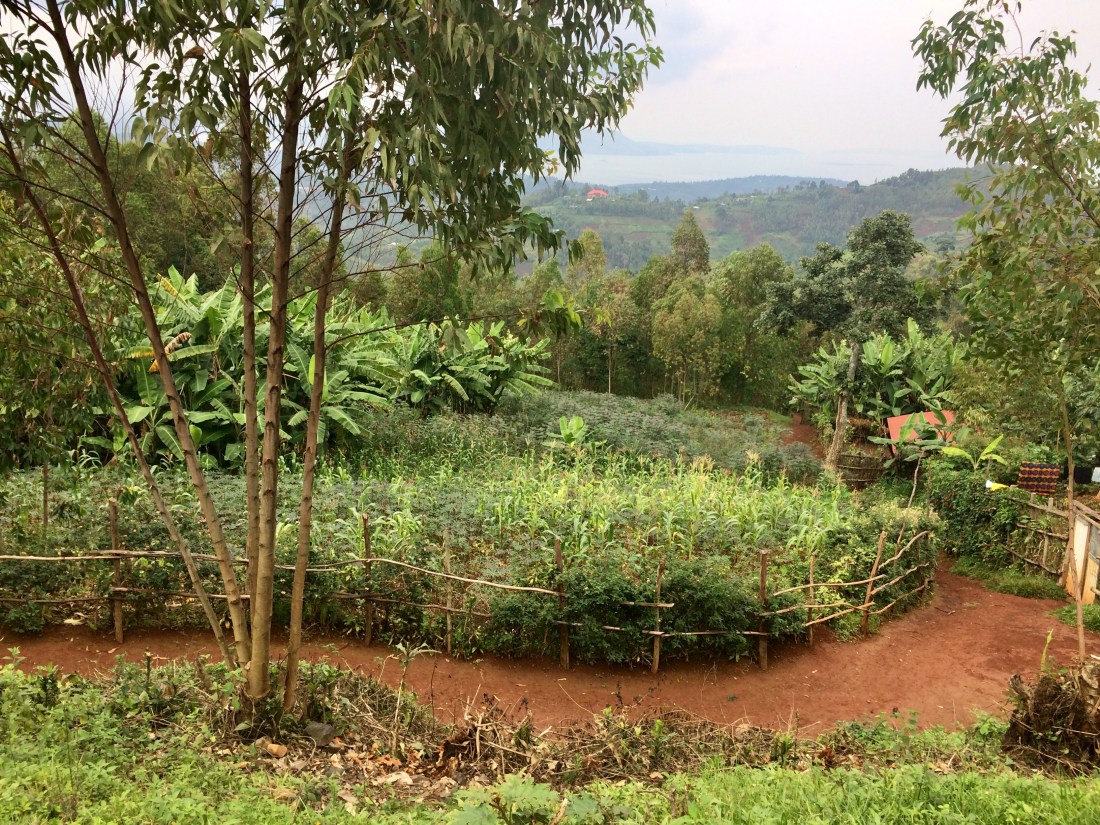
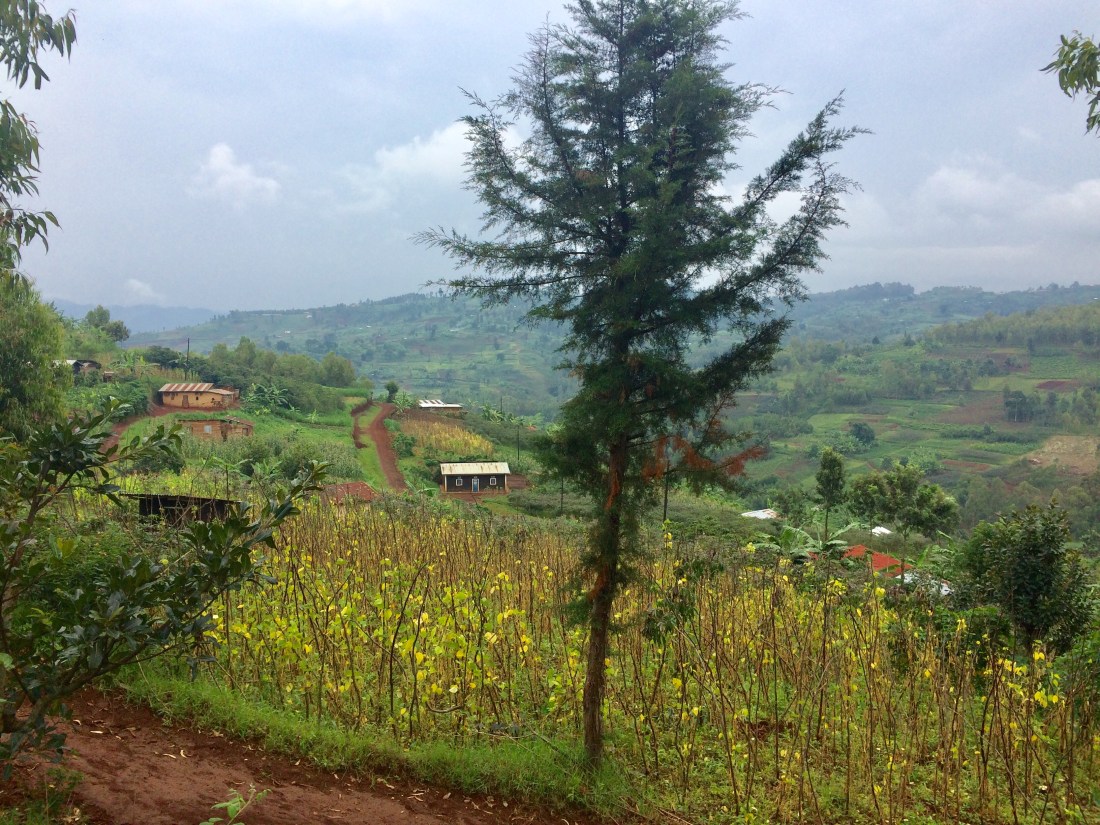
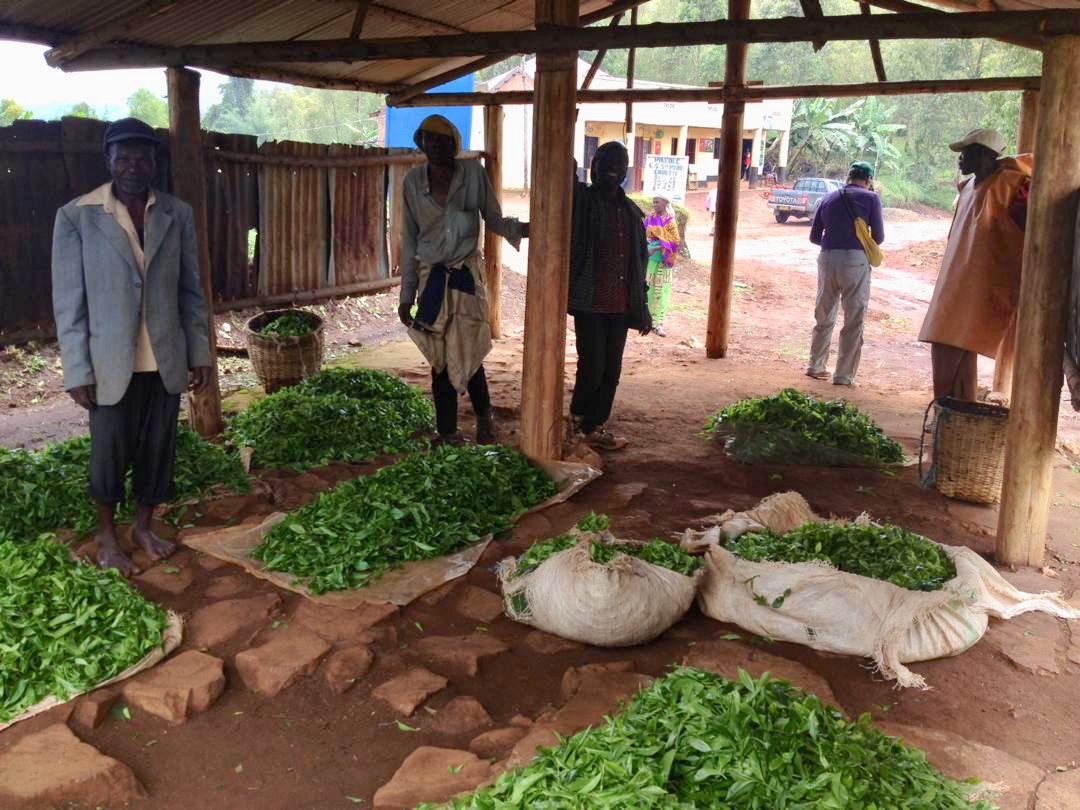
 We came upon a tea plantation, where the harvesting and collection of the tea leaves was in process. Rwanda is known for its black and green tea. The workers invited us to have a look at their harvest.



On our way back to our inn from our satisfying hike, we again passed through town and stopped in a small shop that had gargantuan amandazi (Rwanda’s round dense donuts), and I bought two, not knowing when I might need them.
When we returned to our inn, it seemed as sleepy as when we had left. Since I had left my backpack in Béné’s room, I stood next to her as she used her key to unlock the door, but the key did not work and she became frustrated. I tried my door key, which worked fine in the door of my room. I also tried unsuccessfully to get Béné’s key to work in her door. Then, Béné said, “Someone’s in my room. There’s a man in my room.” I didn’t want to believe her, but there clearly was someone in her room. She pounded on the door. After a few minutes, the door squeezed slightly open and a man’s face appeared, visibly upset with us, and yelling that it was his room before he slammed the door in our faces. I can’t remember what language we were speaking (likely a mix of English and Kinyarwanda), but the gist was clear. It was hard for me not to laugh because it was so unexpected. But, Béné, rightfully so, was hopping mad. “Calm down,” I said, “We’ll get this straightened out. Let’s find Martin.”
As we turned to find him, we saw a young woman hanging around. She worked there and spoke only Kinyarwanda. We had seen her earlier in the day when we checked in so she knew who we were. She stood watching during our clash with the man in Béné’s room but seemed nonplussed by what was happening. In Kinyarwanda, I asked her where Martin was and she pointed. When we found Martin and explained that there was a man in Béné’s room, he said that was impossible.
I convinced Martin to return with us to the room, where we knocked on the door and again stirred movement in the room. After a few minutes, the same man opened the door a crack, again angry at being disturbed. Martin and he spoke heatedly in rapid-fire Kinyarwanda for a few minutes, before the man fully opened the door and Martin told us to go in and get our backpacks. When we did, we saw that the bed was in disarray and a woman was sitting sheepishly on a chair in a corner. As we departed the room leaving the man and woman to their previous activity, Martin explained that, while we were out hiking, the young woman worker had mistakenly given Béné’s room to the man without Martin’s knowledge.
“Okay,” we said, “What do we do now?” Meanwhile, I had entered my room only to find that it hadn’t been cleaned and was as filthy as before we had left. When I mentioned that to Martin, he said not to worry, that they would get around to cleaning it. As for a new room for Béné, he showed us two rooms adjacent to ours. However, both rooms looked like storage rooms, as they were dusty, dirty and piled with junk. Again, Martin said not to worry, that they would fix one of the rooms for Béné. By this time, however, Béné had had enough and announced that we couldn’t stay there. We asked for a refund and, thankfully, Martin readily agreed.
But what to do and where to go? I was still a Peace Corps volunteer and bound by Peace Corps rules, but Béné had completed her service and wasn’t bound by those rules. Peace Corps required that I not travel after dark. So, we had to get to our next destination by dark. With our refunded money in hand, we high-tailed it out of that inn and began walking the three kilometers back to the main road. Béné, no longer being a Peace Corps volunteer and still agitated by the squabble, opted to take a motorcycle taxi to the main road, while I hiked it and met her sometime later.
 While we waited for our bus, Béné called Mary of RDB to complain about Benoit’s bad advice and the “Hotel California-ish” experience we had had in Busenge. Béné believed that the inn was a house of prostitution, while I thought that perhaps it was simply a convenient place for a quick afternoon tryst. Mary assured us that it was not RDB’s intent to direct hikers to such a place.
We caught a small local crowded bus to take us to the city of Kamembe, the official end of the Congo Nile Trail. Just before dusk, our bus arrived in Kamembe, and, as darkness was descending, we walked the few miles downhill from town to the Peace Guesthouse, which was starkly different from the inn that we had fled from. 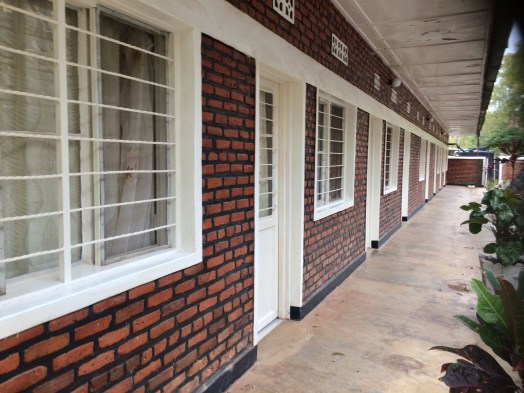
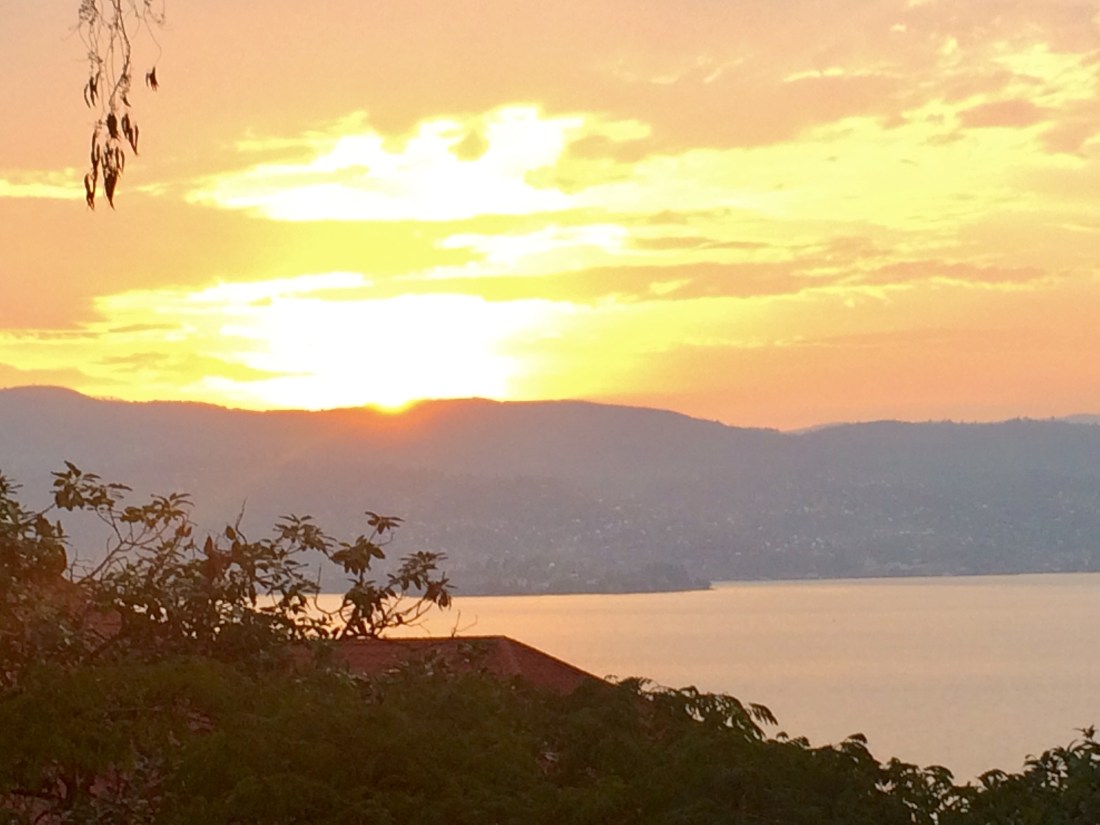
 Not only were the rooms spotlessly clean and neat and the grounds perfectly manicured, it was situated on a cliff overlooking Lake Kivu with fabulous views of the lake and the Democratic Republic of Congo on the far side of the lake. We were treated to an exquisite sunset over the Congo side of the lake.
We ate dinner in the guesthouse’s large restaurant. 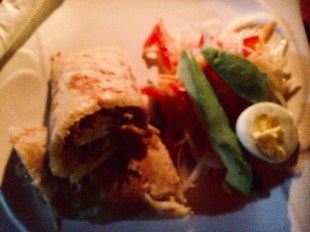 I had a wrap made out of chapatis. The next morning, our scrumptious buffet breakfast of mushroom soup, waffles, hard boiled eggs, bread, margarine, jam honey and an array of fruit (mango, papaya, pineapple), as well as coffee, tea, African tea or hot milk to drink was included in our 15,000 franc (less than $17) room rate.
So, today, the best-laid plans of these mice and women went awry. Our day began with RDB’s Benoit’s suggested itinerary, which turned out to be impossible, and then morphed into an interesting visit to, and hike in, Busenge and a mildly unpleasant encounter at our Hotel California-like inn, but ended sweetly and peacefully in Kamembe at the aptly named Peace Guesthouse.
The next day, we found the Congo Nile Trail sign for the beginning (or end, depending on one’s direction) of the Trail, giving us more information that RDB ever had. Had we known how to get to Kigaga from the north (maybe there is a bus from Kibogora) and if we knew there was a place to stay in Kigaga, we could have taken a bus there and then hiked the final 20 kilometers (just over 12 miles) to the end.

Although we literally completed the Congo-Nile Trail, it was not all by foot. After Mushubati, we traveled by boat, foot and buses. We were greatly disappointed that the way we “hiked” most of the southern half of the Congo-Nile Trail was by sitting on buses. So, when we finally got to the end, it seemed anti-climatic.
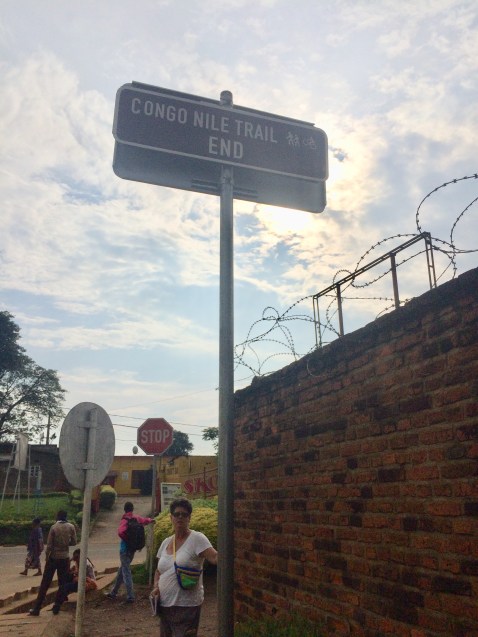
Still, on those buses and in the unplanned places that we fortuitously stopped, we met lots of interesting, kind and hard working people that we probably would not have met on a trail. We hoped that we would be able to return one day if, and when, the southern portion of the Trail is constructed for hikers.
So, our advice for now to those wanting to hike the entire Congo-Nile Trail is to skip the southern portion and just hike the northern portion from Gisenyi (a/k/a Rubavu) to Mushubati, then take a bus to Kibuye (a/k/a Karongi) for your overnight stay. If you want more distance, hike the northern route backwards, too. If you really want to get to Kamembe (which is the southern tip of the Trail), take a bus, a boat or a combination of the two from Kibuye. And, don’t miss stopping at the sweet Esperance Guesthouse in Mugongero on the way.


As I was reading this to Barry, we were both on the edge of our seats wondering what would happen next! Be careful and be safe.
LikeLike