
This morning, we set off for Karangera, which the Rwanda Development Board’s official Congo Nile Trail map said was 20 miles away. The map also promised that we would find lodging there at the Karengera Secondary School. But we never got to Karengera.
From Esperance, we hiked uphill about one quarter mile to the paved road. Surprisingly, when we joined the paved road at the intersection with our dirt road, there was no sign for Esperance. Thus, it was easy to see how hikers would miss it. In fact, they would have no idea that Esperance is so close. There was, however, a huge sign informing hikers and motorists that the Kivu Lodge, the pricey new luxury hotel, was 8 kilometers down the dirt road. And, an equally large Congo Nile Trail sign informing hikers of the lodging choices of the Kivu Lodge or Mugonero Base Camp, but with no indication that Esperance and the Base Camp were the same.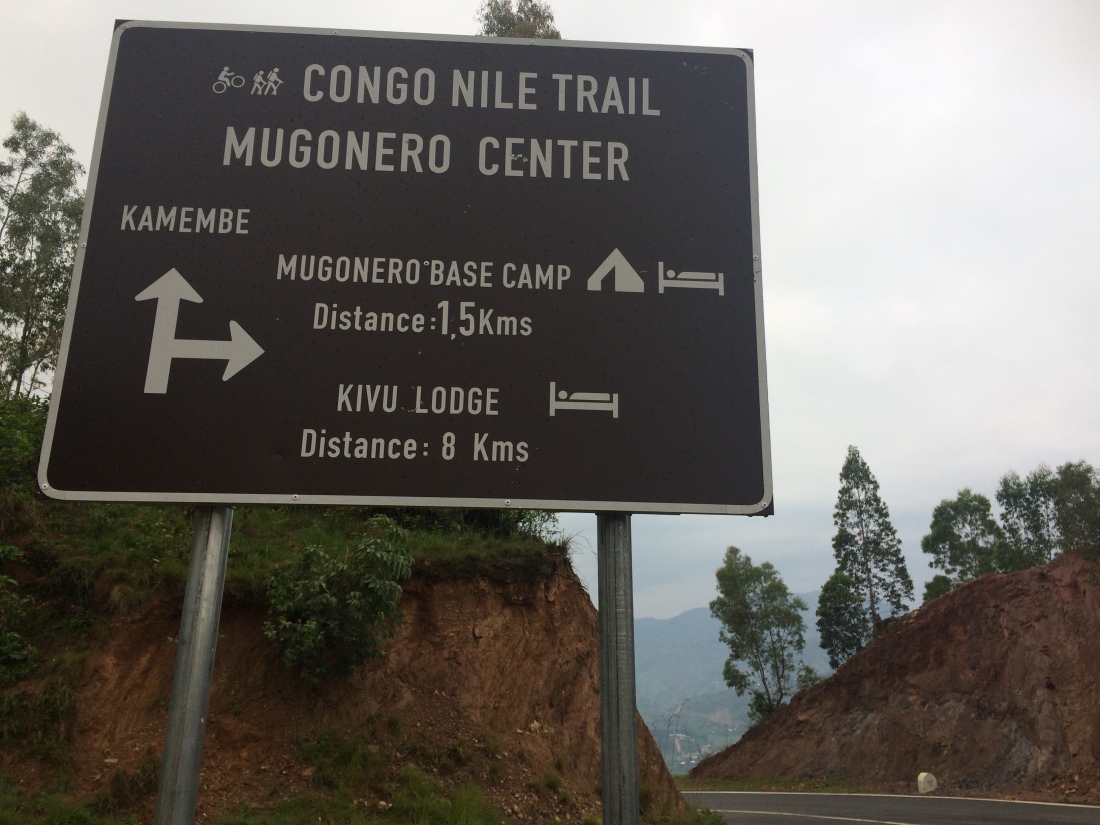
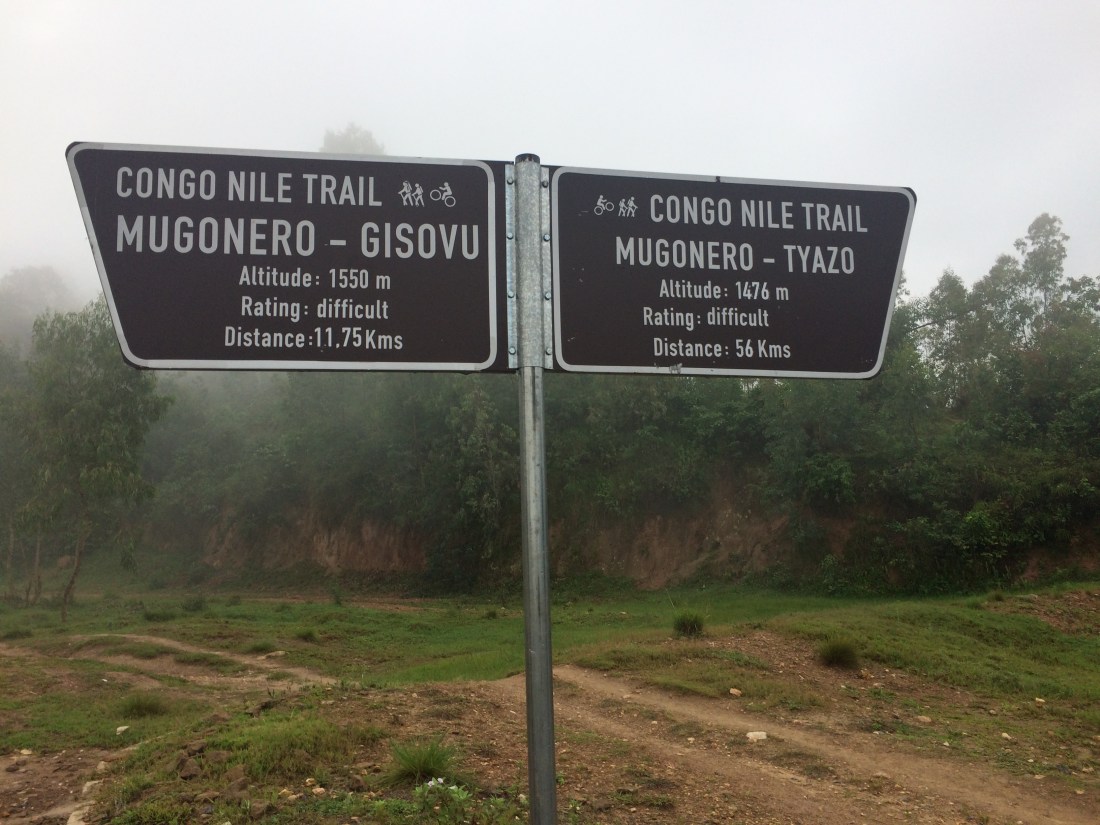
There was also a 50 kilometer marker on the road (unclear where the 50 kilometers was from) and signs for the Congo Nile Trail, amazingly with distances. And, a sign showing where we were headed (Mugonero – Tyazo) for a distance of 56 kilometers (about 35 miles). Yet, we had never heard of Tyazo or seen it on any maps. Despite being stumped, we knew that Tyazo was the direction we needed to go to find Karengera (the next stop according to the Rwanda Development Board’s official Trail map) so we headed that way.
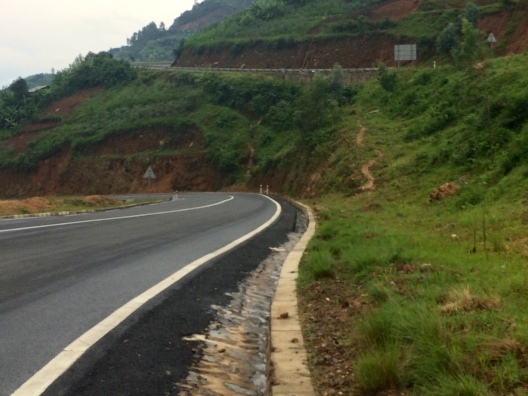
Sad to leave the dirt trail behind, we gingerly turned right onto the paved road. We concentrated on the positives. It was downhill. The pavement felt very smooth under our boots after many days of hiking on often rocky, dusty dirt trails. It was easy walking. But, soon the negatives surpassed the positives. Whenever big trucks or buses passed, we jumped onto the shoulder of asphalt chunks and pebbles, which did not make for comfortable walking. 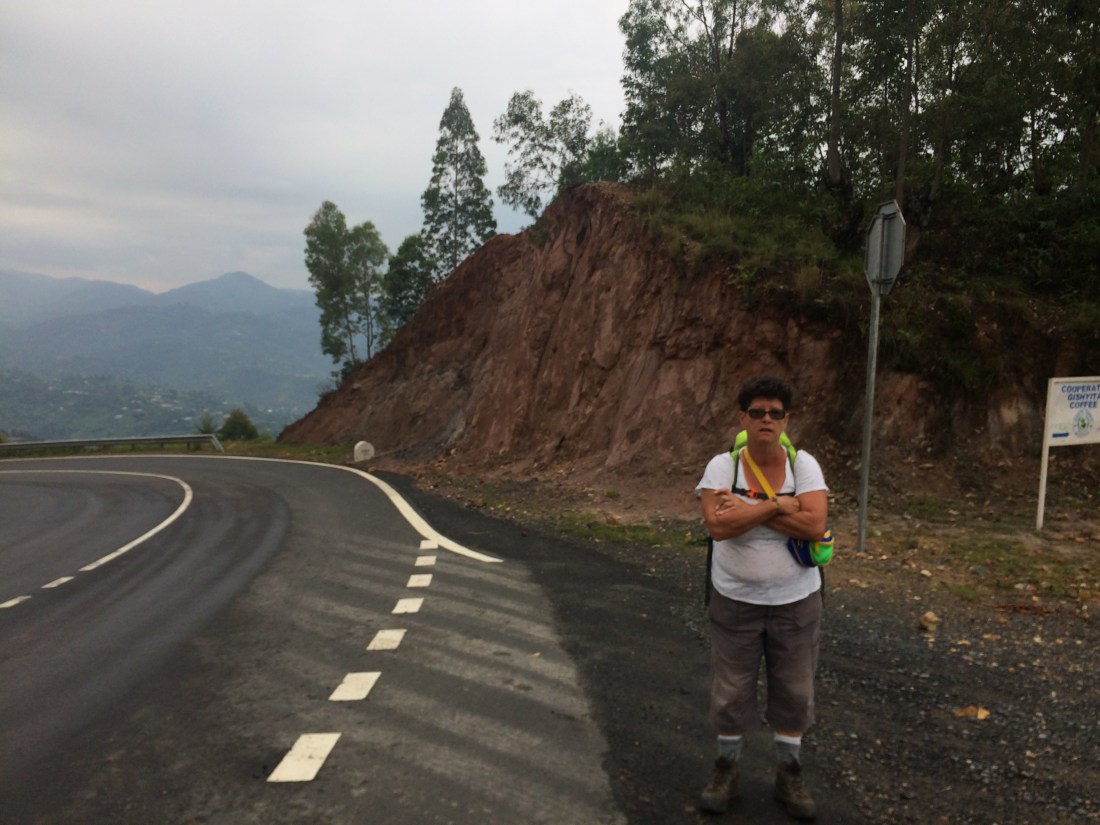 Whenever a vehicle passed spouting black fumes (no vehicle emission control laws here), we turned our heads and held our breath, trying not to inhale the soot. We regularly turned our heads backwards, trying to be one-step ahead of large vehicles rapidly approaching from behind.
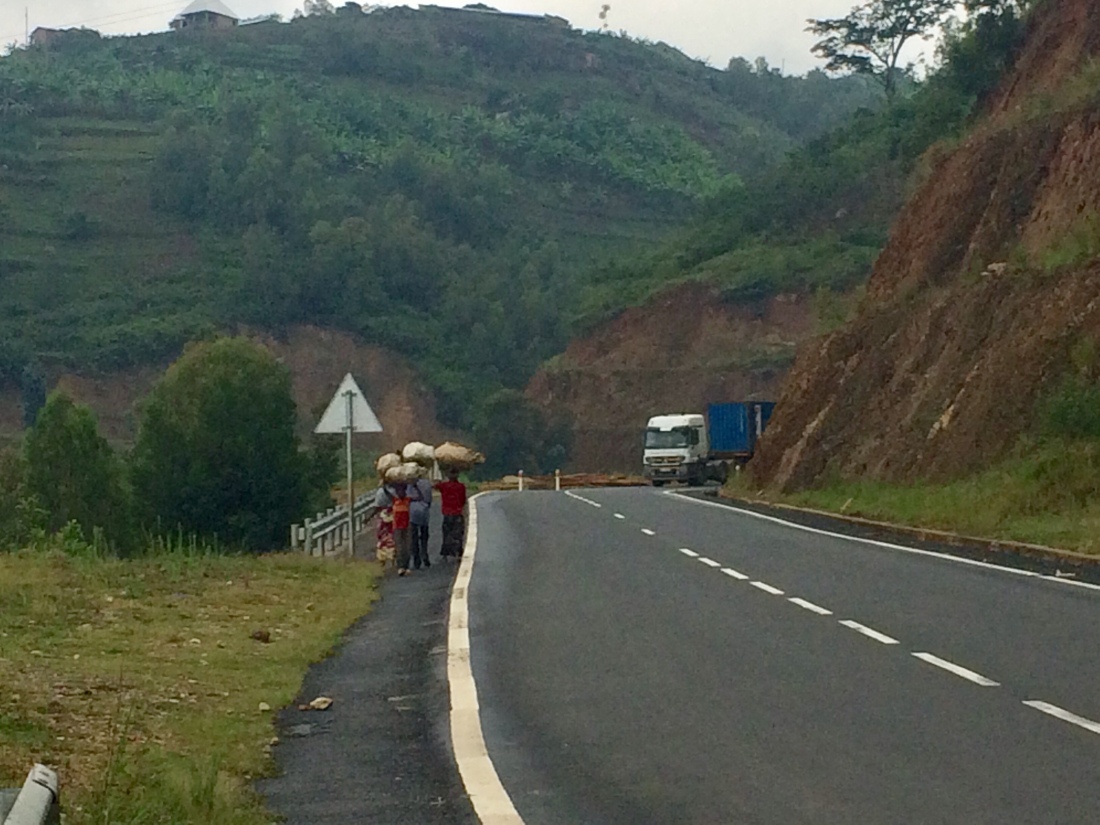
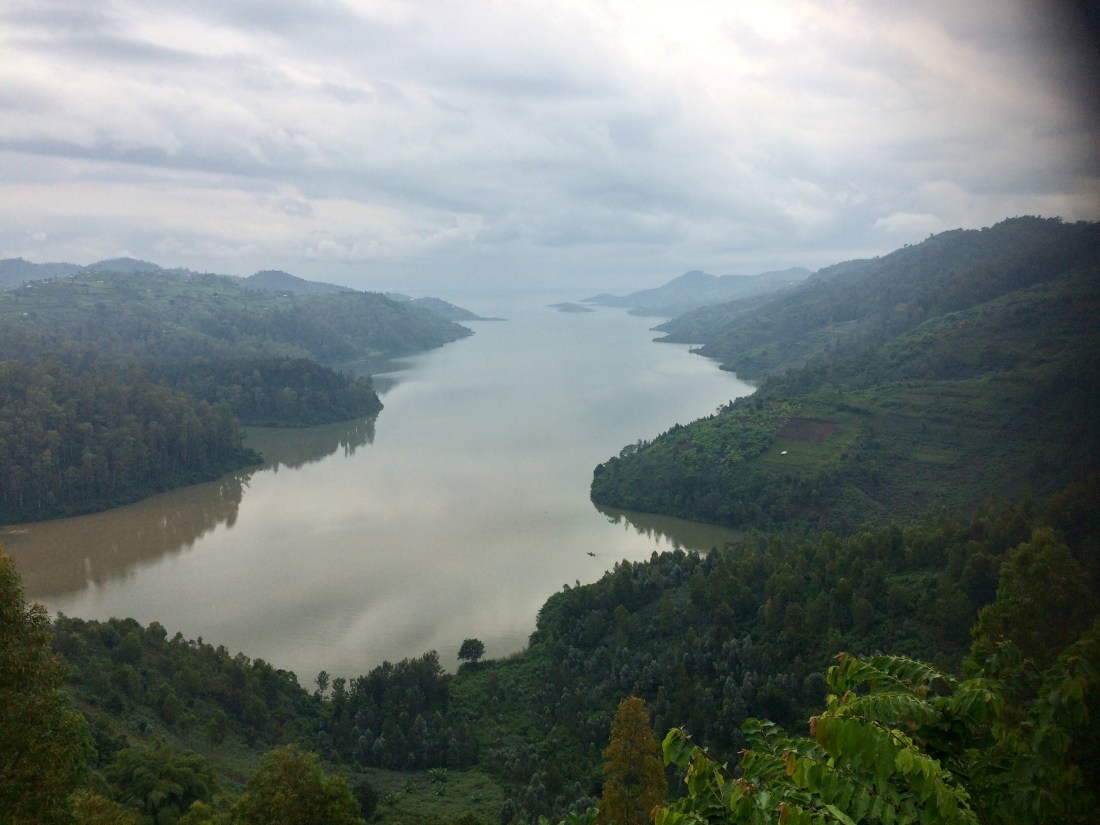
The views continued to be stunning. The road has switchbacks and snakes around the finger-like inlets or bays of Lake Kivu.
We passed cows, many people carrying large loads on their heads and gobs of kids, some asking for money. One boy made us burst into laughter when he said, “What is your name? My name is Money.” (I had not walked ten steps from the Esperance Guesthouse this morning when one small boy shouted, “Give me money.”)
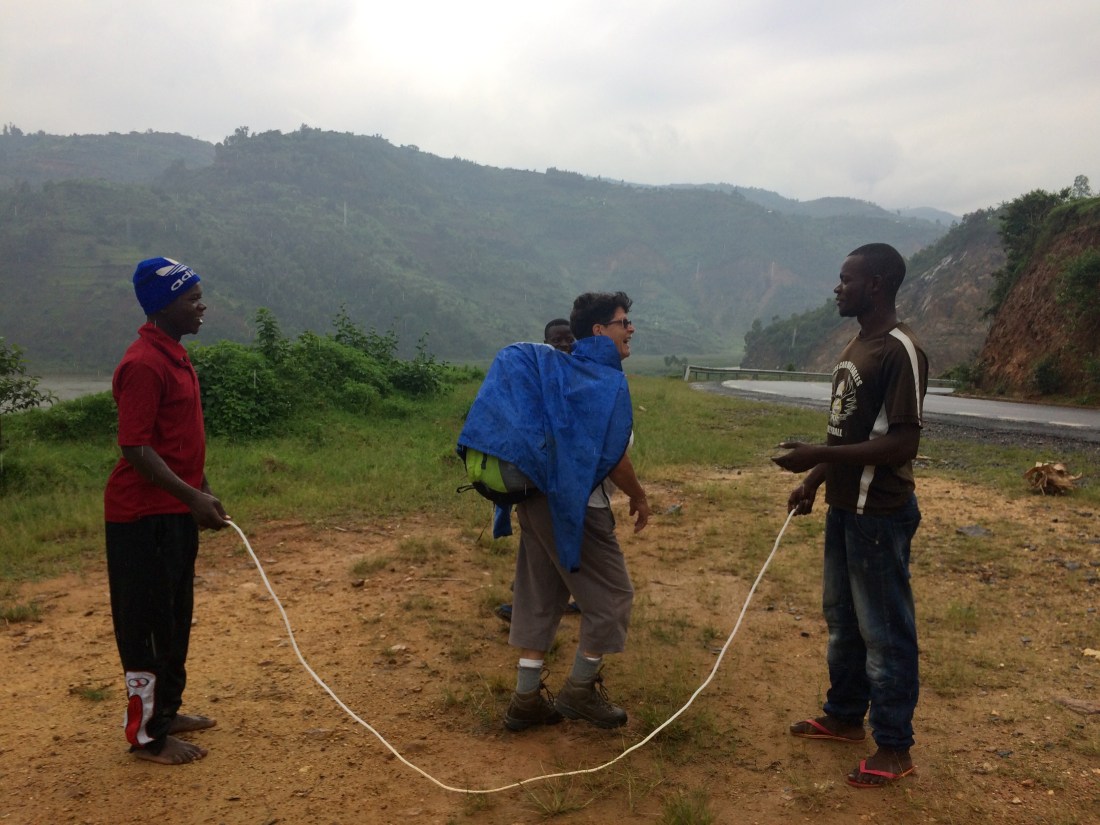
That morning, we passed an unusual sight: a group of smiling teen-aged boys playing jump rope. Béné and I could not help but join in the fun, taking our turns jumping while two of the boys twirled the rope, while we all reeled with laughter.
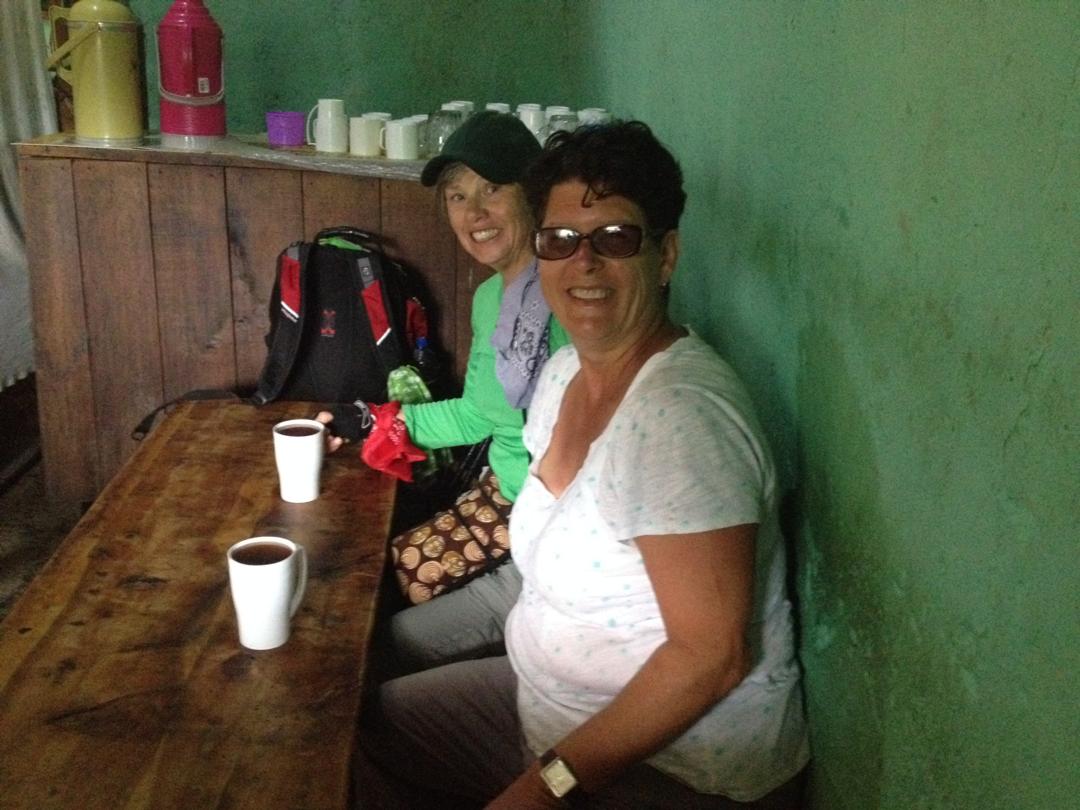
The entire morning had been overcast, and late in the morning it began to lightly rain, which felt quite lovely as it was hot. We came to an interesting market, where fruit was being sold and there were some small shops. 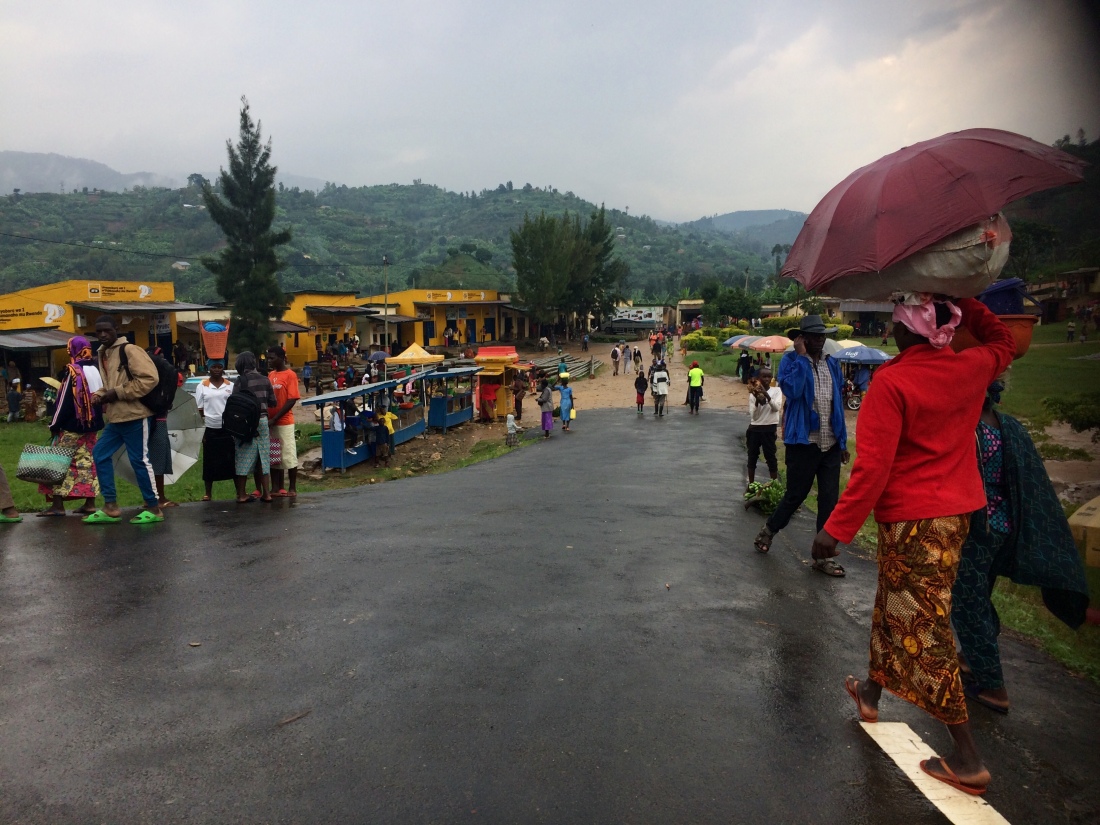 Still enjoying the light rain, we found a tiny restaurant and sat in a room separated by a curtain and had a cup of mukara, Rwanda’s piping hot, sweet and spicy black tea. And, then it started to pour. It was quite a storm and lasted a long time, but Béné and I were safe and cozy, sipping our tea and amazed at our good luck.
After walking on the road 12 miles, at the village of Rwamatamu, we were surprised to see a Congo Nile Trail sign for a dirt trail to Tyazo. The dirt trail certainly was inviting but the trail appeared to wind down to the lake, making us pause because we did not want to hike down to the lake just to hike back up again. We stopped to consider whether we should take that trail. We were tempted to take it, as we were sick of the paved road. However, we were confused, because, before today, we had never heard of Tyazo. We re-checked the official Congo-Nile Trail map, but there was no mention of Tyazo, and we were concerned that we wouldn’t find a place to sleep. 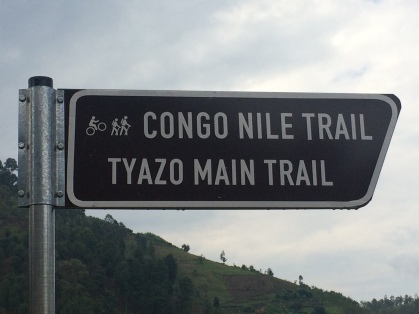
Coincidentally, about a dozen men were standing near that sign and so we asked them whether that was the way to Karengera. Unanimously, they insisted that was the wrong way and that we must stay on the road. Still perplexed, we nevertheless took their advice and stayed on the noxious road.
By this time, the road was wearing on our nerves. My pack was heavy. There were a lot of large trucks, local small but jam-packed Twege buses, local mid-sized buses (Nile Safari buses and Capitol buses) and the giant Ritco buses, which are the size of a Greyhound bus, all plyng this road alongside Béné and me. Plus, there were speeding SUVs, Toyota trucks, motorcycles and bicycles careening at full speed downhill and around the curves. I was nearly hit by a bicycle that flew past me, just inches from my elbow as I distractedly stepped back onto the pavement from the shoulder.
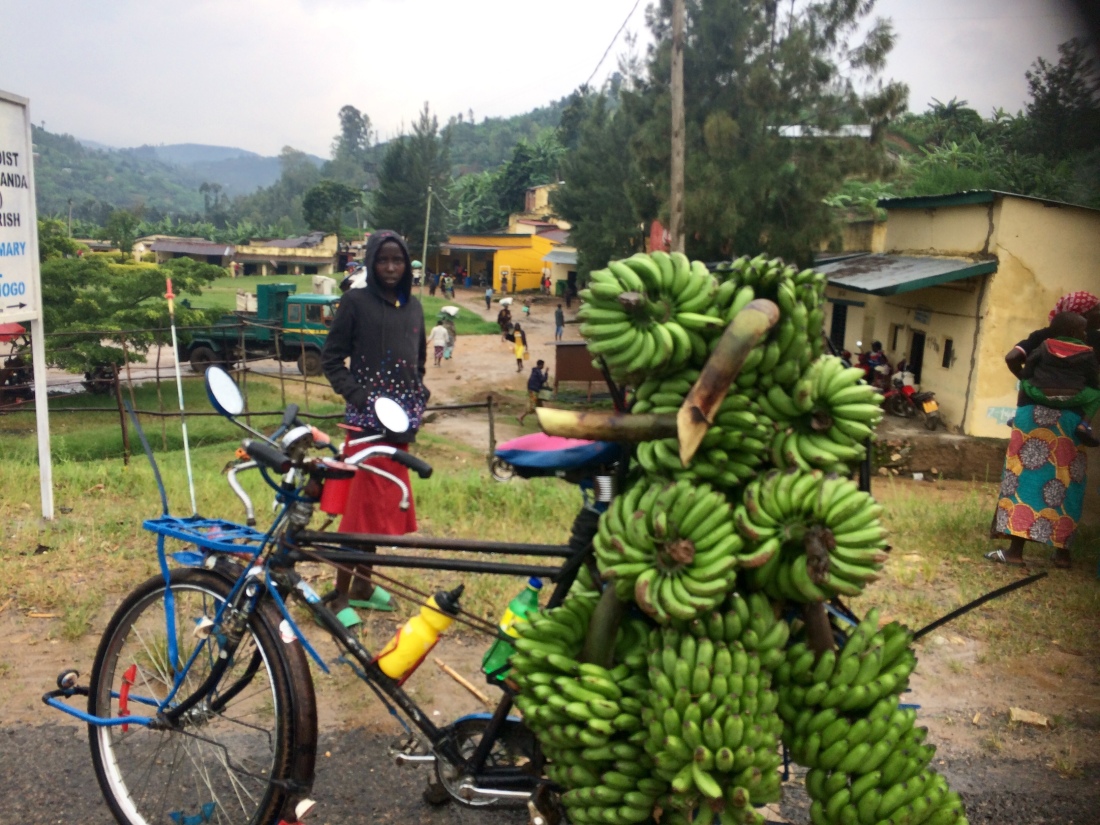
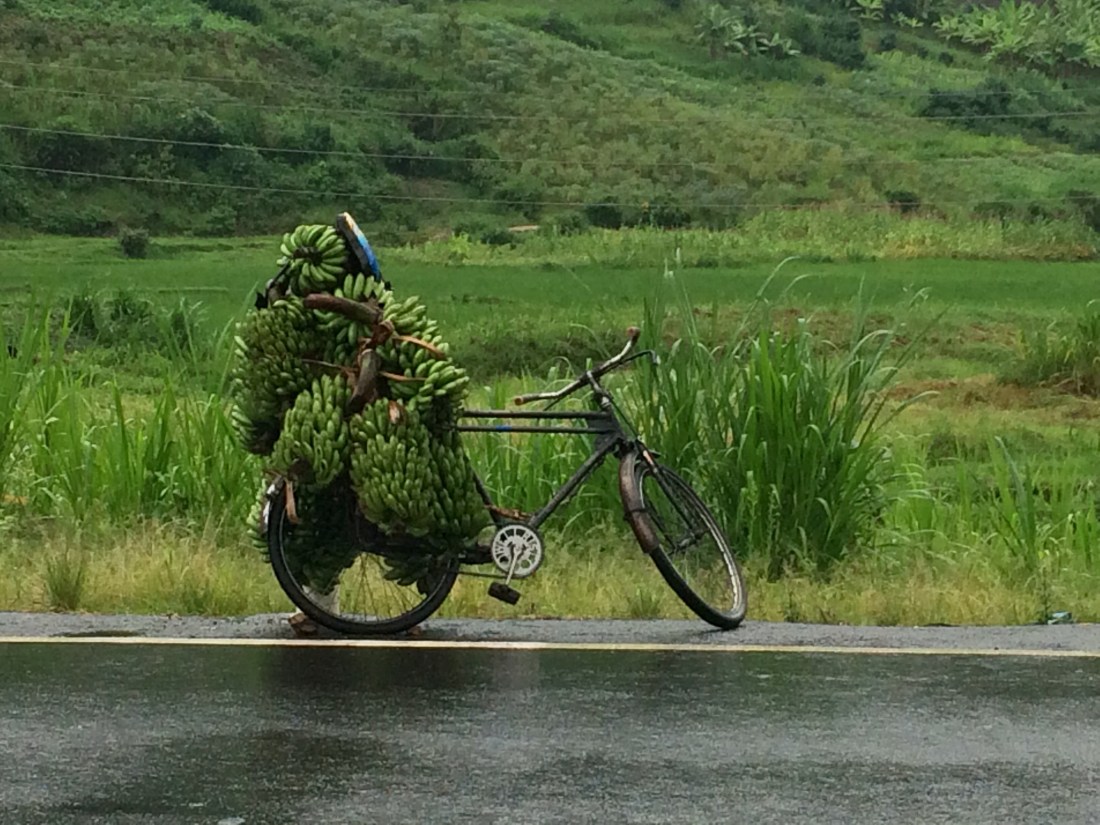
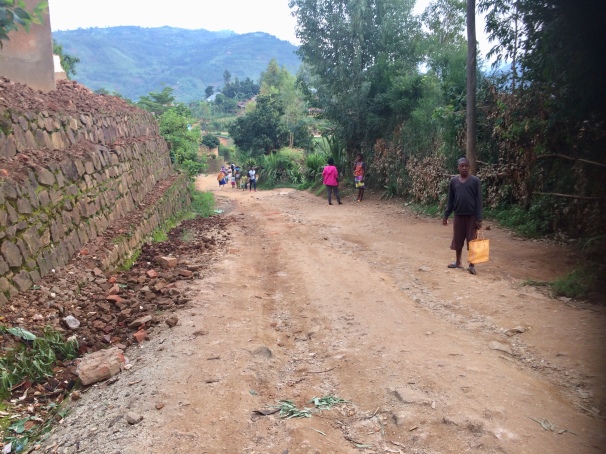
The scenery, of course, was gorgeous, but the chaotic traffic dampened our ability to enjoy it. We saw rice fields, banana groves and farm plots of potatoes and cassava. We were never alone. Children constantly called out to us. Farmers stopped their weeding and stared at us. 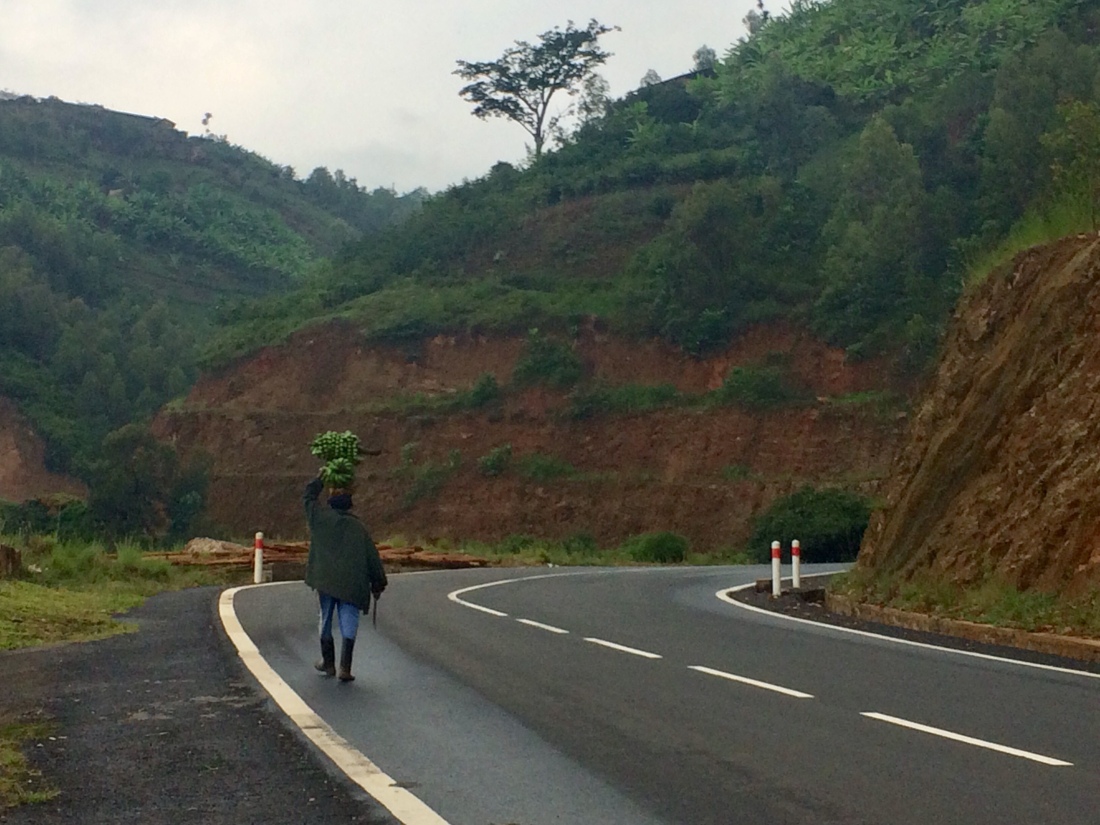 We encountered many people carrying their wares to and from the market, many carrying bunches of bananas on their heads and bicycles.
 We saw kids gathering stones and pulling them in plastic containers cut in half with a rope attached, like a wagon without wheels. The toys made an annoying grinding sound as the kids dragged them on the road behind us. Many children walked in lock step with us, sometimes surrounding us and demanding money. I used the Kinyarwanda word, considered very impolite, for “Scram!” which is “Hoshi!” – sometimes effectively and sometimes not – to get the kids to disperse.
We stopped for lunch under a small copse of trees, and a young girl came out of nowhere to stare at us and ask for money. We ate our leftover breakfast chapatis with a can of sardines that resourceful Béné had packed. We had bananas for dessert. Cows were lowing in the distance. Béné left the sardine can with oil in it, and the little girl immediately scooped it up even before we had left.
At another point, when I stopped to take a drink from my water bottle, we met a crazy teenager and a group of young boys who were very aggressive. I left them my water bottle and, as I walked away, they yelled, “Give me, give me, give me!”
We saw a group of people at what looked like a bus stop. A giant Capitol Bus the size of a Greyhound came barreling down the road, and the people flagged the bus down for us. Surprised, we got onto the bus, which cost 1,500 francs (about $1.75). The bus was full with no empty seats, so Béné and I sat on the floor. 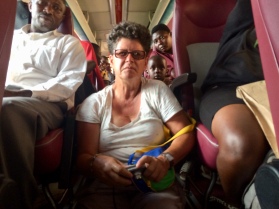 Some time later, a few people got off, and I sat next to a girl who sneezed non-stop. I wondered if I could catch a second cold on top of the one I already had. We passed Karengera, our intended destination but continued on about twice that far.
We got off the bus with most of the other passengers at a town called Kibogora.
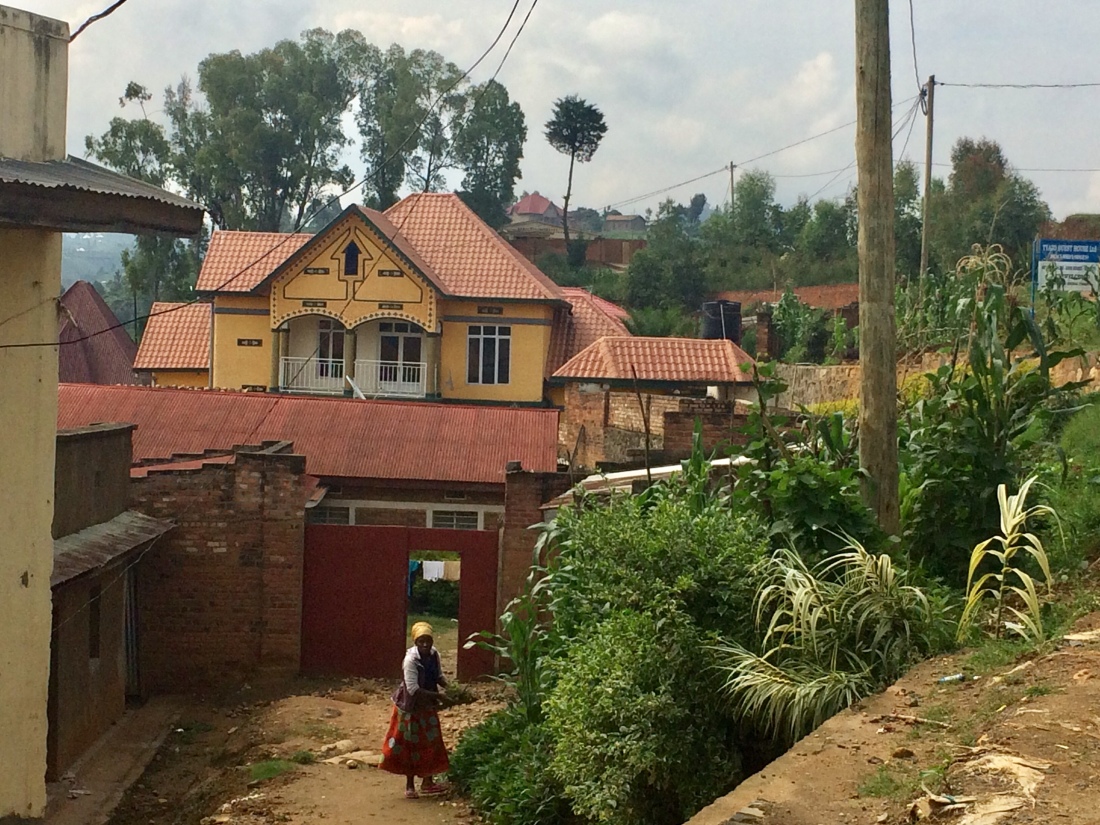
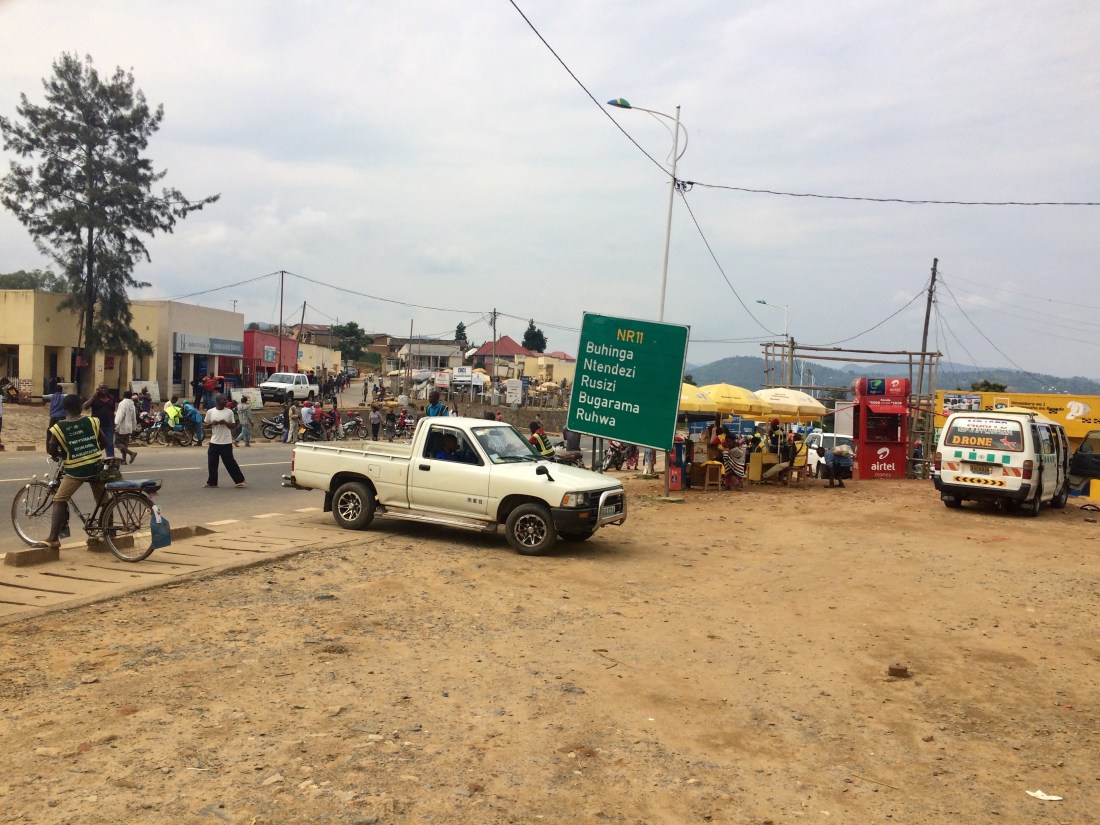 Across from the bus stop was a large restaurant called the Godwin Shop Restaurant Bakery & Coffee House. We stopped in for a refreshing cup of mukara. Then we walked down a side dirt road and came to the Tyazo Lodge, which looked cozy and inviting from the outside.
  The rooms had a small table and hooks for clothes and towels, flip-flops, tile floor and mosquito bed nets.
 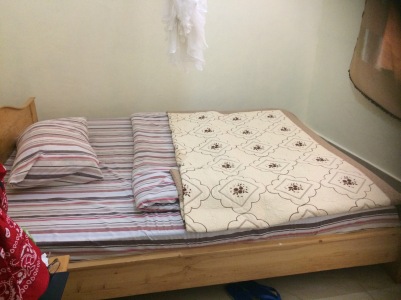 Béné and I got separate rooms, which was good because of my non-stop coughing. The beds were comfortable with warm blankets. It was nice to have a private bathroom.
After checking into the Lodge, we took a walk around town. Not far from the lodge, is the busy Tyazo outdoor market, selling lots of fruit, vegetables and other food staples. We wondered if we might have arrived here if we had taken the Tyazo Trail that the men had earlier convinced us not to take. If so, we made a big mistake because that would have been a lot more pleasant than walking on the hectic road. However, it would have been a very long distance.
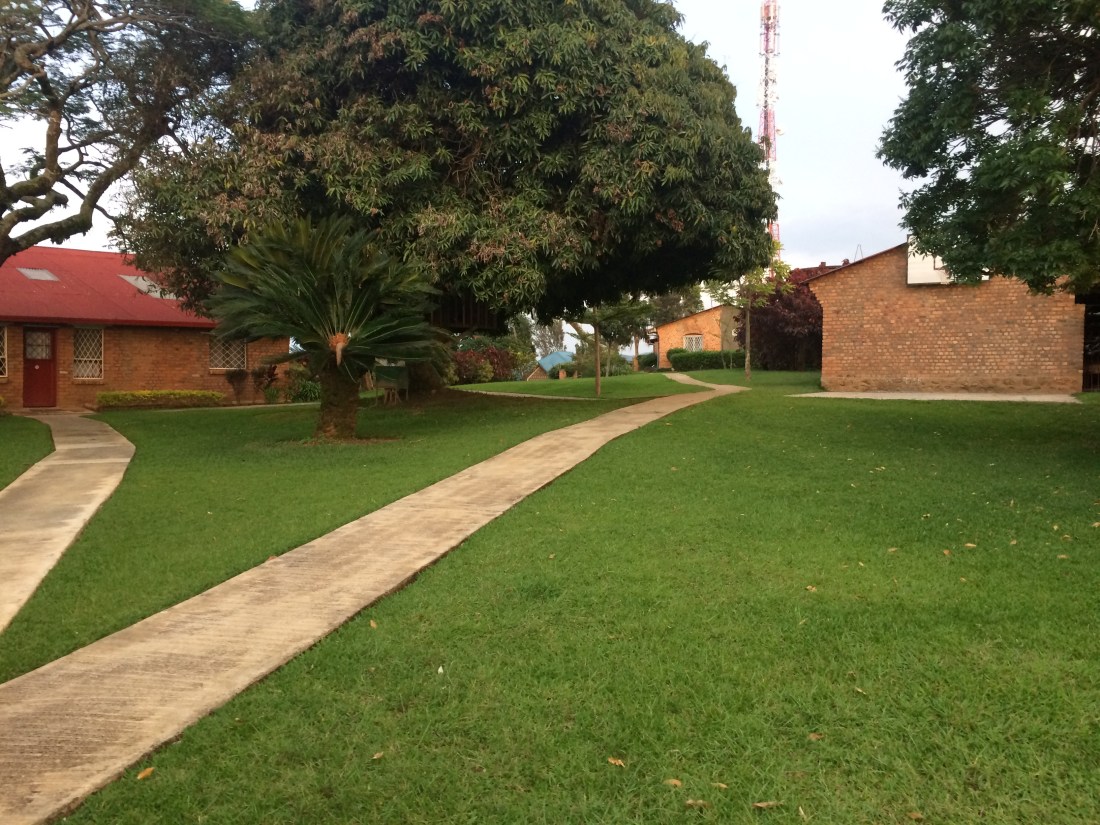
On our walk, we noted the BPR Bank with an ATM. I found a pharmacy to buy throat lozenges. The concerned pharmacist recommended vitamin C powder to put in my tea, so I bought some. While wandering around town, we came upon the Kibogora Methodist Hospital Guesthouse,  where we talked to a tri-lingual young man who spoke English, French and Kinyarwanda. He explained that the guesthouse did not serve dinner, but had apartments for 15,000 to 20,000 francs per night. We were sorry we didn’t stay there because the grounds were meticulously maintained. This would be a good place for hikers to stay.
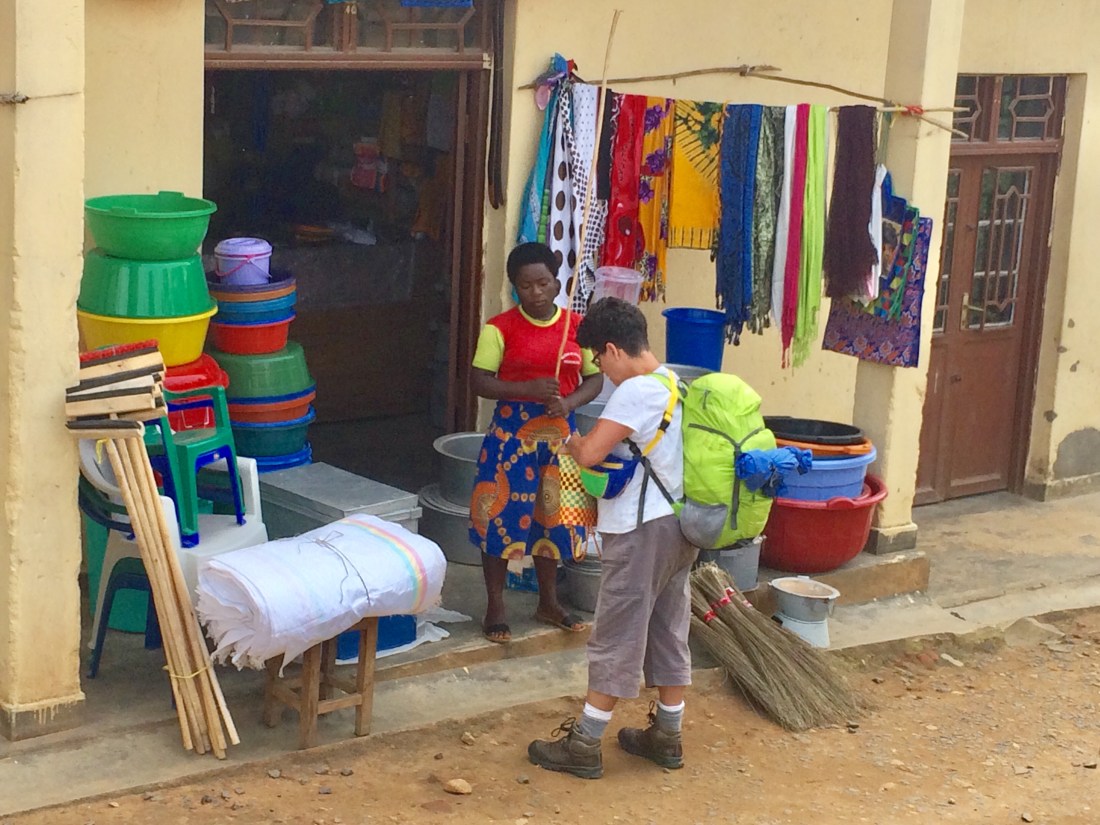
Bene, consummate shopper that she is, couldn’t help stopping at this colorful shop.
On a side dirt road near our lodge, we spotted a brown Congo Nile Trail sign for “Kigaga Main Trail” 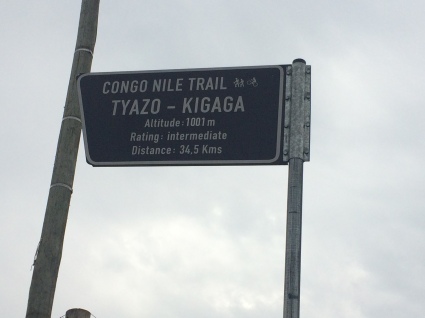 and another for “Congo Nile Trail Tyazo – Kigaga.” That sign stated that Kigaga was 34.5 kilometers (over 21 miles) away. We were extremely curious about the sign because nothing that Béné and I had read in preparation for this hike mentioned Kigaga. So, we asked people we met in town where Kigaga was. No one had ever heard of it. One man suggested that maybe it was a typo and should be Kinaga instead of Kigaga. But we couldn’t find either Kinaga or Kigaga on any maps. We were unsure of where we would go the next day. But, we were certain that we were sick of the paved trafficky road; thus, this trail sounded inviting. So, Béné called Mary at the Rwanda Development Board (the tourism agency). Mary also had no idea about Kigaga or Kinaga but gave Béné the phone number of Benoit, whom she said was more familiar with the southern portion of the Congo Nile Trail. Béné called and texted Benoit, but he did not respond.
We asked three different people for suggestions on where to eat dinner and we got the same answer from each – the coffee house where we had a cup of mukara earlier. In fact, it’s the only place to eat in town, but fortunately it’s a very, very good place, with friendly staff and very popular with the locals. So, we gladly returned for dinner and ordered from the large menu.
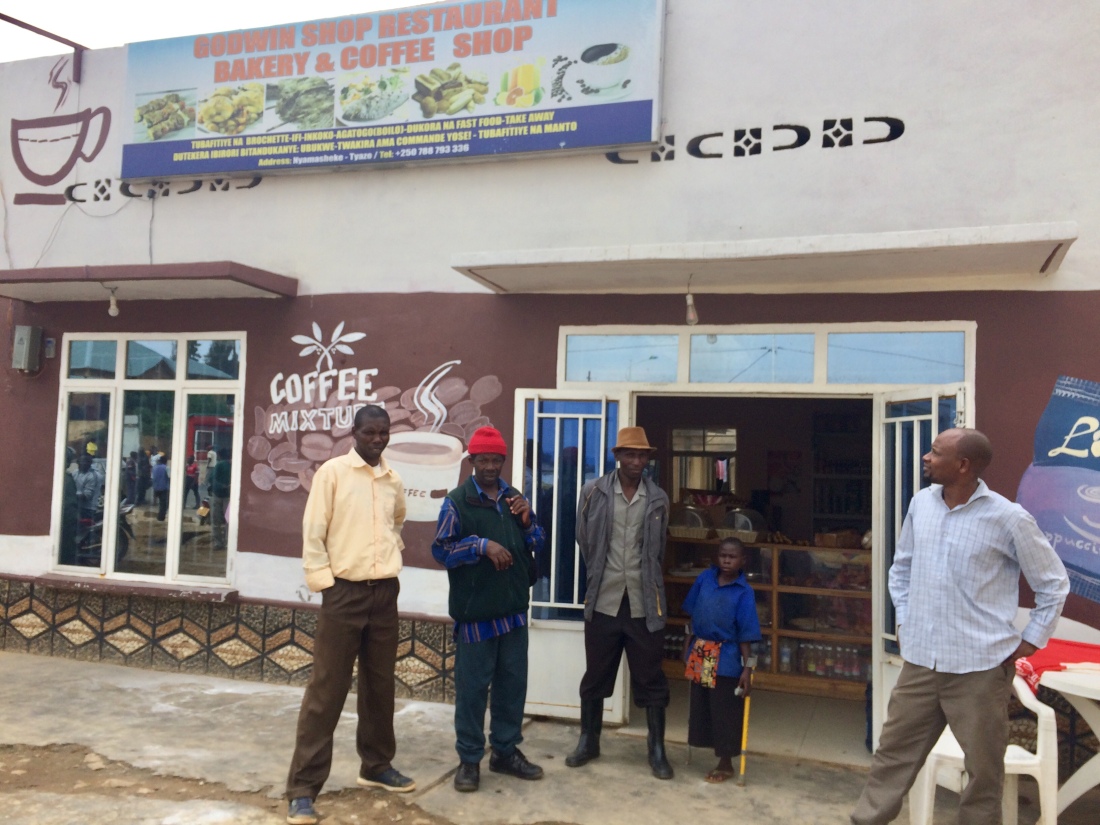
However, our meals took so long to come (There is no fast food in Rwanda) and I was feeling so sick that I decided to go back to the lodge and lay down. Much later, kind Béné brought me my dinner of beef brochette and eggplant garni made from Rwanda’s tiny and bitter eggplants with carrots and cabbage, as well as dodo (similar to spinach) soup, all of which were delicious. When I was done, Béné graciously walked back to the coffee shop to return the plate, bowl and silverware that the coffee shop had sent with my meal.
When we went to bed, we had no idea what we would be doing the next day. We wanted to continue hiking on the Congo Nile Trail, but both agreed that hiking on the road was the pits.
After a good night’s sleep, I felt better at breakfast, which was served in the lodge’s high-ceiling dining room that made us feel like royalty. Our breakfast was an omelette with very hard rolls that were inedible with Blue Band margarine and bananas. To drink, we had a choice of instant coffee or black tea bags.
A word about Rwandan omelettes. They are the most commonly served Rwandan breakfast. But, unlike American omelettes, they are not folded over and stuffed with cheese and veggies. Rather, the stirred eggs are poured into the frying pan; they cover the bottom of the pan and then are flipped over like a pancake, so the resulting omelette is relatively thin and in the shape of a plate. They sometimes have a few chopped onions in them and rarely a few bits of chopped green pepper. The Kinyarwanda word, like the English word for omelette, derives from the French. In Kinyarwanda, the word is spelled umulete and pronounced oo-mer-ette-ay.
 Ruminations from Rwanda
Pat, I am loving reading all of your reporting. As I read, I can only surmise how all of this teaching of law to Rwandans, this hiking, this vastly different living experience has affected you. I am hoping to read some future post about just how, specifically, you are a very different person (or not?) because of all your experiences in Rwanda and beyond. I just thought I would mention this if you are looking for ideas for future posts . . .
Your devoted reader,
Gerri
>
LikeLike
Love the pics Pat. I spent some time with Jim Libovicz last Friday at La Placita
Sent from my iPad
>
LikeLike