
My house has been eerily quiet for the last two days. I had grown accustomed to listening to the constant chatter of the many thousands of bats living around me. I learned to sleep through it; in many ways, it was like background music. I was always aware of it but never distracted by it. It seemed like the bat population increased exponentially daily. Their chatter became louder and louder. However, they never bothered me. I never saw bat guano. They never entered my house. They simply inhabited the tree in front of my house and the trees around my house and in the neighboring field. Every branch of each tree had clusters of bats, shoulder to shoulder or more aptly wing to wing. More than a hundred in each tree, I’d guess. I found them interesting and wondered what they were chatting or bickering about. Below are photos taken from my bedroom window on a normal morning before they were forced out.
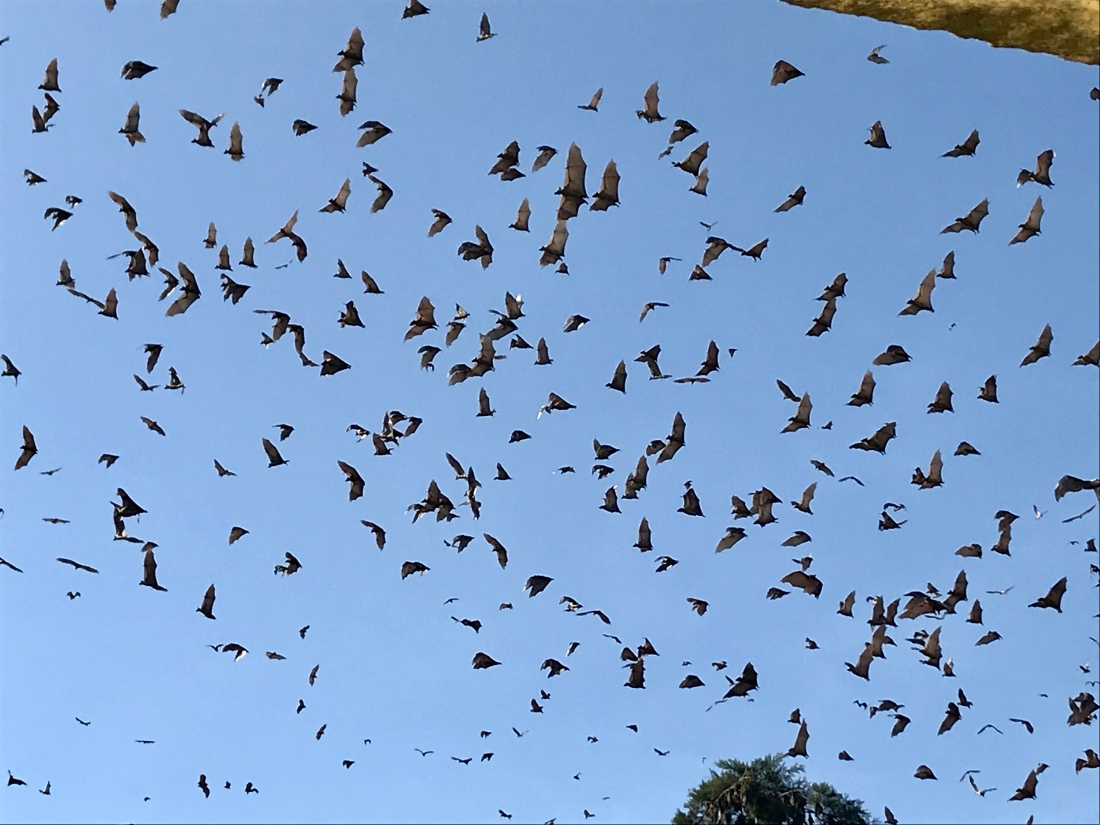
But now they are gone, gone to who knows where. The week before last, the town started cutting down the trees a few blocks away where bats also lived. I asked a friend where will the bats go when their trees are cut down, and he replied, “To the forest where they belong.” “What forest?” I asked, “All the forests around here have been cut down for firewood or for places for people to live.” “They will find a forest,” he assured me. I could not help thinking that perhaps they will go to Nyungwe Forest, a national park about five hours drive away. They will be happy there, I thought, because there are no people, only occasional hikers who rarely go beyond the edges of the forest. And, the many species of monkeys in the national forest won’t mind the bats.
“And, the beautiful tall fir trees that lined the edges of the street,” I groused to my friend, “are now gone. Even if new trees are planted, they will take so long to grow again to that size.” “No matter,” he consoled me, “The bats are very annoying to people.” And, he was not even aware, as I had recently learned, that some bats may carry the Ebola virus, though they can only transfer it through bodily fluids. Researchers believe that a 2013 Ebola outbreak in Guinea, a West African country, began when a 2-year old boy was playing under a tree that was a roosting place for bats infected with the virus. Fortunately, I did not play under the bat-inhabited trees surrounding my house, though I often stood under the trees while craning my neck and staring up at the scores of bats hanging upside down or taking off en masse.
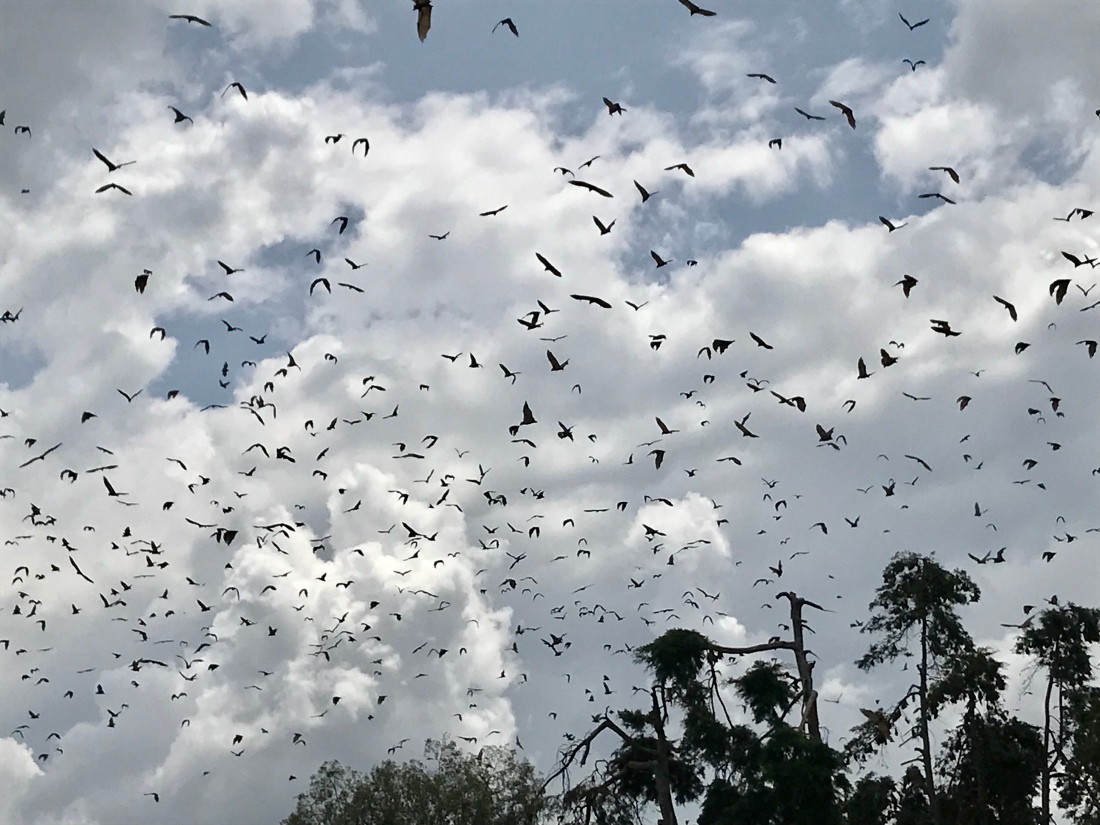
Many African countries control bats by catching or shooting them and eating them. Bats are mammals and full of protein. In fact, when I was a young Peace Corps volunteer living in Ghana, West Africa in the early 1970s, I encountered bats as a meal. Being a big believer of the adage “When in Rome, do as the Romans,” I overcame my reluctance to eating bats and ate a skewered and roasted bat. When I was asked what it tasted like, I glibly responded, “Like chicken.” However, Rwandans do not eat bats. My Cameroonian students, seeing the battles with the multitudes of bats, clucked “Why don’t they just eat the bats?” Without humans, it seemed that the bats here had no predators and, thus, the bat population in town was out of control.
Belatedly, I searched the internet for less drastic alternatives to getting rid of noxious bats. High pitched sounds is one means. Because bats operate by sonar to catch their prey and to avoid bumping into one another in flight, they are particularly sensitive to any noise. Another means is the tried and true scare crow, which doesn’t actually have to look like a person but can be anything that moves providing the sense that something else has taken up residence in their tree and conveying the message that it’s time for them to move on. I learned that tying balloons or old shiny CDs onto branches of a tree was often enough to convince the bats to move on. Tying CDs or balloons onto tree branches sounds like a lot of work, but it’s certainly less strenuous than cutting down a tree, doesn’t kill the tree and seems to me to be at least be worth a try.
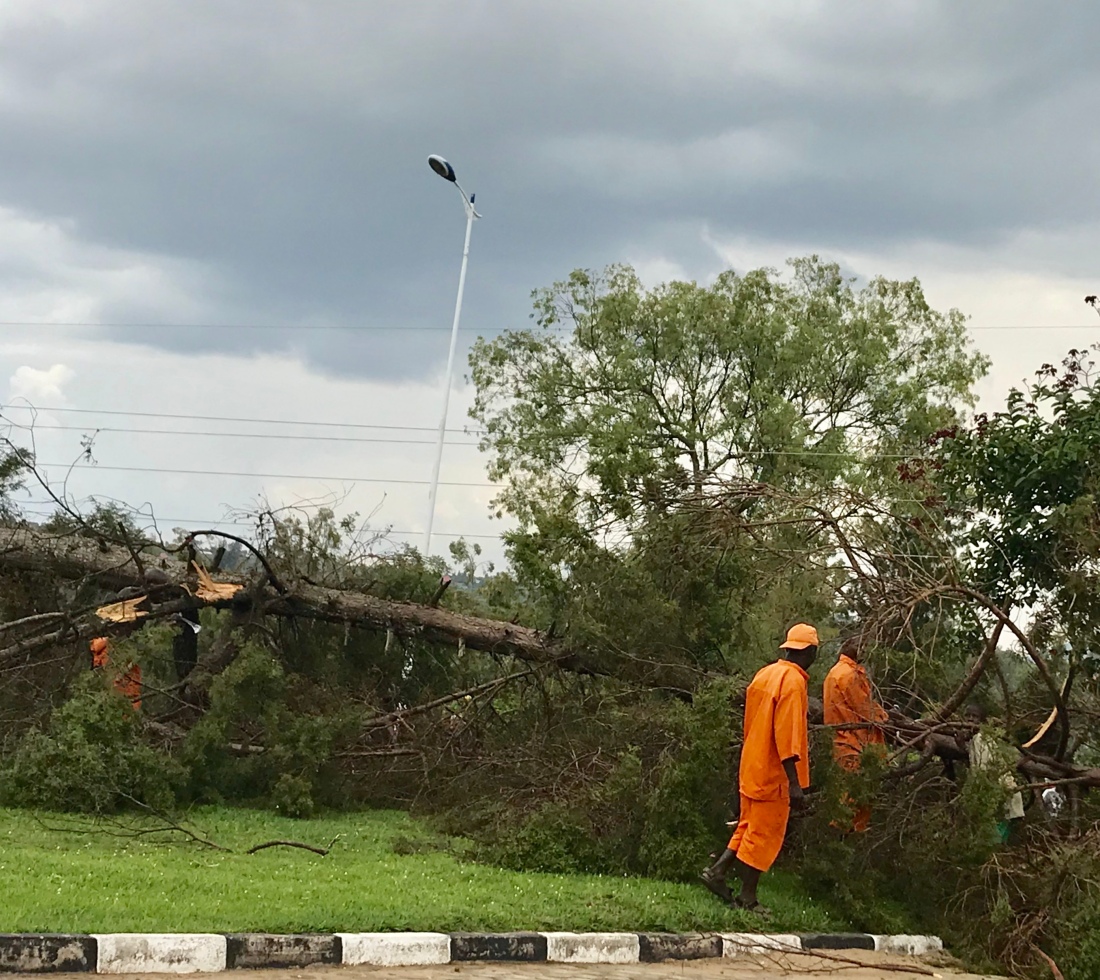
But the town cut down all of the trees, using local prison labor to do so. (The men in orange have already been convicted; the men in pink are still awaiting trial.)


Although I was aghast that the prisoners were cutting down the tree in my front yard, I nevertheless thanked them for their work and rewarded all of them with amandazi (Rwanda’s version of donuts). While the hard-working and congenial prisoners cut down the trees, throngs of local children arrived to collect the smaller pieces as kindling to take home to their mothers to use as firewood for cooking. Below are the prisoners finishing the job of cutting down the tree in my front yard.
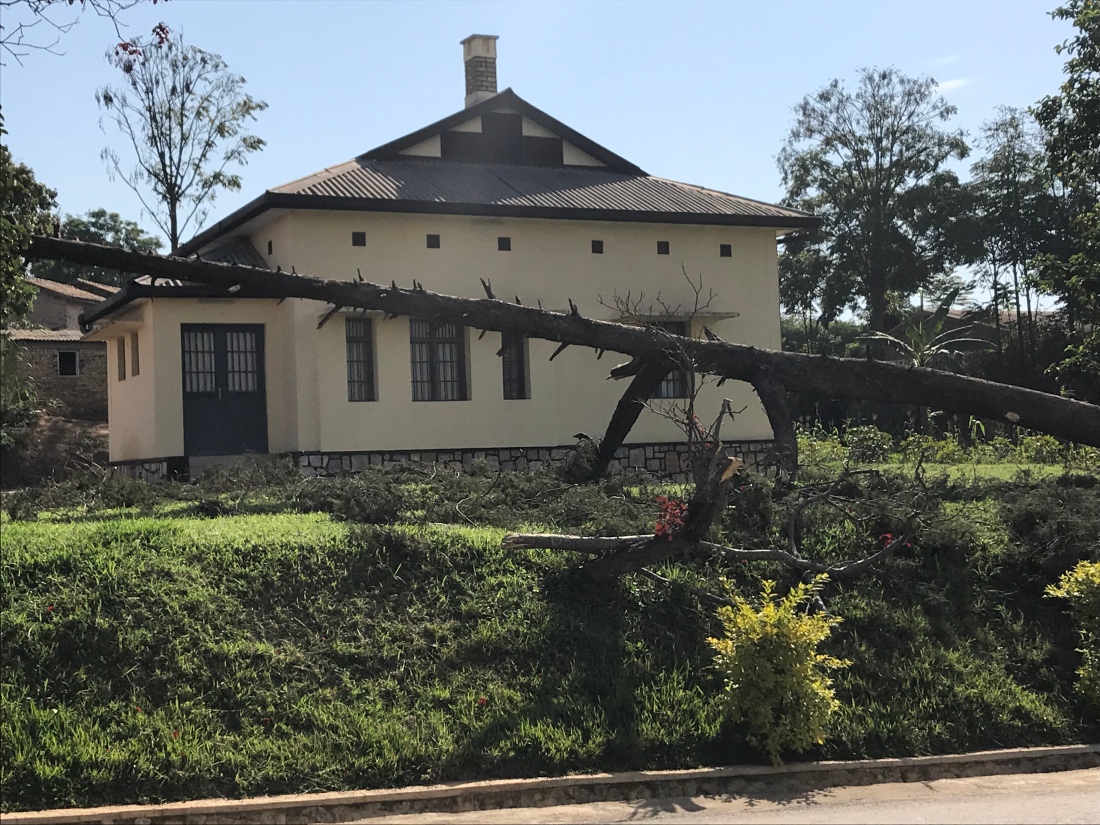
Below is the felled tree in front of my house, stripped down to the trunk by children. This morning, sturdy young men were already sawing the felled trees into smaller chunks to be carted away to make fires for cooking. As the trees were being cut down, the bats were going crazy, their normal jabber turned to panicked shrieks of alarm as they escaped the trees and filled the skies in search of a new home. Soon, there will not even be a memory of the trees and the swarms of bats that once made their homes in them.
 Ruminations from Rwanda
I am sad to learn the trees were cut down and the bats have gone. Bats eat mosquitoes, and mosquitoes are harmful whereas bats are benign. I am curious: Does the mosquito population rise after the bats go away?
LikeLike
I’ve been told that these bats are fruit bats. Currently, there is not much rain, so the mosquito population is low now, and I haven’t noticed any increase in the mosquito population since the bats have been gone.
LikeLike
I’m so very sad about the trees and the bats. I will appreciate our small swarms of bats here in Arkansas even more now.
LikeLike
Great bat pictures!
LikeLike
Kind of sad! I like bats. I’m sure they will find a new home. We used to have them around our place in Mexico. Also used to have cocktails outside a cave and watch the bats come out for the night.
LikeLike
So like you to have cocktails watching the bats. What fun that must have been!
LikeLike
You got quite an interesting adventure going here. While you live in the Southern Nile Basin, I live in the Eastern Basin. However, that part of the Nile Basin still offers quite a good bit to the ecosystem of this Great River whose source is in East Africa.
Next year, join us us at the “Save the Nile Marathon”
LikeLike