
After learning that I’d be coming to Rwanda as a Peace Corps Response volunteer, I tried to learn everything I could about the country. Imagine my glee when I discovered the Congo Nile Trail, which stretches along the entire western border of the country, often within sight of the shores of Lake Kivu, the great lake that separates Rwanda from the Democratic Republic of Congo and which, according to the Rwanda Development Board (Rwanda’s Tourist Office), is 227 kilometers (140.74 miles) long. I packed my hiking boots and poles, and from the moment I arrived in Rwanda I plotted how and when I would hike the trail. The school where I’m teaching conveniently had a break in December, and I had saved my vacation days to hike the trail. When I told my Rwandan co-workers about my plans to hike the Congo Nile Trail, they all asked, “But, why?” The only answer I could think of was “Because it’s there.”
I was delighted when my friend Béné decided to join me. Although her Peace Corps service ended December 11th, Béné stayed in Rwanda to hike the trail. After signing all the paperwork to end her service, she rushed to board a bus to Nyanza so we could make our final preparations for the hike and leave together the next day.
The trail is called the Congo Nile Trail because it skirts the Congo-Nile Divide that separates the areas of land that drain west into the Congo River, which is one of the world’s longest rivers and is in the Democratic Republic of Congo, from the areas of land that drain east into the Nile River, the longest river in the world.  According to the Nile Basin Initiative, a partnership of countries for the development of the water resources of the Nile River, Rwanda has two hydrographic basins: The Congo River basin, which covers 33% of Rwanda, and the Nile River basin, which covers the other 67% of the country. Streams flowing west of the divide flow into the Congo River, while those flowing east of the divide flow into the Nile River. The picture to the left shows just how long the Nile River is, especially when combined with its White Nile tributary that flows into Rwanda.
The White Nile, one of two tributaries of the Nile River, has its source in either Rwanda or Burundi (Rwanda’s southern neighbor). Which country is actually the source of the White Nile is up to debate, but it’s somewhere near the border of the two countries in the forest that straddles the border between them. The Nile River flows north from its source in southern Rwanda to Egypt.
Credit for finding the source of the Nile in Rwanda goes to the dapper German, Richard Kandt, one of the first European explorers in this area. He was the first person to trek the Congo Nile Trail, though of course it wasn’t called that at the time. He explored that area from 1897 to 1898 and, while doing so, claimed to have discovered the source of the Nile in Nyungwe Forest in southwestern Rwanda. Between 1899 and 1901, he drew the first map of Lake Kivu, which would later be used to establish the boundaries between the Belgian Congo (now Democratic Republic of Congo) and Rwanda, which was then part of German East Africa. The European colonists would later use the Congo-Nile Divide to designate the boundary between British and German-controlled territories to the east and the French and Belgian-controlled territories to the west.
However, I cared less about the hydrographic and colonial history of the trail’s name than about the trail itself and the chance to hike the entire length of Rwanda on its westernmost edge, experience the beauty of Rwanda and interact with literally hundreds of friendly Rwandans. What follows is my experience on the trail in December of 2018 and my recommendations for future hikers.
Day 0 – Rubavu (Preparation for the trail) (Wednesday, Dec. 12, 2018)
It had been raining every day for the last four days, and this morning was no exception. We were prepared for rain. Plastic grocery bags are banned in Rwanda, so plastic bags are not easy to find. However, for months, I’d been hoarding every plastic bag I could find, including the small plastic bags (the size of a sandwich bag) that napkins are sold in. I had amassed enough plastic bags that I could put every article of my clothing in a plastic bag and had extras to share with Béné. We also packed umbrellas and rain jackets. We expected a lot of rain during the hike and did not want to have wet clothes inside a wet backpack. We packed as lightly as we could, but our backpacks still felt heavy.
We took a crowded Volcano bus from Nyanza, with our backpacks on our laps, to Nyabugogo, the chaotic central bus station in Rwanda’s capital city, Kigali, coincidentally founded by German explorer Richard Kandt, where we transferred to another bus going to Rubavu (formerly, and sometimes still, called Gisenyi). After more than five hours of travel from Nyanza to Rubavu, we were happy to get off the bus. Unfortunately, we missed the stop where we should have alighted and rode to the end, resulting in having to walk an extra mile to get back to where we should have gotten off.
Because Béné was eager to get information on the Congo Nile Trail, the first thing we did was to look for the Rwanda Development Board (RDB) office, which is Rwanda’s tourism office. RDB is supposed to have up-to-date information on the trail. Although prior hikers who have recounted their experiences on line were uniformly of the view that RDB was useless when it came to information about the Congo Nile Trail, Béné, spewing with optimism, was determined to prove them wrong. I was not so sure, and, based on the negative comments on-line, would have skipped RDB entirely, but reluctantly traipsed after Béné on her quest to find RDB.
We walked and walked and walked and, after asking many people, finally found the office next to the S & P petrol station near Lake Kivu, but the office was closed at 5:30 p.m. when we finally reached it. In addition, we found the office of Green Hills Ecotours, which also is supposed to have information on the trail but, alas, it too was closed. However, next door to the closed Green Hill Ecotours was a well-stocked grocery store, where we purchased some snacks: peanut butter, Laughing Cow cheese and chocolate.
Rubavu is a beautiful town along the lake, with majestic palm trees and a sandy beach. It has a grand beautifully landscaped boulevard along the northern shore of the lake. 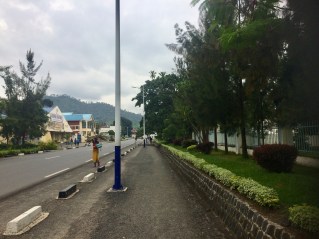 The market part of town, away from the lake, is congested, but hikers can likely pick up last minute things for the trail there. It is impossible to find a car taxi in Rubavu, but motorcycle taxis are ubiquitous, as they are all over Rwanda. However, it’s easy to walk to most places.
Unable to find any trail information, we checked into the first hotel we saw, which was the Discover Rwanda Hostel, which happens to be the former Belgian colonial governor’s mansion. It sits on a large and exquisitely landscaped property in a fabulous and convenient location, just a short walk to town and across from the beach on Lake Kivu, where the sunset was amazing, and, most importantly, near the first sign for the Congo Nile Trail. Although it was a bit worn down now, we could envision the mansion’s bygone days of grandeur. 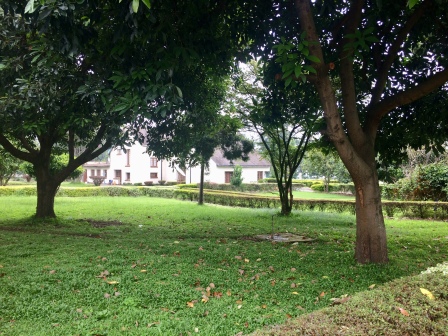 There were only four of us spending the night there: my fellow hiker, Béné, and me, plus a traveling couple we had met while getting off our bus.
Béné and I shared a room that was in a separate smaller building, tucked into the backyard, a short walk from the stately former governor’s mansion. Our room had bunk beds, each with its own mosquito net and a tiny but private bathroom.
After dropping our backpacks off in our room, we walked into town to find an ATM. (There were many choices, as there are many banks in Rubavu). With a little money in our pockets, we looked for a place for dinner and luckily found the No Stress Café Bar & Restaurant, which was next to our favorite grocery store, and which had pleasant, not overly loud, music and outdoor tables. I had fish brochettes with a salad of tomatoes, onions, carrots & cucumbers, washed down by a Primus Citron beer (or maybe two. Heck, we were going to hike the trail the next day). The young women who checked us in at the Discovery Rwanda Hostel had recommended only the Aubergine restaurant, which was farther away, for dinner. Our friends went there and said it was fine, but we were glad to have found the No Stress Café, which, true to its name, was absolutely free of stress.
We slept soundly that night. In the morning, we had no water in our bathroom, but it wasn’t a problem because the main governor’s mansion had water in the bathroom. The breakfast was perfect for hikers: eggs, bread, fruit (banana, passion fruit & pineapple), plus coffee or tea. We each paid 17,000 francs (less than $20) for our room and breakfast. In Rwanda, the room rate almost always includes a sumptuous breakfast. Our friends chose to stay in the dormitory so paid a little less.
Day 1 – Rubavu to Rubona (Thursday, Dec. 13, 2018) (about 7 kilometers)
The next morning, we delayed departing until the RDB office opened because Béné was determined to give RDB a chance to provide trail information. We were jubilant to find the office open. However, the man in charge did not speak English. Fortunately, Béné sprung into action with her French. But, even in French, he had no information to give us and only a single map (his last, he said) for the two of us. 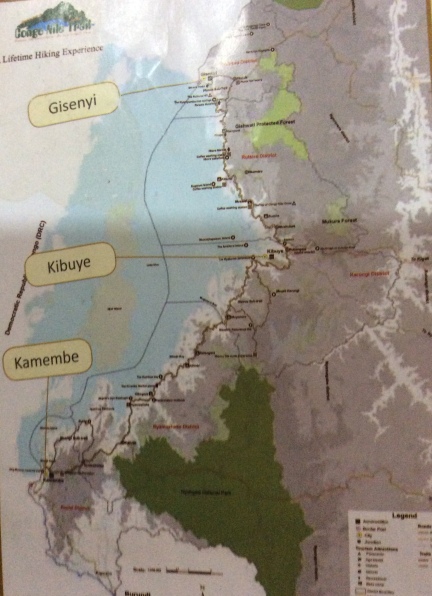 Since it was after 9:00 a.m., we also tried to go to Green Hills Ecotours, but they were still closed. Despite our paucity of information, we were eager to hit the trail. Before our trip, meticulous Béné had visited the RDB office in Kigali, the capital, which also did not have maps, but they gave Béné the phone number of Mary, whom they said was knowledgeable about the trail. So, we felt we had a lifeline if anything went amiss.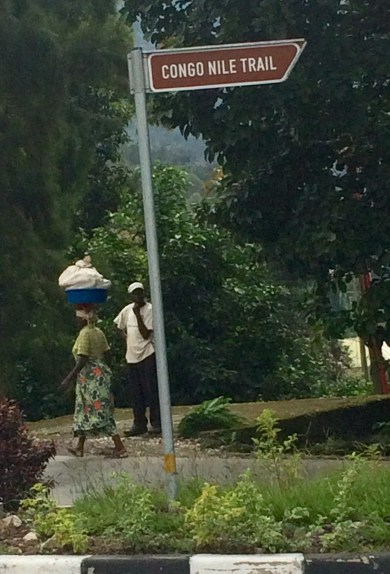
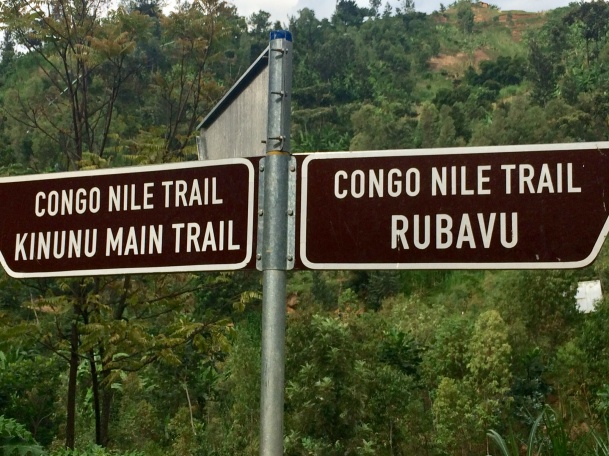
Most hikers do not count the seven kilometer paved road from Rubavu to the brewery in Rubona as part of the trail; instead, they consider the beginning of the trail to be at the brewery because that is where the dirt trail begins. But not me. The first sign for the Congo Nile Trail is in Rubavu, just a short walk from our hostel and the RDB office, and near the lake. So that was my official start of the trail. We were elated to finally take our first steps from that sign.
Not long after we began our hike, we saw a sign for an Italian restaurant and an another for an Indian restaurant. Those would have been additional choices for last night’s dinner, but the staff at our hostel apparently was unaware of those restaurants and so did not mention them.
Almost immediately, kids were attracted to us, asking for “amafaranga” (money). We would eventually get used to their refrain of “Give me money” or “Give me my money,” but on the first day, it grated. Béné enjoyed conversing with the children, but was not enamored of the kids who ran to greet us and then walked at a snail’s pace in front of us or surrounding us, slowing us down. 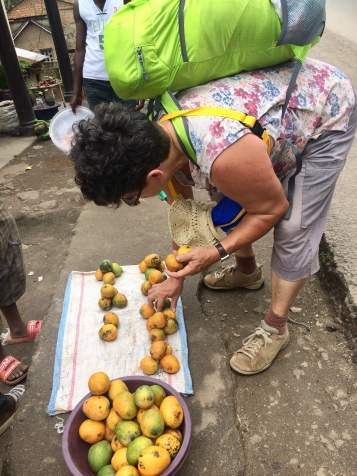 We stopped to buy some champagne mangos for ijana (100 francs or 12 ½ cents) from a woman selling them on the side of the road, Béné carefully inspecting them to find the ripest. We sat on the side of the road eating them, sweet mango juice dripping down the sides of our mouths.
We passed many people, who called to us “Muzungu” (white person or westerner) which we were accustomed to, having lived in Rwanda for ten months. We greeted everyone. We passed a woman selling chickens, as well as men and women carrying eggplants, avocados, wood, sugar cane and coal. We passed lots of tiny shops, selling provisions like water, juice, soda, biscuits, bread and Rwandan donuts, which are called amandazi.
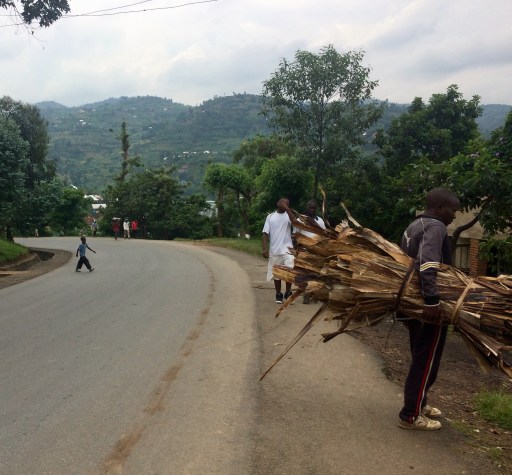
When people asked where we were going, we told them “The Congo Nile Trail,” but, they did not understand. However, when Béné used her French accent to say, “Congo Nil” (Congo pronounced with a long “o” and nil pronounced kneel), they got it.
It was a pleasant walk with little vehicular traffic to Rubona, a small picturesque but thriving town on the shore of Lake Kivu with several choices of lodging.
When we arrived at Rubona’s intersection, we had our first view of the brewery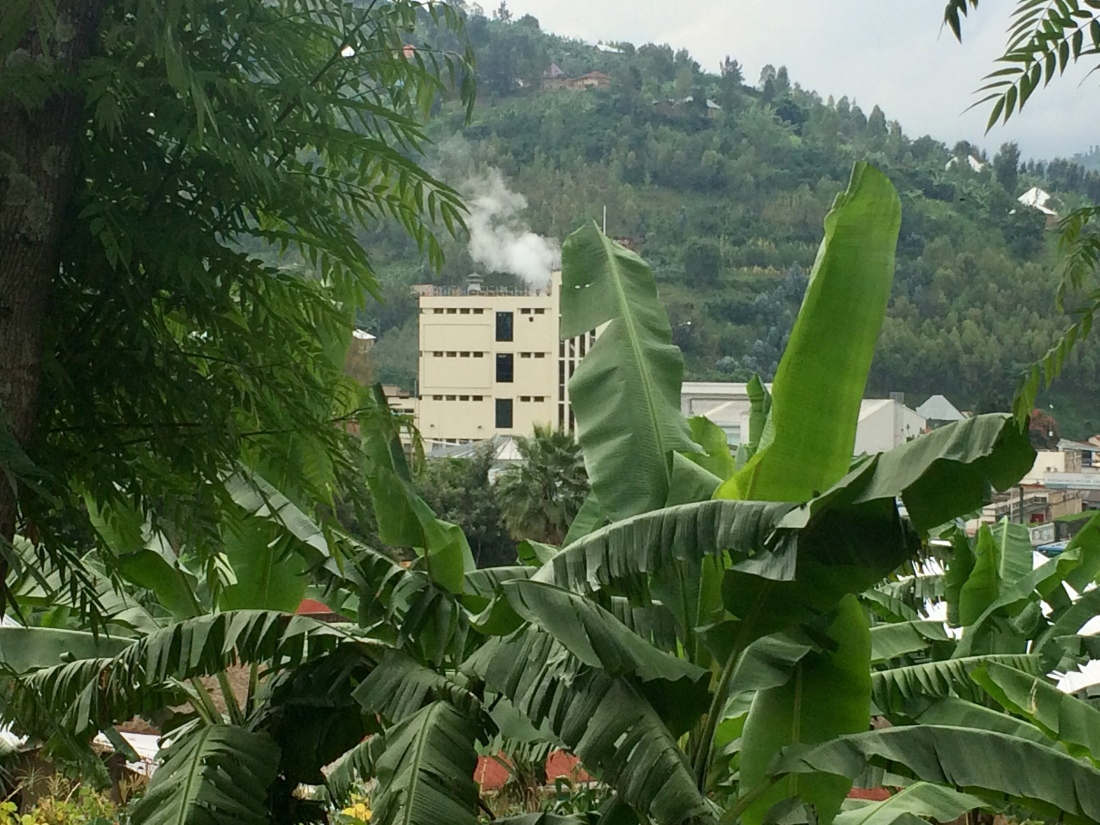 and had to make a decision – whether to hike 15.5 miles more or stay here. We both felt good and thought the additional miles would be doable, but Rubona looked like such an inviting place that we decided to stay and explore it and were glad we did. Therefore, instead of continuing straight to the brewery, we turned right and stopped at the “Simple Café,”
 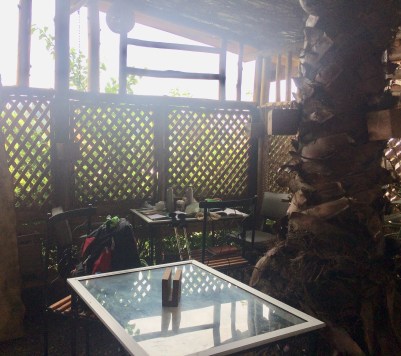 aptly named for its lovely, quiet simplicity, for a cup of “mukara” (Rwanda’s piping hot black sweet and spicy tea) and snacked on a wedge of the cheese Béné had purchased in Rubavu.
As we left the restaurant, it started to lightly rain. Boat captains occasionally stopped us, asking us if we’d like to take a boat ride on the lake, but we declined. We continued hiking to the Paradis Malahide Guesthouse, which we reached just as the sky opened up to a heavy downpour, sealing our decision to call it a day and stay in Rubona. This was the first and, amazingly, only rain we encountered on the entire trail.
The Paradis Malahide is owned by Rwandans and is a beautiful, upscale and not inexpensive ($90/night for a double, including breakfast) inn on Lake Kivu. The décor alone made it worth it for us to splurge. It has a large comfy common area with a huge fireplace and lots of cozy chairs, all with cushions made of vibrant African prints. The walls are covered with colorful Rwandan art.
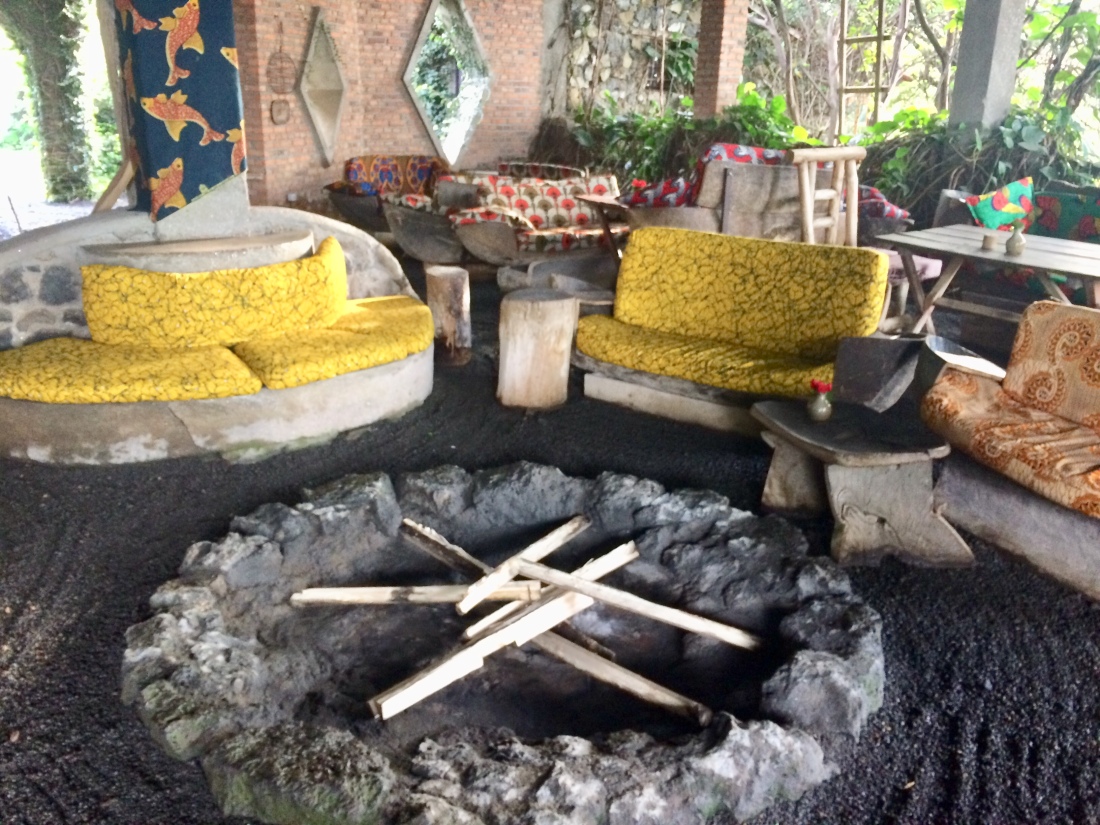
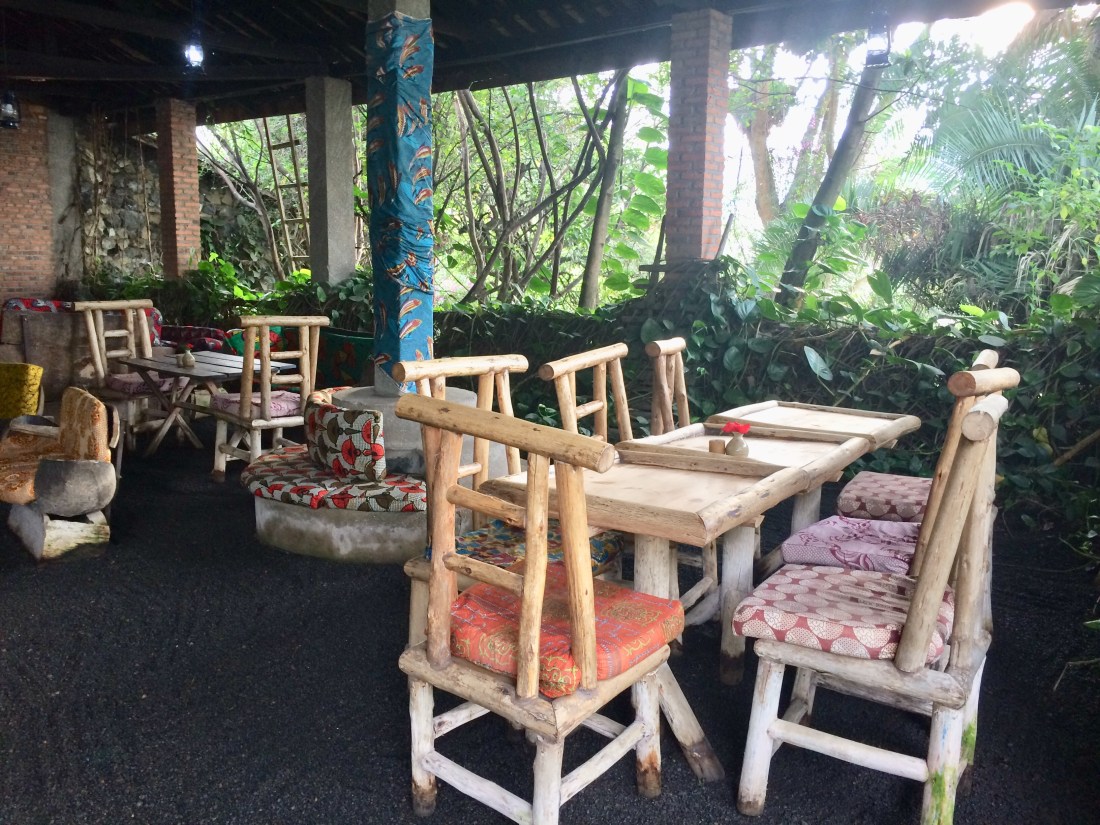
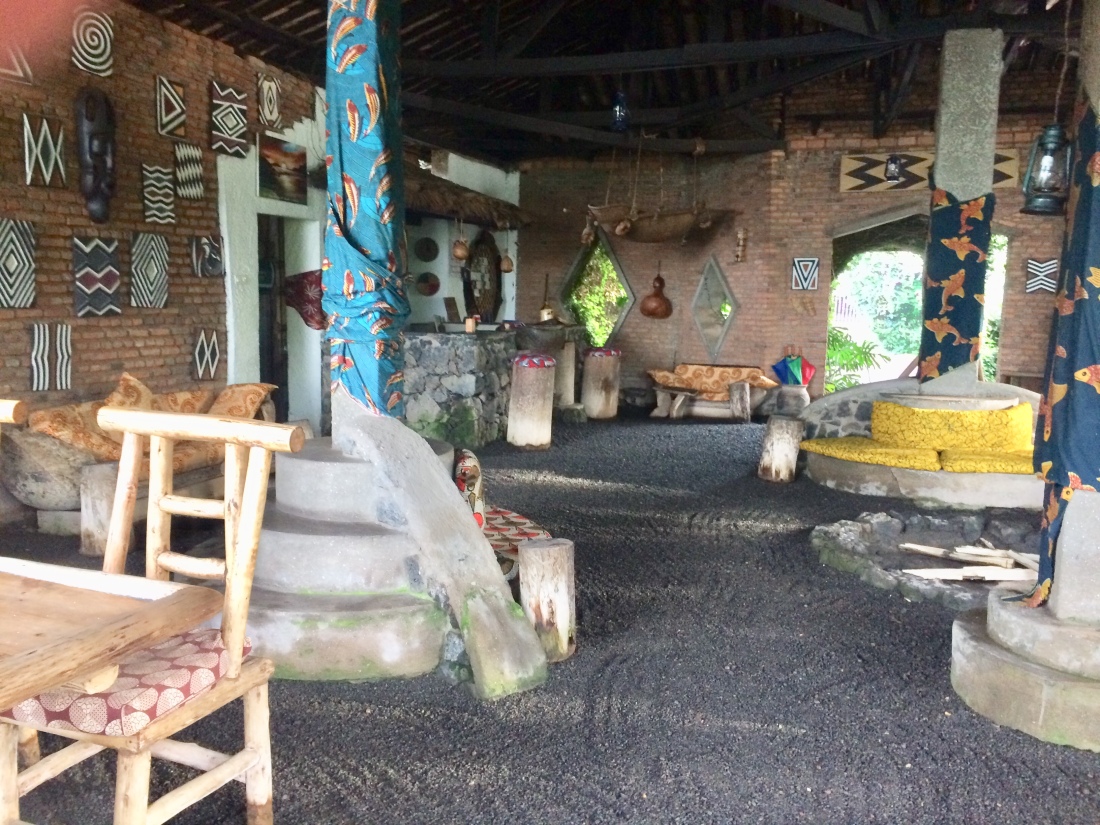
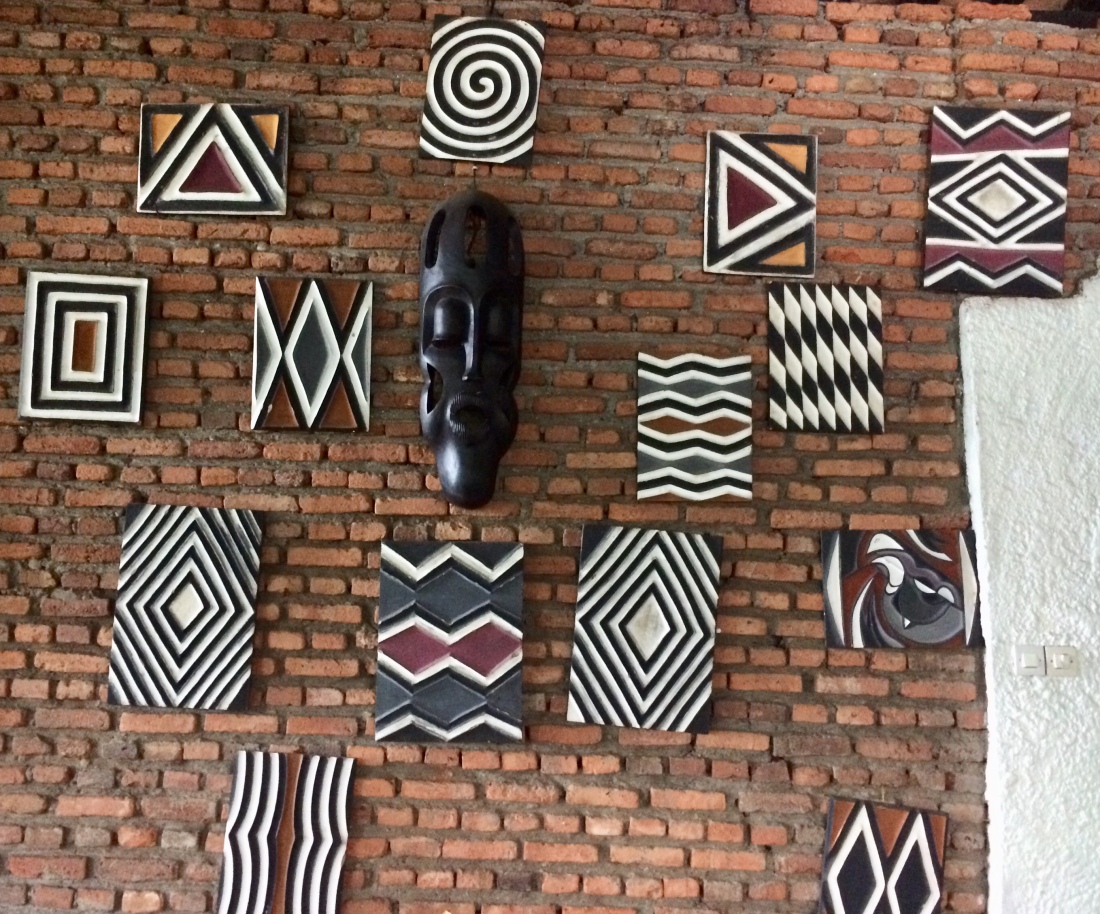
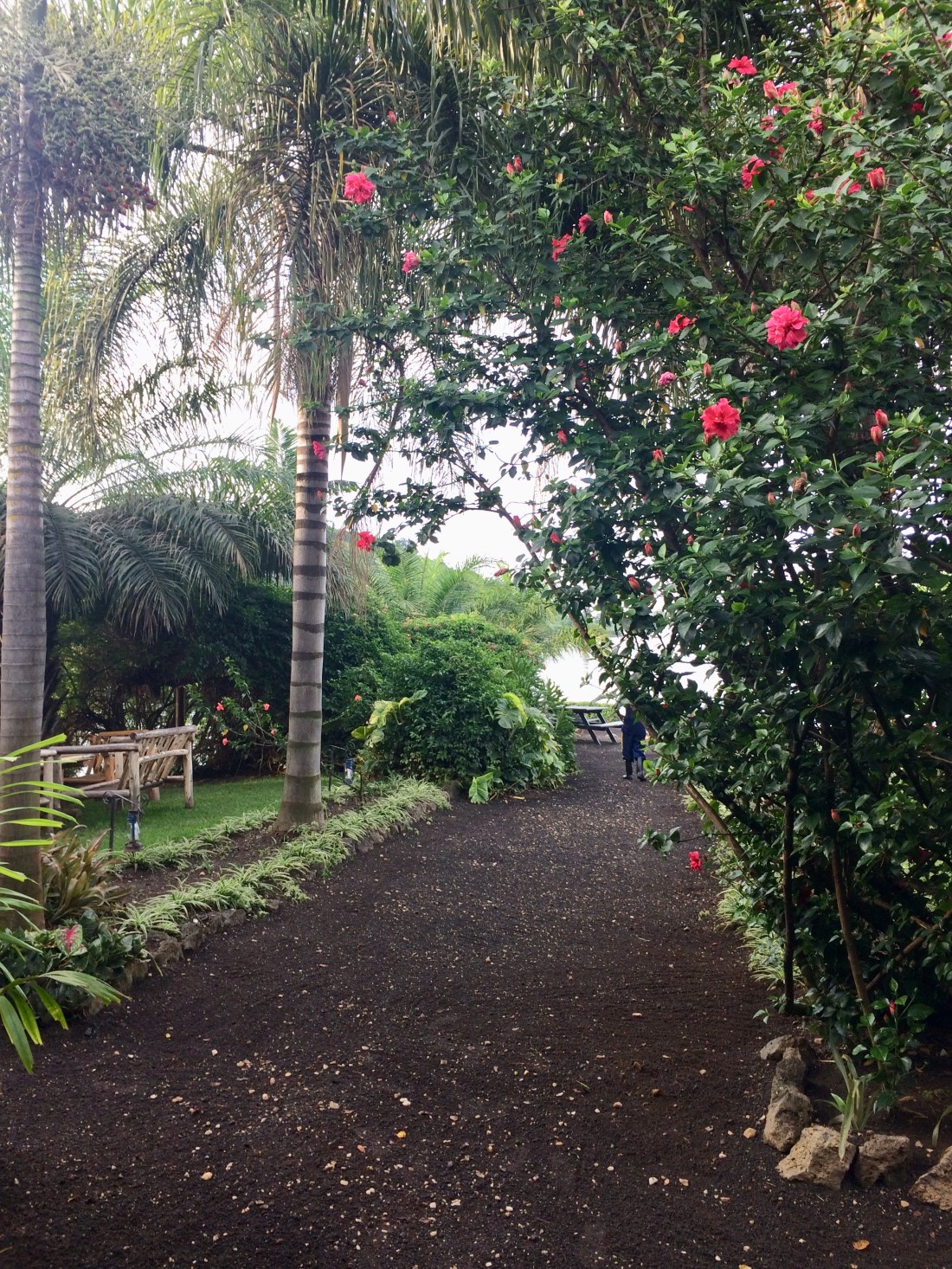
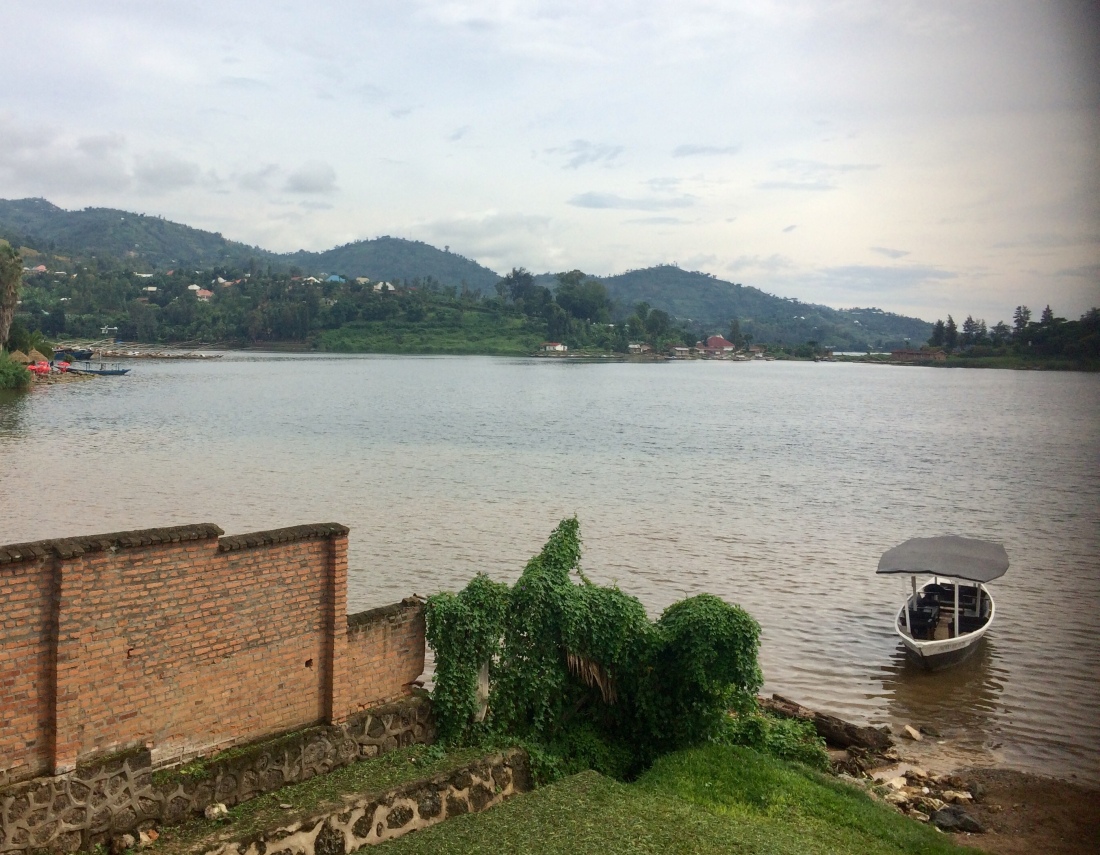
The reception counter is made from an old fishing boat, as are the couches. Our room was on the second floor of another building with a large balcony overlooking the lake and taking advantage of the lake’s gentle breezes.  The grounds are gorgeous. There were kayaks available for rent at $25 per person per hour, but we felt that was too expensive. Our room was luxurious, with two twin plush comfortable beds and a large private bath.
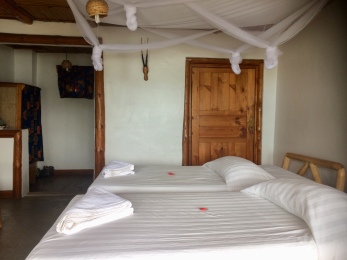
Since it was raining, we ate lunch at the hotel, having sambaza (the tiny fish freshly caught in Lake Kivu and fried) plus a vegetarian pizza and Vitalo (the Rwandan equivalent of Pelligrino) for 9,000 francs (just over $10) for the two of us.
The rain lasted about two hours. Afterwards it was overcast and cool, but very pleasant. So, we walked past the Bralirwa Brewery (which makes Primus, Mutzig and Turbo King beers), laughing at the goats that had glued themselves to the fence to nibble on the hedge on the opposite side, and then 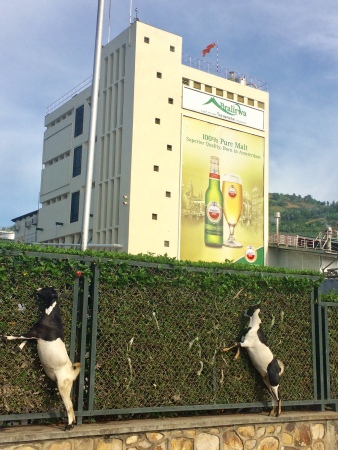 to the hot springs, which cost 1,000 francs (just over $1) to enter. I was unimpressed. The locals have tried to make the springs touristy, but I didn’t think it was worth the visit. The main attraction is about a ten foot in diameter hot springs which have been turned into something like a hot tub by stacking sandbags in a circle. I sat on the top of the sandbags, rolled up my hiking pants and dipped my feet into the warm water. There were about ten other people already in the “hot tub,” one was getting his head, neck and back massaged. Visitors can pay for a massage, including a full mud massage where one is buried up to one’s neck in hot mud on the edge of the lake. It didn’t look fun to me. There was also a bar on a hill above the springs. Some people went swimming in the lake, which is said to be very warm in this area. However, parasitic worms released from infected snails that live in the water can cause schistosomiasis, a/k/a bilharia, which is an awful disease and, according to Wikipedia, common in fresh water bodies in Africa, Asia and South America. The disease mainly affects the kidneys, bladder and liver with devastating consequences. After five minutes, I’d had enough of the hot springs and convinced Béné to leave.
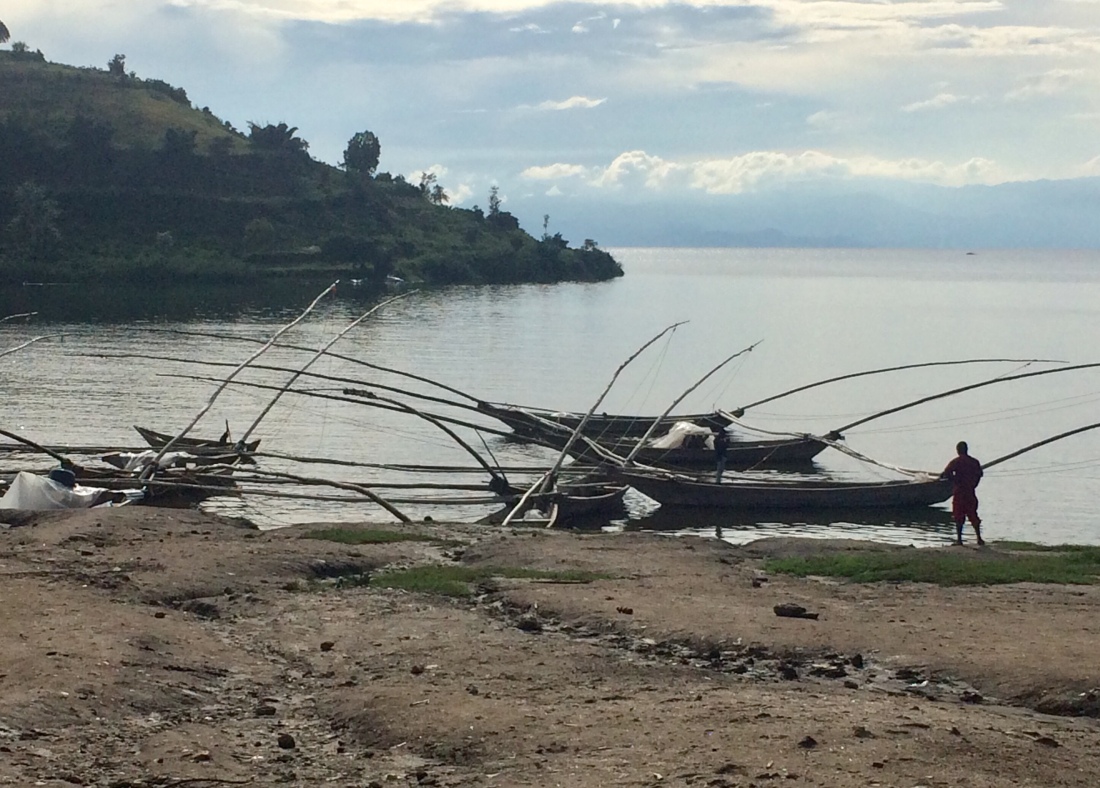
On our way back to our inn, we stopped at El Classico Bar, which has tables on the water’s edge, for a Primus Citron our favorite lemon-flavored Rwandan beer. 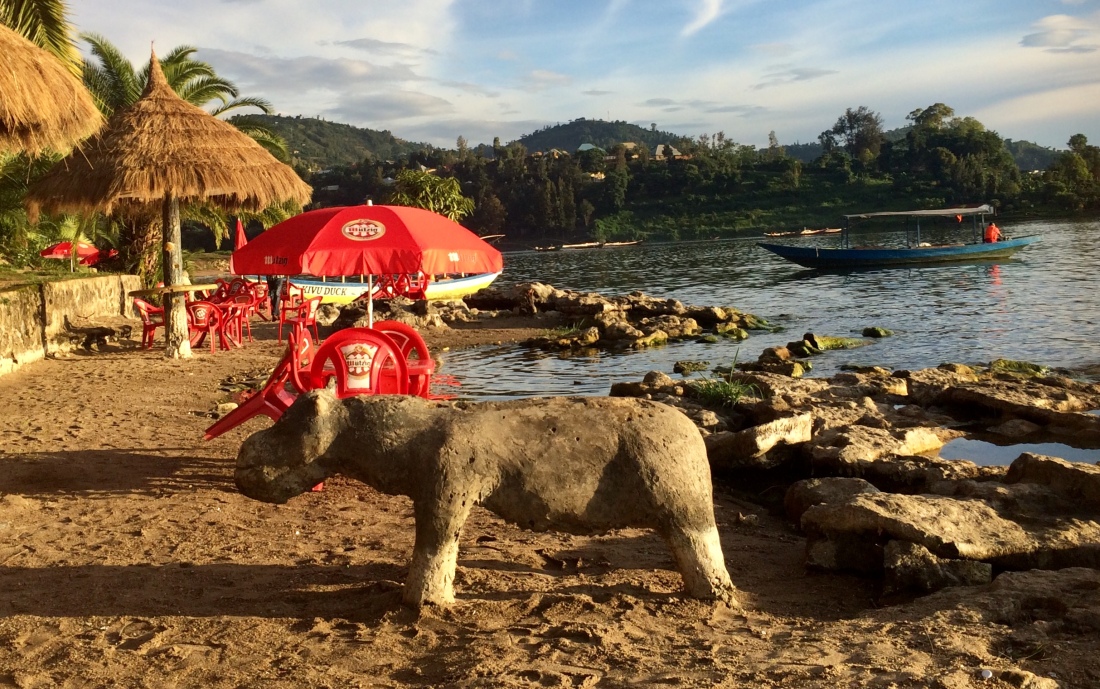 The menu seemed boring, so we just sipped on our beers and watched the sunset over the lake and listened to the fishermen and women sing as they paddled their boats out for night fishing.
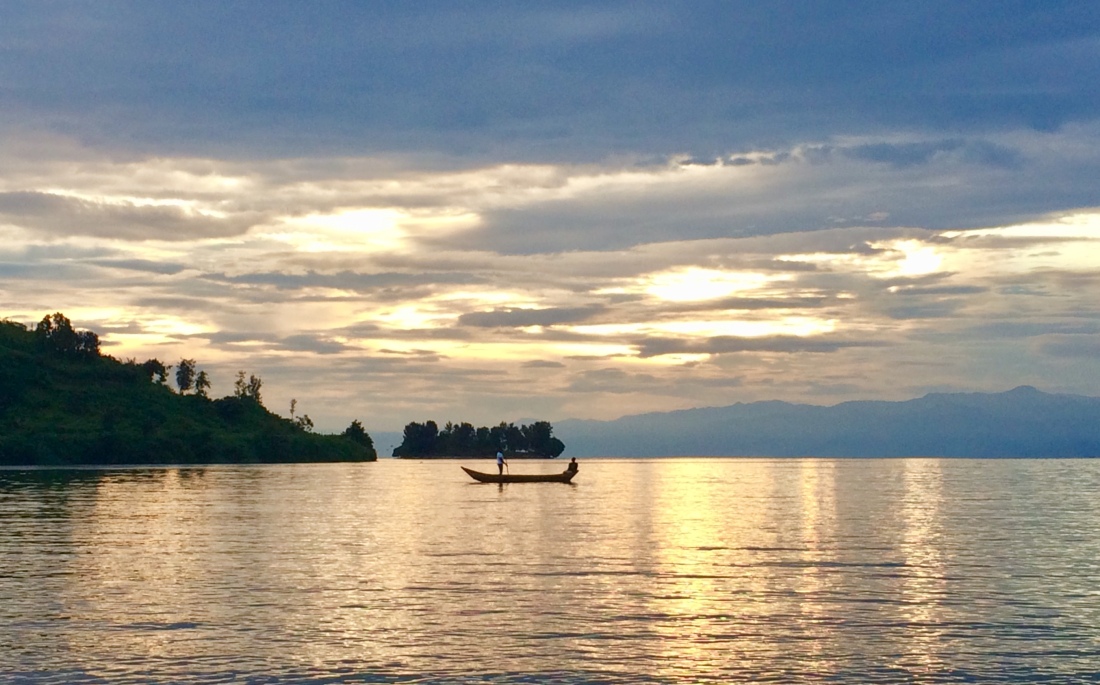
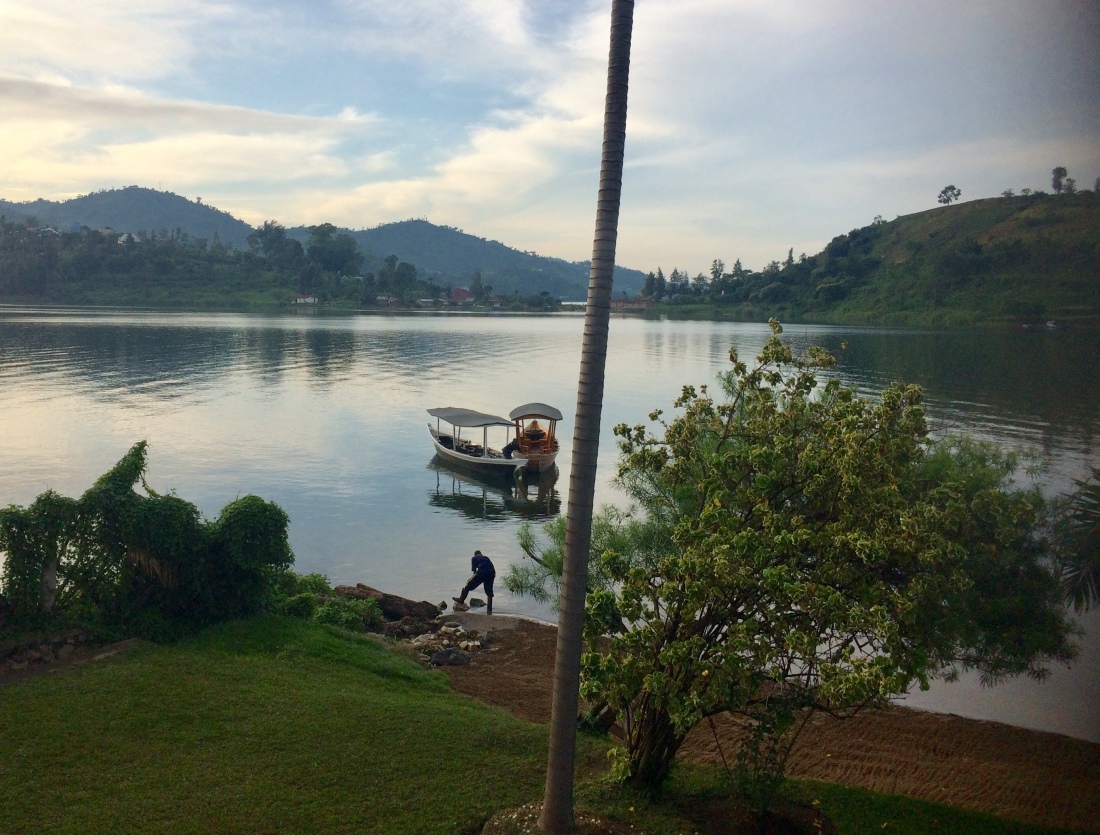
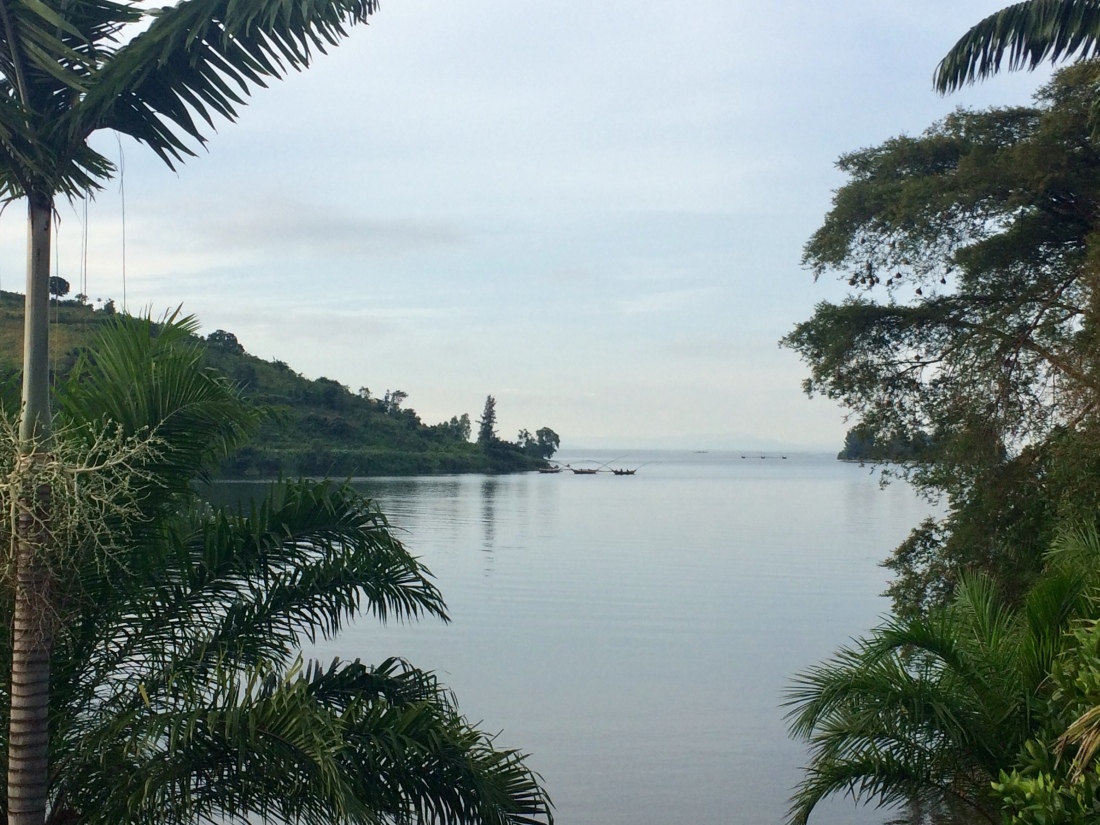
They cast their nets and then wait and sometimes sleep. After several hours, they pull in their nets filled with hundreds of thousands of the small but tasty sambaza fish that are later sold to market vendors to sell.
We returned to the Paradis Malahide for dinner, and, of course, had more fish: fish brochettes and another huge plate of fried sambaza, plus a salad and fries. Afterwards, we met a British woman traveling in Rwanda and talked for an hour, while sipping on our after-dinner drinks of Amarula, the South African liqueur that tastes like Bailey’s. What a way to prepare for tomorrow’s hike! Our British friend was staying at the Inzu Lodge, further down the road, camping in a luxury tent for considerably less than what we paid.
The next morning, we had hoped to have breakfast at 6:30 a.m. so that we could get an early start. However, our breakfast did not arrive till 7:00 a.m. We also had hoped that the inn would have filtered water so that we could fill our water bottles, but they didn’t. It was not a problem, however, because bottled water is available just about everywhere on the trail. Before we set out, the inn gave us a treat for the road: a crepe wrapped in aluminum foil for each of us.
Day 2 – Rubona to Cyimbiri (pronounced Chimbeery) (Friday, Dec. 14, 2018) (approx. 15.5 miles)
We retraced our steps back to the brewery, walking between the multi-story brewery and the port facilities. Once past the brewery, the paved road disappears and the dirt trail begins.
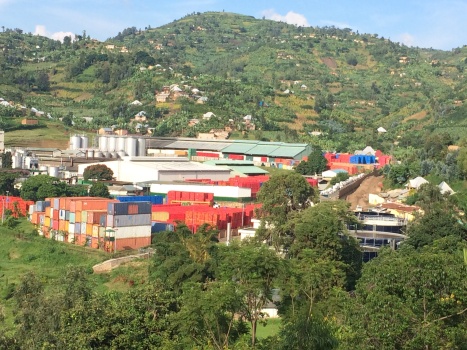
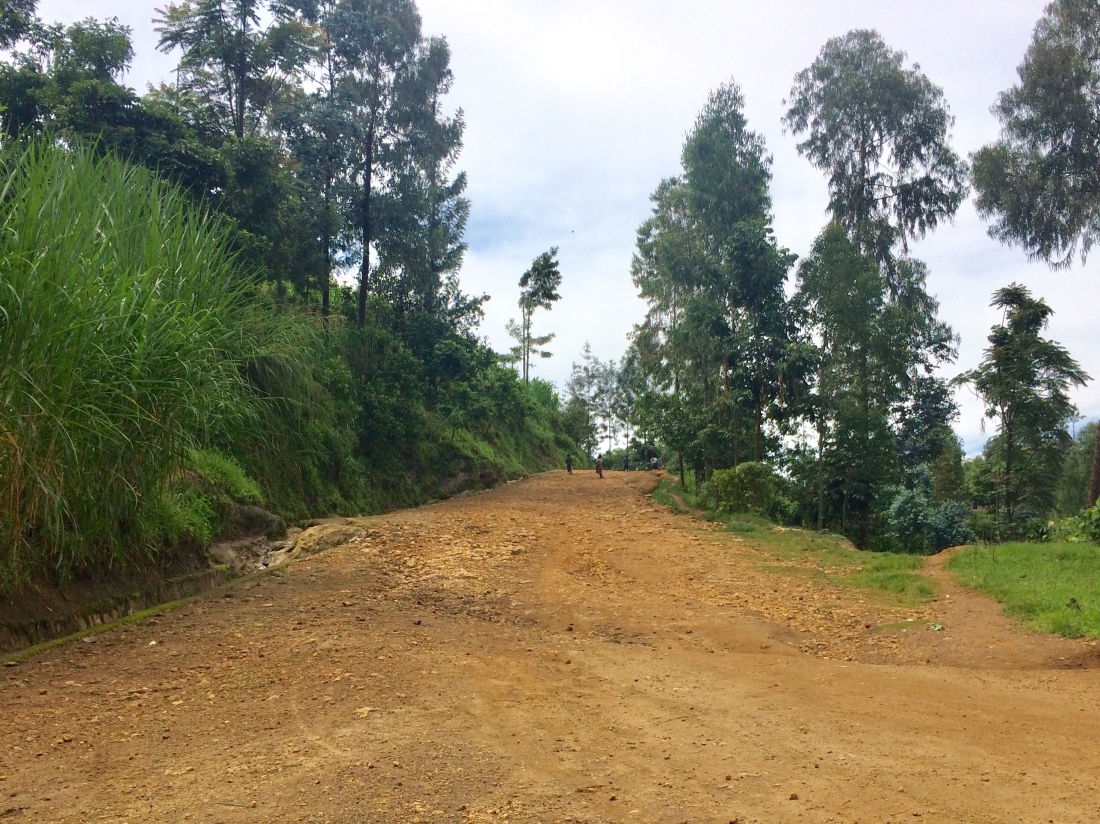
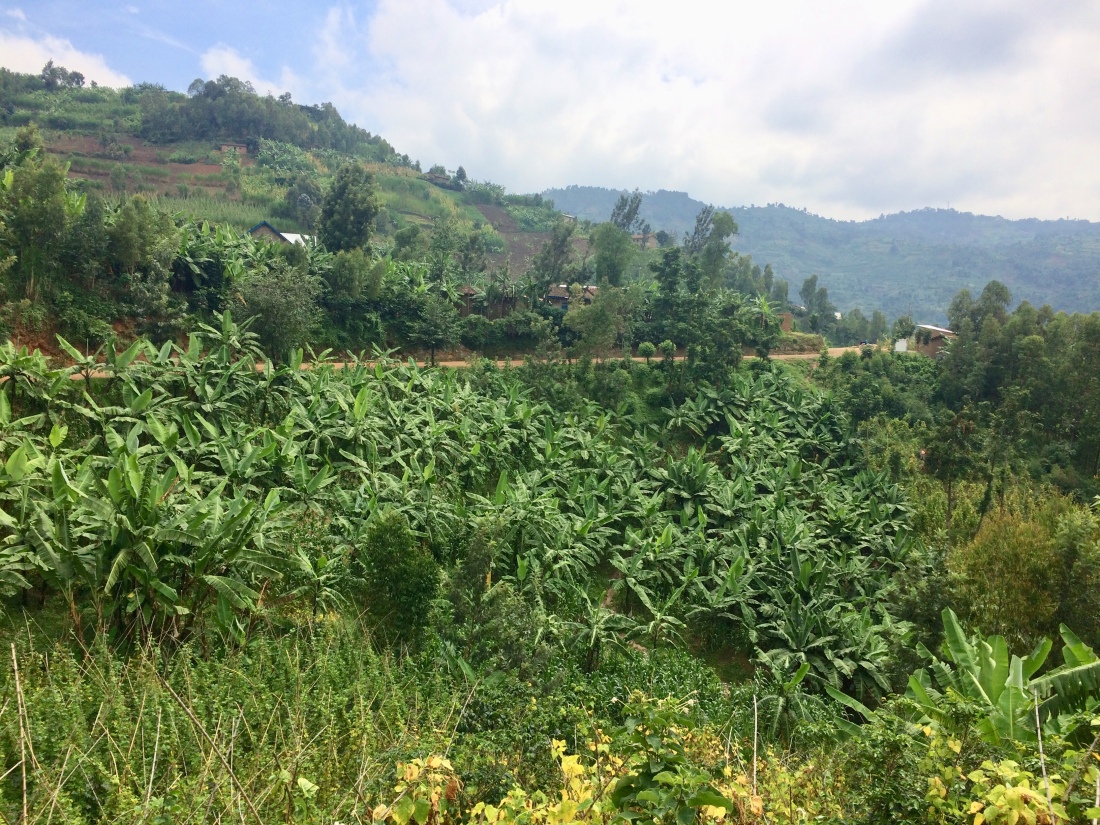
 We hiked for a total of 7 hours and 10 minutes, including lots of breaks and slowing down to greet everyone along the way. It was extremely hilly. The road was often rocky, and I could feel the sharp rocks through the thin soles of my Lems hiking boots, so the bottoms of my feet were sore by the end of the hike. I found it a tough hike, perhaps because it was our first long day and my pack was heavy and had no chest strap.
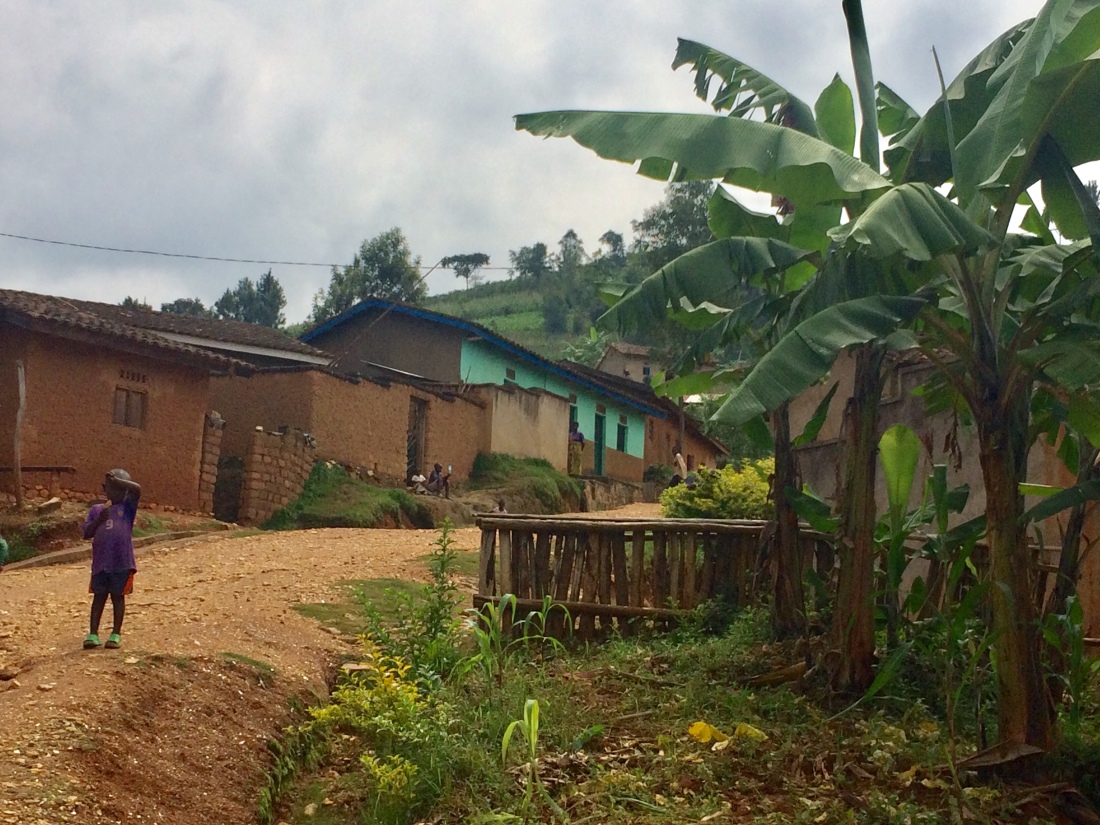
The trail was easy to follow, usually obvious, and signage was good, except at the town of Kyambere, where there was a Y in the road and no sign. All of the townspeople were eager to assist us; however, half told us to go one way and the other half told us to go the other way. Each group of people was adamant that Cyimbiri was in the direction they pointed. It was maddening. We started walking one way, and people told us to go the other way. Finally, after much scratching of our heads, we decided to turn left. However, I felt uncomfortable about it. It was very hot and we were very tired. I did not want to have to backtrack four miles because we went the wrong way. Fortunately, before embarking on the hike, I had made a list of all the places we could stay along the trail, complete with names and phone numbers. About a half mile later, I took out that list and called Jean at the Cymbiri Guesthouse, who said we were going the right way. I think that maybe both directions would have been okay; however, one way might be longer. Jean’s confirmation lifted a load off us and instantly our backpacks, as well as our steps, felt lighter. Jean also gave us explicit directions to the guesthouse: Turn right at the sign to the base camp, turn left at an unmarked junction, then walk through the school to the unmarked gate on the right and go through the gate to reach the guesthouse.
We passed through many villages. In the afternoon, we found very little to eat or drink. In one small village, there were no stores open and it seemed like a ghost town – perhaps because it was Friday afternoon and the Muslims were at prayer. Mid-morning, we had snacked on the yummy crepes the inn had packed for us, but now we were hungry. So, I asked a man where we could buy bananas. He went away and returned with three small bananas and tried to charge us 500 francs, then reduced it to 300 francs. Béné, however, astute shopper that she is, told him what she paid in Ruhango and gave him 150 francs, which he gladly took. We had no rain at all today, though for an hour the sky looked threatening.
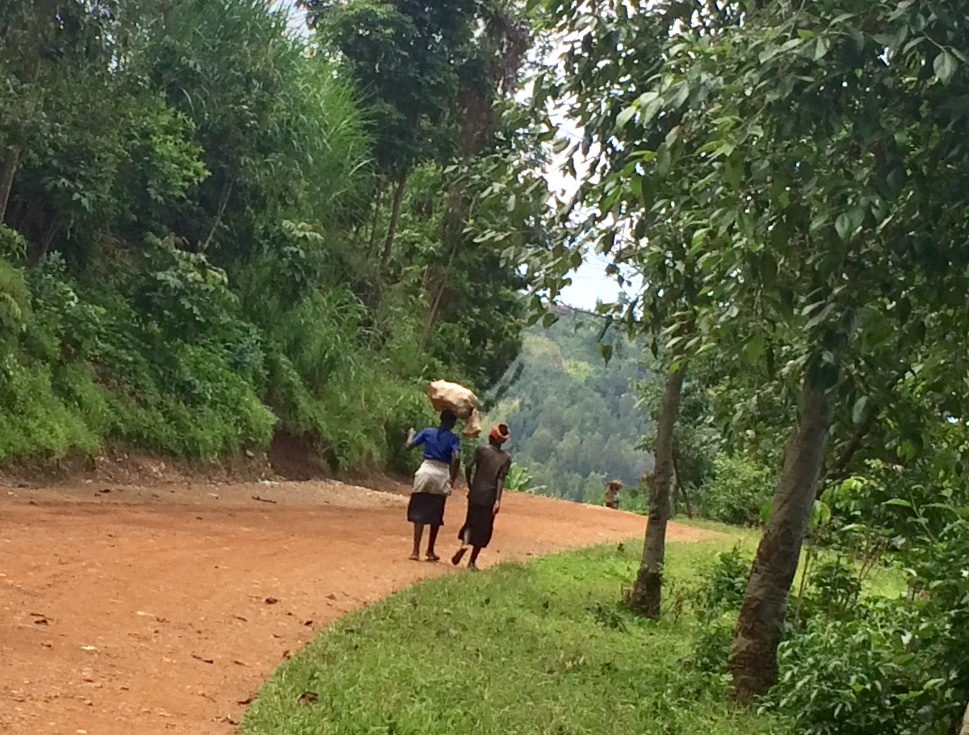
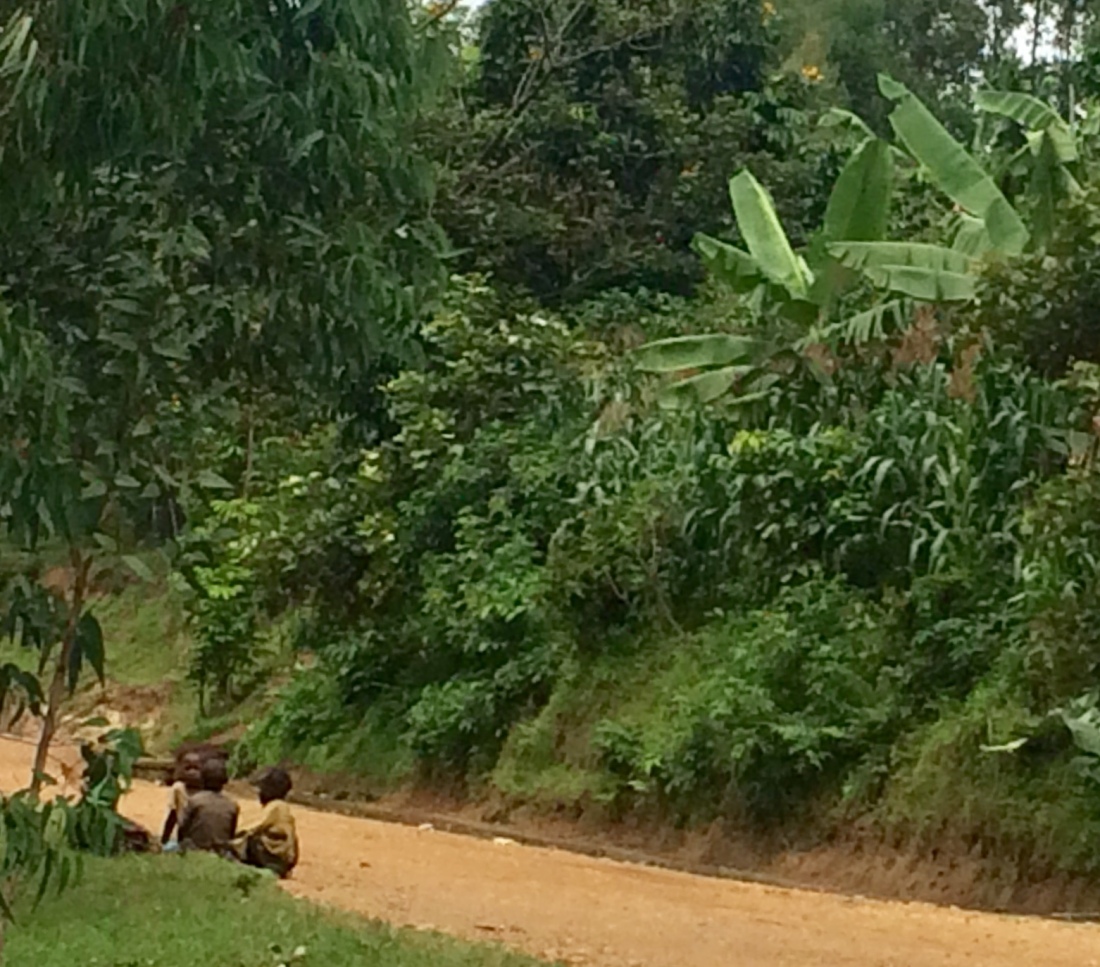
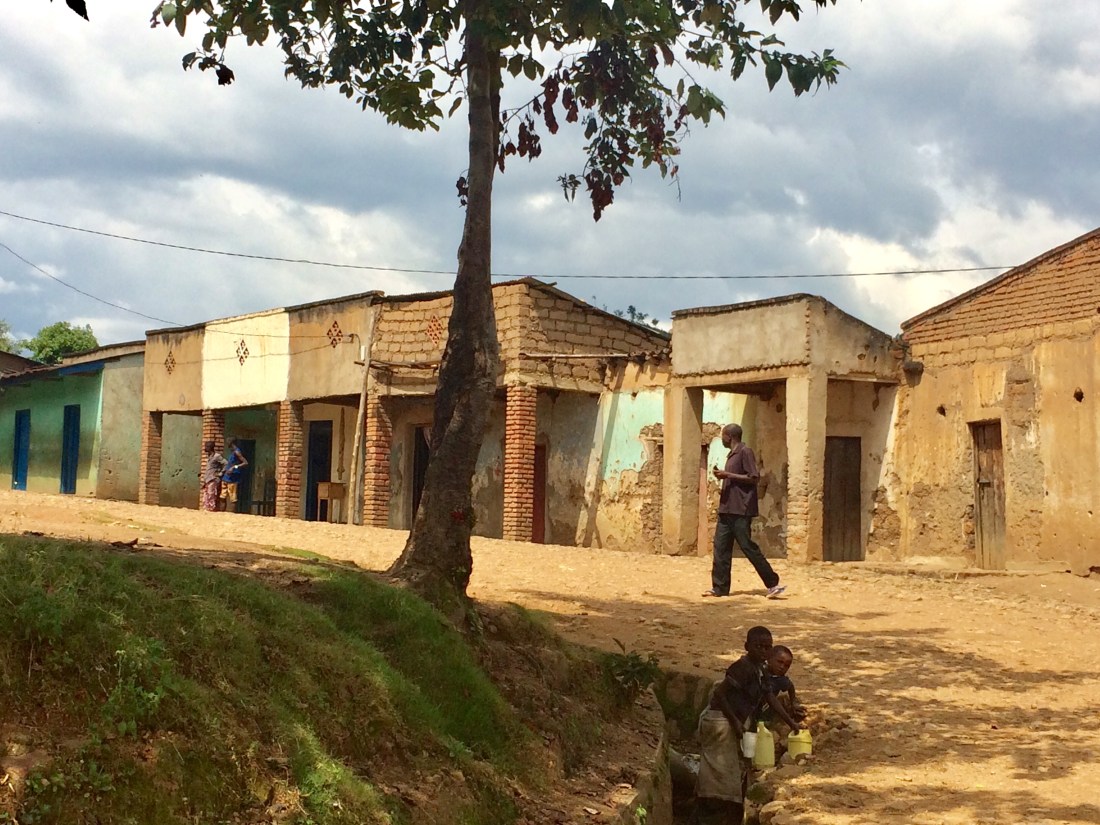
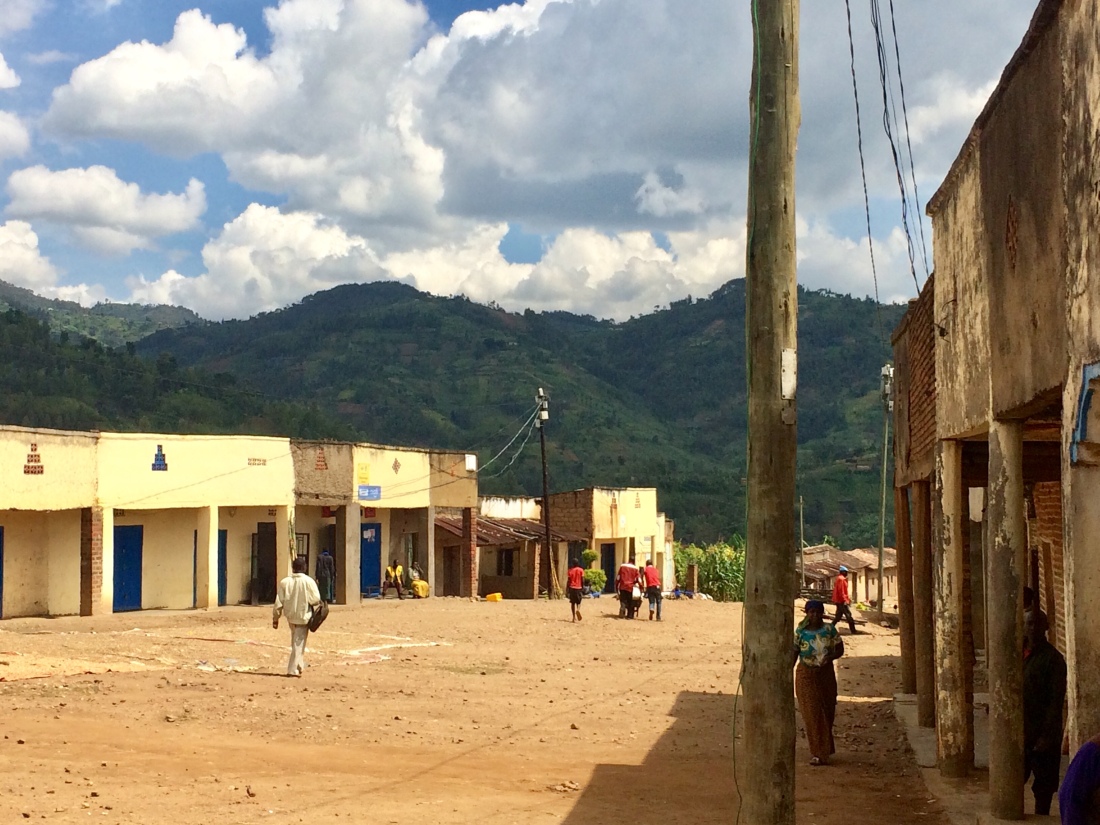
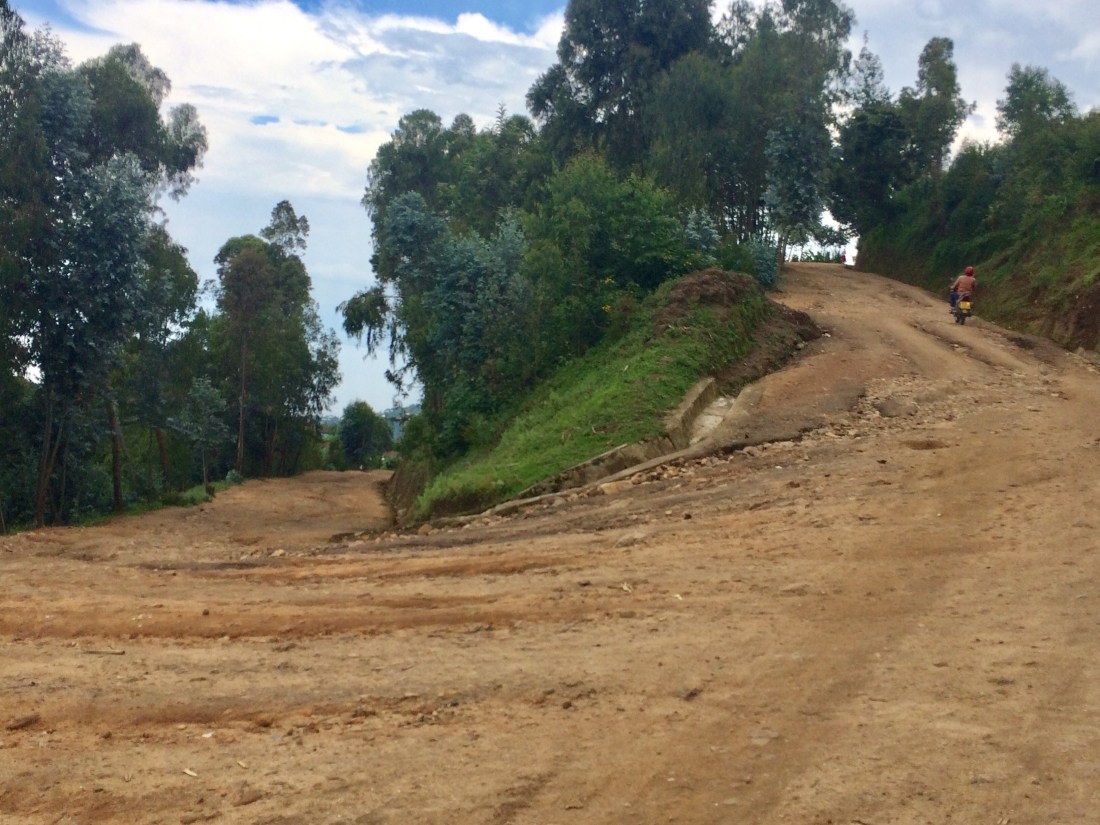
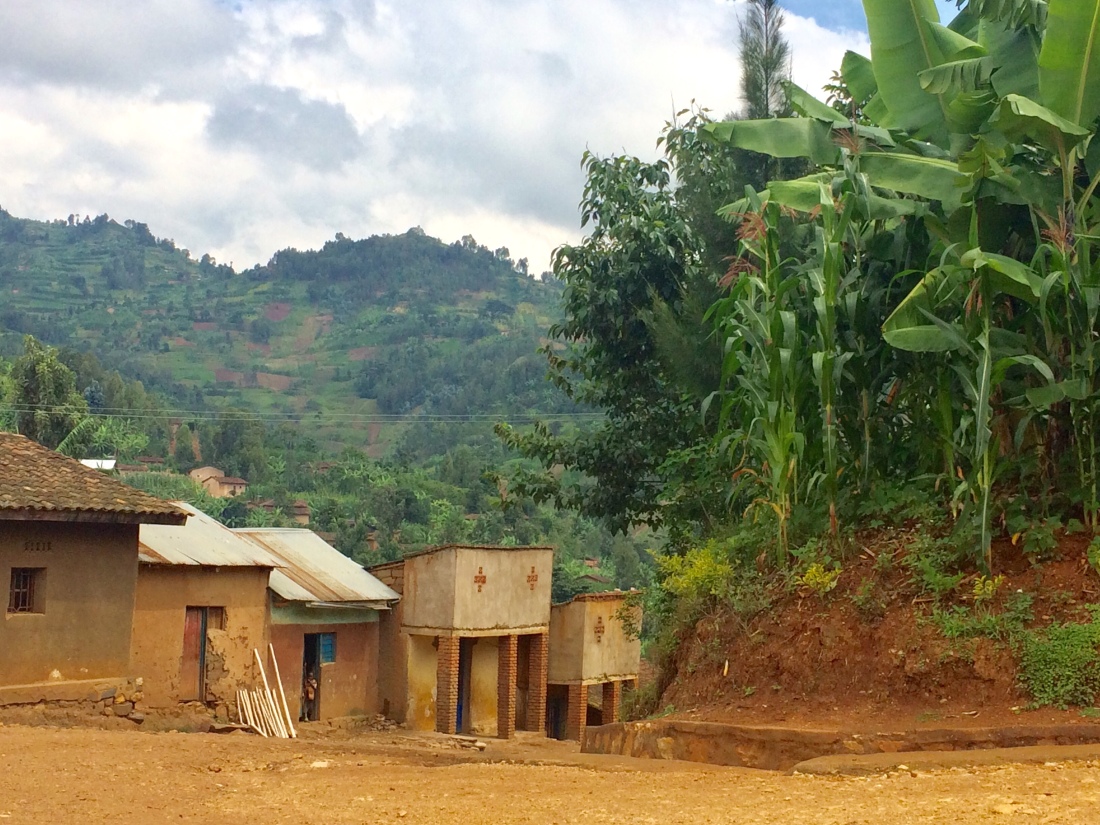


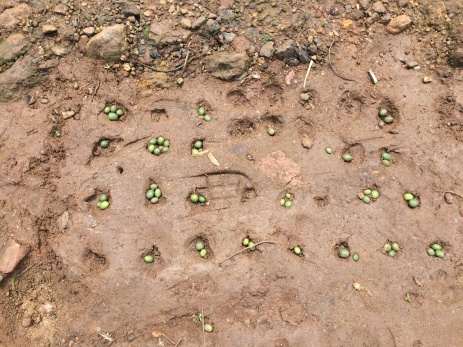
Several times during our days on the trail, we came across holes in the road filled with beans, which is the traditional Rwandan game of igisoro, which is a mathematically challenging board game played by two players, normally in a piece of wood with 32 holes chiseled out for holding the seeds or beans. I have seen the game played with such speed that it’s dizzying to watch and impossible to keep up with the math. Here, I assume that enterprising children made their own game in the middle of the quiet road.
We were never alone. Often, children walked alongside or behind us, saying, “Goot morning” no matter what time of the day it was and asking for “amafaranga.” Even the few times that we thought we were alone, we looked around and saw someone staring at us from the hillside. In one village, we were surprised that the children did not ask for money or stick to us like glue; instead, they yelled, “Hello,” and we said, “Hello” back. That went on, back and forth, for some time and more and more kids joined in, mostly invisible to us; it was quite enjoyable. It kept on even after we could no longer see any kids, though we could still hear them calling from the hills and the bushes on the sides of the road and we kept responding until the “hellos” became so weak we could barely hear them.
Some children asked for “icupa” or “agacupa,” which mean bottle or little bottle. So, when we finished a water bottle, we always gave it to a child. The children were always excited to get our water bottles. Kids also asked for food or said they were hungry. In Rwanda, it’s rude to eat in front of someone else without sharing. However, if we gave something to one or two kids, magically a dozen more appeared out of nowhere with their hands out.
We were so relieved to finally see a sign for the village of Cyimbari.


However, the Cyimbari Guesthouse was at least an hour’s walk further, past a waterfall, then a left turn at the sign for the base camp (where nothing is) and at least a mile downhill through fields of coffee beans, the school and then through the red metal gate. 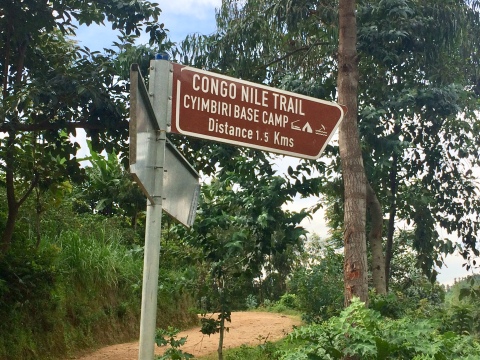 The guesthouse is Baptist-run, so there is no alcohol. However, guests can order beer and the guesthouse will have it delivered. We ordered two Fantas and a large bottle of water. Our congenial host, Christian, spoke excellent English and could not have been nicer. He welcomed us wholeheartedly, turned on the hot water heater for our baths and made us hot tea. The guesthouse, which felt like a B & B, is adjacent to a large coffee plantation. The guesthouse has a large veranda perfect for relaxing that faces Lake Kivu and is just steps from its shore. Thus, the views were stunning. It is a serene and peaceful setting.
Béné and I shared a clean and neat room with two comfy twin beds, each with a mosquito net.
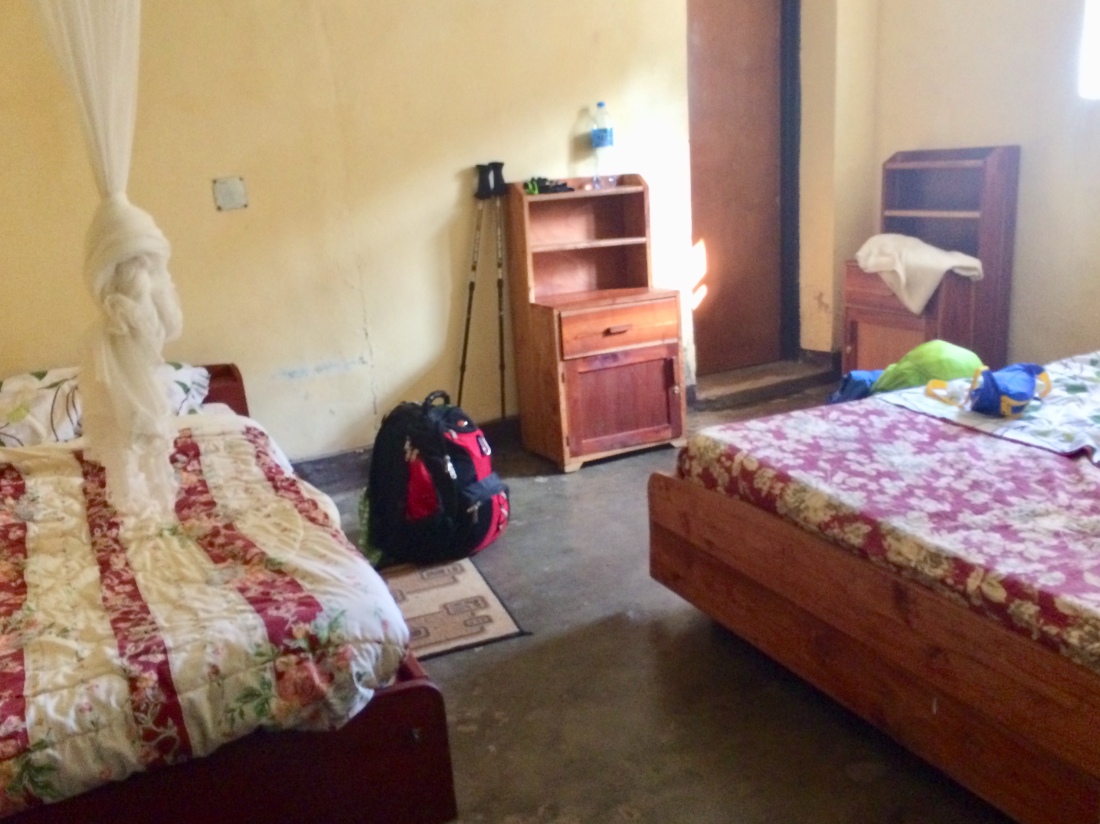 True to the Rwandan custom, there was a pair of flip-flops for each of us under our beds and towels on our beds. And, we had a private bath and places to charge our phones. The house had been built by an American missionary, who picked a gorgeous location.
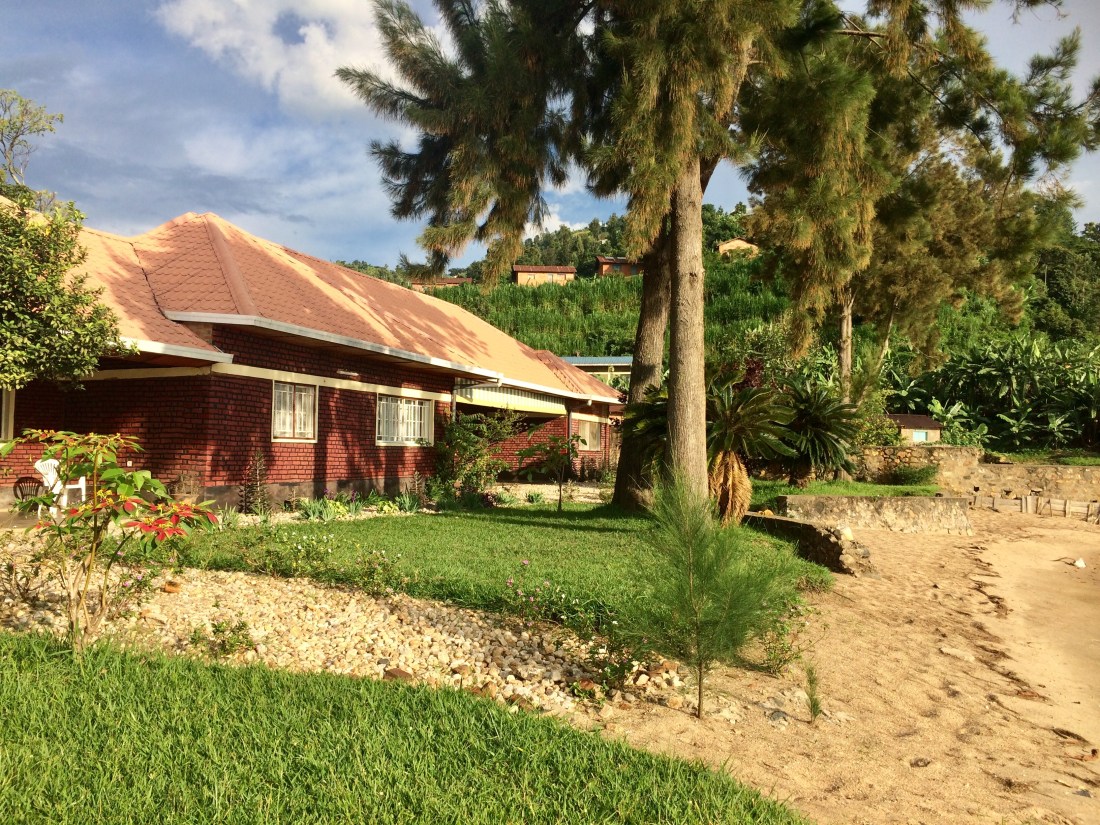
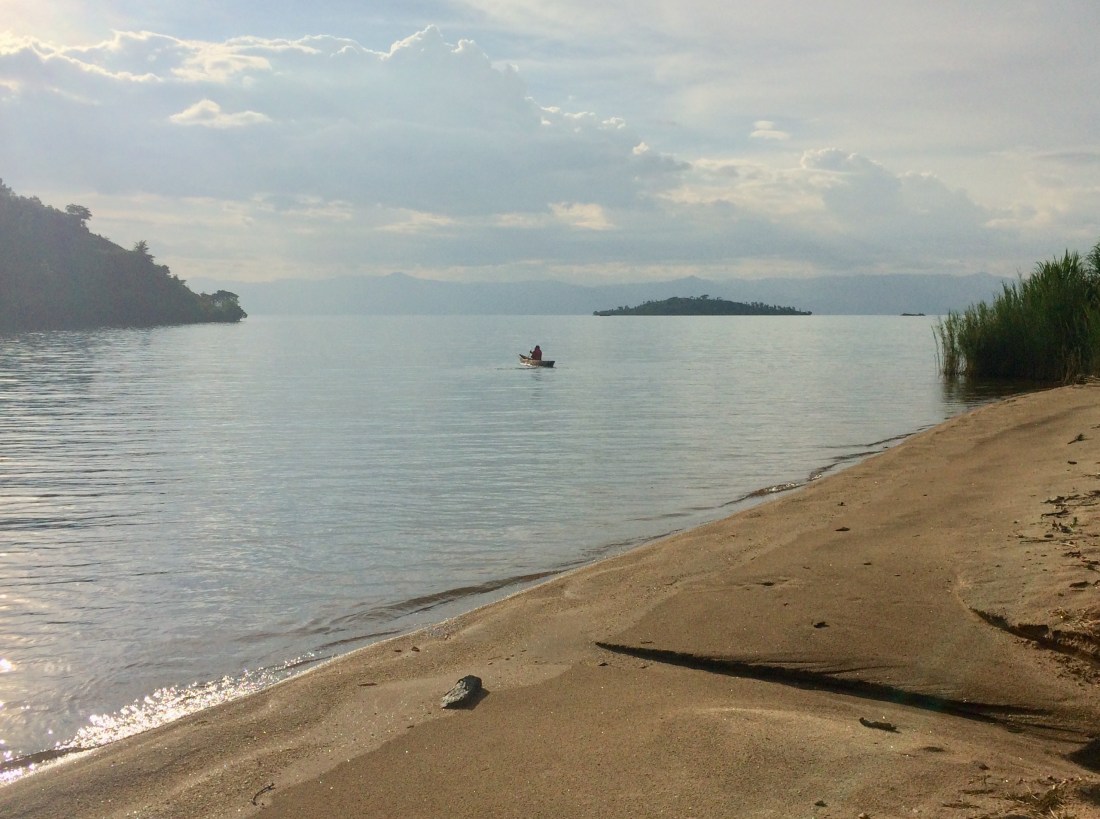
Our room cost 15,000 francs (about $17) for the two of us. Our dinner of dodo (similar to creamed spinach), beans, sambaza fish and tomato sauce, white rice and french fries, with bananas for dessert, was 5,000 francs (less than $6) per person. A vegetarian option was also available. Our hearty breakfast was 2,000 francs (about $2.30) per person. We had omelettes, lots of bread with jam and margarine, pineapple chunks and our choice of tea, hot milk or Cyimbiri Estate Coffee. Of course, we chose the locally grown coffee, which was delicious. Our Fantas were 500 francs (less than 60 cents) each, and the large bottle of water 600 francs (less than 70 cents). Be sure to call in advance so that the guesthouse can get your room and dinner ready.

 Ruminations from Rwanda
What an interesting and beautiful trip! Really looking forward to seeing and hearing more.
LikeLike
Loving this story 😁
LikeLike
Absolutely fascinating. Pat, you are so brave!
LikeLike
You are so brave and the country so beautiful. What an adventure!
LikeLike
Barry and I are so happy you are Sharing your great adventure with us! You write beautifully. We look forward to the “rest of the story”. Tess
LikeLike
Is the Nile River drying?
LikeLike
I am finally reading your account of our travels. How cool to see all the pictures and recall things as I read. Thanks for posting!!
LikeLike