

In 2018, when I was selected by Peace Corps to come to Rwanda as a volunteer teacher, I had no idea what to bring and what not to bring. Because we were limited to two suitcases and a carry-on, it was essential to be selective about what we packed. I scoured the internet for advice and was very thankful for the little advice I found. So I am adding to that advice based on my experience since I’ve been living in a town in Rwanda for ten months. I’ve also added information about food. Here are my suggestions and comments in no particular order.
Things to Definitely Bring (Or At Least Think About Bringing) to Rwanda
- Extra charger cables for phone & tablets. I picked up a cheap one at CVS before I left that has 2 interchangeable plugs, one for an iPhone and the other for other phones. Many of my staff members borrow it from me to charge their phones. You can plug the cables into your computer or an adapter with a USB connection to charge your phone. I keep one charger at home and one in the office.
- A note on electricity: All of the Peace Corps Response Volunteers that I’ve known have had electricity in their homes. Most, but not all, of the 2-year Peace Corps Volunteers also have electricity. For those who have electricity, the electricity is fairly reliable, but it does frequently go off.
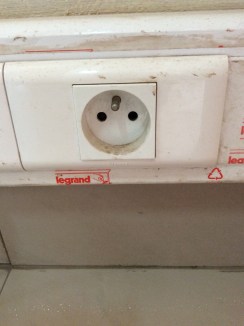 In my town, the electricity goes off several times a day, which is quite annoying if one is teaching and relying on electricity for, say, an overhead projector. Fortunately, my school has a generator that kicks in soon after the power goes out. But many places are not so lucky. So, if you bring electrical appliances with you, you will most likely be able to use them. However, you will need an adapter to Rwandan plugs, but adaptors are easy to buy here.
 - Portable charger (My iPhone can’t hold a charge all day. When I travel to Kigali, the capital, my phone is dead before I return, which is annoying. I’ve met other volunteers with portable chargers so that they don’t have that problem).
- Jeans (everyone here wears them).
- Hiking pants, if you hike. They are also good for rain, which there is a lot of here. I brought one pair & wish I had packed another.
- Hiking boots or shoes. You will be doing a lot of walking and possibly hiking. The hiking here is fabulous because of the many paths and hills. The Congo-Nile Trail is a 142 mile hiking trail that runs along Lake Kivu in the Western Province. One can hike the whole trail or just parts of it.
- Belt – if you have a favorite, bring it. (Most volunteers initially lose weight here. But note that belts are sold in most markets.)
- Extra pair of eyeglasses
- Warm pajamas. (the nights during the long rainy season starting in February can be cold depending where you live – especially in the mountains outside of Kigali and in the north.) I live in the Southern Province and found the nights very cold when I first arrived in February of 2018.
- Lightweight pajamas for most of the year.
- Lightweight robe – I wear mine every morning.
- Bras for women. (They are available in all the markets here, but you might not be able to find a good fit or may feel weird buying one with everyone staring at you.)
- Swimsuit (A number of hotels in Rwanda, even outside of Kigali, have swimming pools. Usually, the cost of using the pool for an afternoon is just over $1. Huye, a fun city in the Southern Province, has three pools that I know of: two hotel pools and a public pool, all very nice pools where one can get food & drinks as well as swim. The town of Nyanza also has a hotel with a large pool.)
- Shorts – if you run. But note that wearing shorts is generally frowned on for both men and women, so knee-length shorts are preferable, even for running the Kigali Peace Marathon or Half-Marathon in May.
- Sweaters – especially turtlenecks. I only brought 2 lightweight turtlenecks, which I often wore to work during the long rainy season, but I wish I’d brought more.
- Rain jacket with hood (It rains a lot in Rwanda. I bought a very lightweight Patagonia rain jacket that packs into its own pouch so that I can carry it wherever I go).
- Raincoat with hood (I wear this to & from school many days during the long rainy season to keep dry.)
- Hangers for skirts or pants.
- If you think you will be buying a bike (Peace Corps no longer provides), bring bike gloves & rubber bands to put on your pants to keep them out of the derailleur.
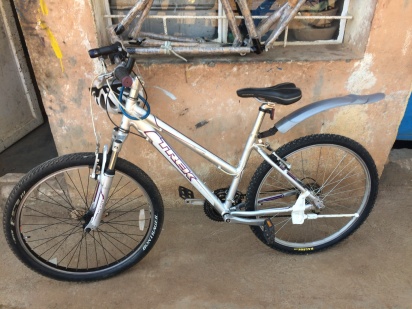 Peace Corps will give you a helmet, but you may want to bring your own. Also, a bike jersey with pockets in the back would be nice.
 - Vitamins & supplements (Peace Corps gives only pink prenatal vitamins, whether you are male or female).
- Baseball cap – (they are available here, but not as nice as the one you probably already have. I was hoping to find one that said “Rwanda,” but no such luck. Although there are many caps in the market, I couldn’t find one that fit right. You will need a cap or hat for Umuganda to keep off the sun.
- Work gloves (Bring a sturdy pair. You will need them for Umuganda, the monthly community work day.)
- Work pants (jeans or old pants for Umuganda)
- Laptop (I brought a 17” laptop, thinking that the larger screen would be useful for teaching a small class. I have used it a lot for showing videos or Powe to a small group of students.)
- Earbuds (though you can get headsets here).
- Speaker for your tablet or laptop (I bought speakers in Kigali, but they are much larger than I wanted.)
- Good sandals. I brought Tevas & am really glad I did, as I hike in them & wear them as casual shoes. That said, sandals are available in the markets here, so if you don’t have room or forget them, you can find sandals here, just not your favorite brand. Note that Rwandan women prefer fancy sandals, which you will be able to find in almost any Rwandan market. I don’t advise wearing sandals at night because of the mosquitoes, but wearing socks helps.
- English/Kinyarwanda dictionary – Several are available on Amazon. I bought one by A.H. Zemback that I found helpful. There is also a free on-line dictionary at Kinyarwanda.net. Being able to speak some Kinyarwanda is critically important here, especially outside of Kigali.
- Small sewing kit. (However, if you forget it like I did, you can take your clothes needing mending to one of the many tailors or seamstresses in the market, who will gladly fix it for likely less than $1.)
- Books – Books are heavy so think carefully about whether you really need them before packing. Many books are now available as e-books, eliminating the need to pack books. If a book that you will need for your job in Rwanda is not available as an e-book and is heavy, pack it in your carry-on. Children’s books are a rarity here.
- DVDs that may be fun and educational to show your students.
- Coffee filters. They are hard to find here. Some volunteers make their own. Coffee snob that I used to be, I brought a French Press with me so don’t need filters.
Things I wish I had brought but didn’t
- Bike jersey (to wear when riding my bike).
- Running shorts – I wish I had brought a pair of running shorts to wear over my swimsuit for extra modesty.
- Binoculars (for looking at birds, bats, trees, monkeys, etc.)
- Really good camera (instead of my iPhone 5)
- Ear plugs (I have a colony of bats in my yard that wakes me up at 4:00 a.m. every day. Also, the blaring radios on the local buses can be deafening.)
- Large & small safety pins (Needed to tighten the waistband of my pants when I lost weight when I first arrived.)
- Paper clips (large & small, especially those cool colored ones). I’ve finally been able to get some paper clips from my school. They are also available in office supply stores here.
- Stapler
- Pen refills. The only pens available in most places are BIC (blue or red), which work just fine. If you bring a pen that can be refilled, bring the refills, too.
- Rubber bands (sturdy ones)
- Thumb or Flash drives (They are simply called Flash here)– bring several. They are available here, but not easy to find in smaller towns & villages. In six months, I bought two 16 GB flash drives here. Many of the school staff & teachers borrow mine (they always return it), so it’s good to have extras. They are so small, why not load up on several? When you leave Peace Corps, you can put all of the teaching materials you’ve created on a flash drive and leave it with your school.
- A second pair of hiking pants
- A baseball-style cap.
- A hair dryer, but I found one at a store in Kigali, the capital city, for about $12. It’s not as powerful as I’d like, but it works.
- Wrapping paper and ribbon for gift wrapping. You will be attending a lot of weddings in Rwanda and giving presents for newborns. Gift wrapping paper is hard to find (though the colorful gift bags are available in every market). There are many professional gift wrappers, but they are expensive and time-consuming. Paper and ribbon are lightweight and don’t take up much space in luggage.
- Birthday, wedding and new baby cards. The card selections here are awful. They are mostly from China, mostly in French. If in English, they often have misspelled words. Cards are easy enough to pack, bring a handful.
Things I brought but didn’t need and never used
- Skirts or dress – I never wear them. (If you want a skirt or dress, you can easily have one made out of the beautiful fabric available in most markets. Besides, bare white legs here stand out and are not very attractive.Fabric displayed for sale in the Huye market
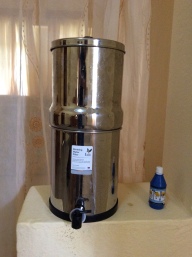
- Water filter, iodine for purifying water or a water bottle (No need for any of those items because bottled water is available everywhere. Also, Peace Corps provides volunteers a large water filter for use at home.)
- Yoga pants – I’ve never seen yoga anywhere in Rwanda, though there may be some in Kigali. Anywhere else, forget it.
Things one can easily buy here
- Plug adaptor (Rwanda uses the European 2-pronged plug, different from U.S. plugs.)
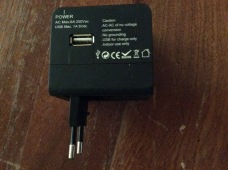 If you bring an adaptor, be sure it can switch between “UK” and “USA” to “Europe.” Some of the appliances that you buy here (like the iron I bought) might have a UK (3 prong) plug; thus, you would need an adaptor that can switch from the UK plug to a European 2-prong plug (different from USA 2-prong plugs). I purchased two adaptors in Kigali and keep one at home and one at school. The adaptor I bought also has a handy USB port for charging phones.
 - Cheap Sunglasses
- Scissors
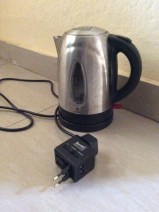
- Electric kettle (more like a pitcher) for boiling water.
- Stove-top for cooking and propane tanks
- Small college dorm sized fridge – a few volunteers have purchased this in Kigali. Almost all volunteers easily survive without.
- Mosquito coils & plug-in mosquito repellents
- Cleaning supplies
- Vinegar
- Bleach
- Hydrogen peroxide
- Bottled water – it’s everywhere
- Umbrellas, including collapsible ones.
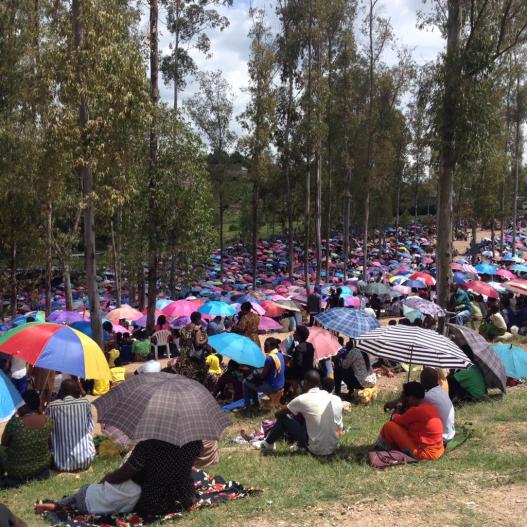
A sea of colorful umbrellas at an outdoor church service. Photo courtesy of Bene Naudin. - Tupperware-type containers for food storage. (I store all my food in them to keep the ants and other critters away.)
- Cookware and kitchenware – T-2000, the humongous Chinese-owned department store in the center of Kigali, has everything Chinese, even cheap French presses. It’s the closest thing to Costco here, but without the free food.
- Headphones for computer or laptop
- Belts – You will lose weight initially here & need a belt for your pants, even if you normally don’t wear a belt.
- Flip-flops, but may not be as good quality and comfy as ones you buy in the U.S.
- Sandals
- Shoes – Rwandans are crazy about wearing neat, clean and proper shoes. Fortunately, shoes are available in just about every market, and there is a Bata Shoe Store in Kigali.
- Shoelaces
- Socks – New and second-hand available in most markets.
- Shoe repair (I’ve already had two pairs of my American shoes repaired in my local market.)
- Dry cleaning (Dry cleaning is available in cities and some towns. Professional men and women are expected to wear suits to work, so dry cleaning is a necessity for some.)
- Rat traps (available in the markets here.)
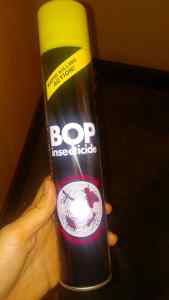
- BOP – The Rwandan equivalent of Raid. BOP is sold in most shops.
- Creams & lotions (Every market has a wide variety of interesting creams & lotions).
- Soap & shampoo – in Kigali, you can find many of the major brands (Dove, Pert, Pantene & a few other name brands). A popular brand here is Geisha soap. You can also buy liquid hand soap in various colors. In towns and villages, you probably won’t find any shampoo you are used to, but you can stock up while in a city.
- Dish soap – I found green liquid dish soap in Kigali, but most Rwandans use a soap paste called Axion that works just fine.
- Laundry soap. There are 3 main brands of powdered soap: Omo, Nomi and Sunlight.
- Clothes pins (plastic)
- Coat hangers (but not skirt or pants hangers).
- Iron
- Bedding: Pillows, sheets and light comforters and light blankets can be bought in Kigali and most towns in the market.
- Toothpaste – Colgate (large or travel size) is available everywhere. In Kigali and Huye, I’ve seen Sensodyne & Aquafresh.
- Toothbrushes
- Portable radios (I bought mine in my town. It cost the equivalent of about $11 & can use either electricity or batteries.)
- Bike lock.
- Batteries of most sizes.
- Paper – printer paper, notebooks.
- Pens – but only blue and red BIC.
- Small plastic pencil sharpeners
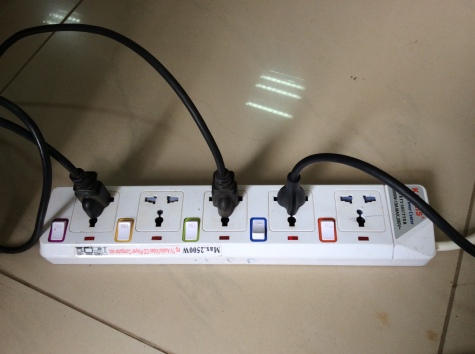
- Electricity – Power strips with built in adaptors are available in cities and towns. My laptop is plugged in below on the right.
Things Peace Corps provides many items, most of which I’ve noted below:
- Band-Aids
- Tweezers
- Dental floss (but not the Glide type)
- Eye drops (I needed these in the dry season)
- Nasal spray
- Nasal decongestant
- Oral dehydration salts
- Tylenol
- Ibuprofen
- Zithromax
- Anti-diarrhea tablets
- Antacid tablets
- Antihistamine pills
- Malaria pills
- Mosquito Bed Net
- Prenatal vitamins (for male and female volunteers)
- Pills for travel sickness
- Triple antibiotic cream
- Anti-itch ointment
- Rubber gloves
- Gauze pads
- Ace bandage
- Chap stick
- Antiseptic hand wash
- Sunscreen
- Antiseptic liquid soap.
- Condoms
- Insect repellent (rub-on)
- Large Water Filter
- Bike helmet (but if you have one you love from home & intend to have a bike, think about packing it, as a helmet is light & doesn’t take up a lot of space)
- Whistle
Food
- Vegetarians can easily survive here. Tofu is not difficult to find because the Seventh Day Adventist religion is big here, and Seventh Day Adventists are vegetarians. In cities and towns, there is usually a Seventh Day Adventist who sells tofu. Widely available are eggs (omelets and hard-boiled eggs) and dairy products like milk, milk tea, yogurt and kefir (fermented milk, which is called ikivuguto). Eating yogurt or drinking ikivuguto is an easy way to add good bacteria to one’s gut. Ikivuguto is close to sacred in Rwanda. Standing while drinking ikivuguto is considered bad manners, as one should properly be seated while drinking ikivuguto. I have noticed of few of Rwanda’s younger generation standing while sipping their ikivuguto, and, when I mention how traditionally people had to be seated to drink ikivuguto, they give me a sheepish look as they quickly sit down.
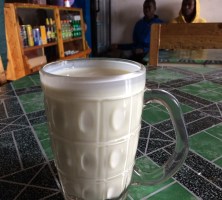
My evening cup of liquid yogurt at my favorite shop. Rwanda’s oral, and later written, history, highlights the importance of ikivuguto. Rwanda’s first king, Gihanda, was suffering from dysentery. His daughter, Nyiraruucyaba, who was living in the forest with her hunter husband, had a cow. Nyiraruucyaba gave her father, King Gihanda, some ikyvuguto, and he quickly recovered. After that, King Gihanda recognized the importance of cows and soon had his own.
- Ghee is also available here, but hard to find outside of Kigali. One can purchase powdered milk or liquid milk in a large juice box style container in the many small stores. Beans are widely eaten for protein. That said, a vegetarian volunteer I knew lost a great deal of weight here.
- Those suffering from Celiac Disease and others who need or want to be wheat-free may find it very difficult here. Breads,
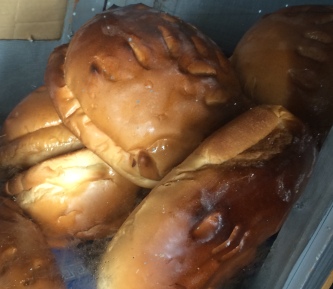 bread-like cakes, donuts that are in the shape of a ball called amandazi, chapatis and samosas (spicy little meat-filled deep-fried pies) are sold everywhere. Also, in every shop are various types of packaged wheat biscuits. It is possible to be wheat-free, but difficult; one must really work at it. Quaker oats are available in the cities. I knew a wheat-free volunteer who ate a lot of peanut butter. But peanut butter is not widely available here, as it is in West Africa. I’ve only seen jarred peanut butter in the cities. Small peanuts called ubunyobwa are widely available in Rwanda and a great snack.
 - Diabetics – a friend is a diabetic volunteer. Despite eating lots of fruits, candy and baked goods made with wheat, she says her numbers are lower than ever since she was diagnosed as a diabetic. However, she continues on her medicine.
- Fruit is available in all the markets. Bananas (large and fingerlings), passionfruit (amatunda), tree tomatoes (also known as Japanese plums), pineapples (inyayansi), watermelon, oranges (amacunga), mandarins (mandarina)(seasonal, & the season ended in November), avocados (avoca), papaya (ipapayi) and mangoes (imyembe).
- Vegetables – carrots, tomatoes, onions, garlic, cucumbers, green peppers, cabbage (usually sautéed), eggplant (The most common is a very small yellow eggplant that is often mixed with beans or a sautéed green vegetable.
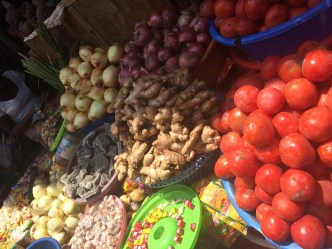 The large black eggplants are here but rarer). Green leafy vegetables are not eaten raw, but instead sautéed similar to creamed spinach. It is rare to find cauliflower and rarer to find broccoli. I have only seen broccoli once in the market in my town. I have never seen kale or lettuce. A wider variety of vegetables is available in Kigali. In hotels, the salad is usually avocado, shredded carrots, chopped cucumbers, chopped tomatoes and sliced white onions. Sometimes a chopped hard-boiled egg is added. The standard measuring weight for purchasing fruits or vegetables is one kilo.
 - Starches – Potatoes, potatoes, potatoes. Cooked every way you can imagine, except mashed and scalloped.
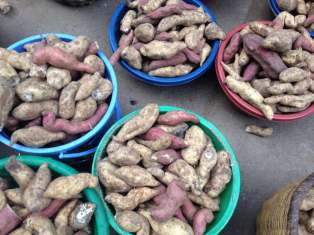 Potato chips are available in stores in many towns. Also, plantain (but smaller than the West African variety), cassava, rice, breads, green beans, peas, and red beans that are the size and color of kidney beans.
 - Meat, poultry & fish – Beef, chicken, goat and fish (tilapia and some small fish that I haven’t been able to identify) are widely available. Pork is available but only in some places. Brochettes are quite popular – mostly goat, but also beef and fish.
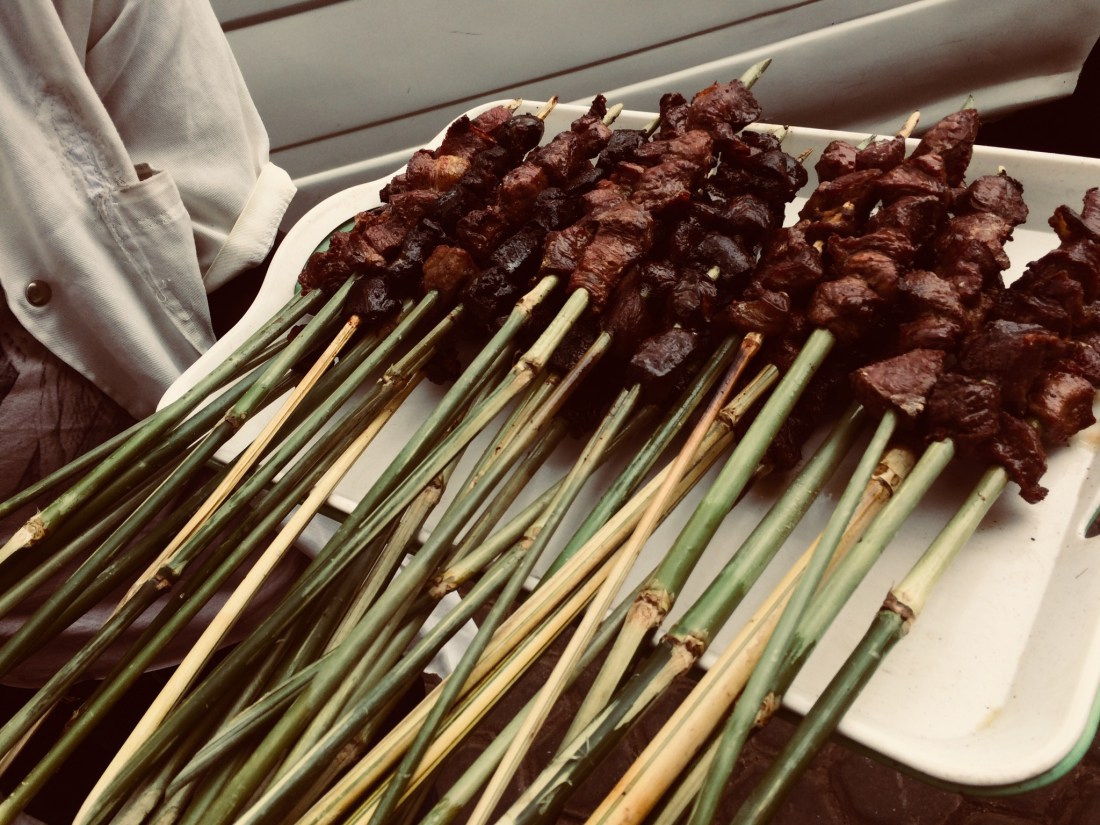 In cities and some towns at a hotel, it’s possible to get a hamburger; the taste and texture are different from American burgers, but still a treat. Canned sardines are available in most shops.
 - Condiments: Ketchup and mayo are widely available. Mayo is popular on French fries. Akabanga – meaning “little secret” – is a very spicy liquid red pepper that many Rwandans adore and a few others despise. It is usually on every table. Margarine is also widely available, and I’ve seen fruit jam in a few places. Rwandan honey is sold in many shops. Sugar (turbinado or white) is sold in every market.
-
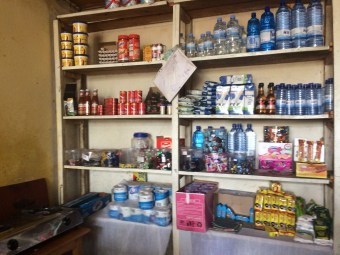
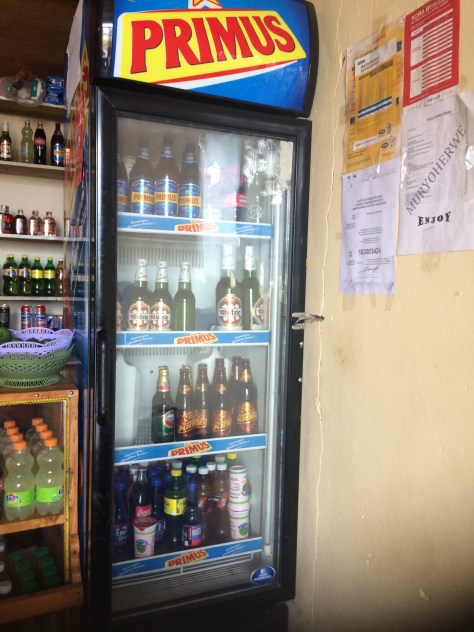
Typical store shelves. To the left is the stove top, where they boil tea, make omelets etc. The middle shelves contain candy. The bottom right yellow, blue and pink packages are wheat biscuits. - Cold drinks: Bottled water is ubiquitous. So are Fanta (orange, citron or grape), coke and beer bottled in Rwanda (Heineken, Amstel, Primus, Mutzig, Gatanu and Turbo King). Canned beers are also available, but less popular than bottles. There is a non-alcoholic canned beer called Bavaria. Energy drinks are popular, especially Red Bull.
- Fruit juices: The most popular are mango, passion fruit, pineapple and apple. They have added sugar. Some restaurants offer fresh-squeezed fruit juices.
- Other Alcohol – Hard liquor is displayed in many stores.
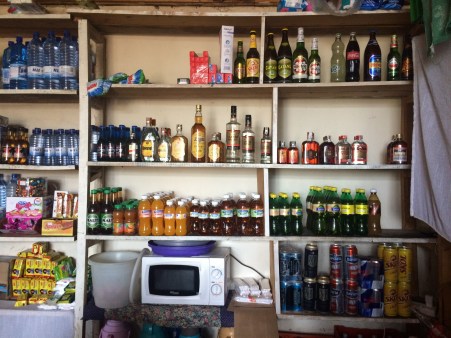
Typical store shelf. Note beer on top and bottom shelf. Hard liquor on second shelf. The bottom shelf contains the only microwave I’ve ever seen in Rwanda. However, the proprietors never use it because the customers don’t like it and it makes the food too hot. Vodka is popular. A very few stores even sell wine boxes for about 22,000 francs (about $25).
- Hot beverages – The main choices in restaurants are: mukara (which is a spicy, sugary black tea), African tea (which is a milky, spicy, sugary black tea that is also called icyayi) and instant coffee (Nescafe from South Africa).
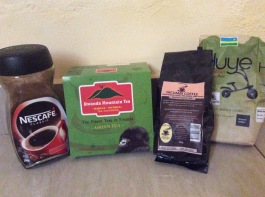 Nescafe is available in most small shops. If you want to brew your own coffee, the small stores in most towns sell ground Rwandan coffee, but I’ve only seen whole bean Rwandan coffee in Kigali or the coffee plantations that give tours. Rwandan black tea and green tea is widely available in large boxes of tea bags. One can also purchase black leaf tea. Herbal teas are available only in Kigali.
- Kirida – Toothpicks are on every table. Kirida comes from the French word for toothpick: cure-dent, pronounced as only the French pronounce words and then turned into a Kinyarwanda word. After every meal, Rwandans fastidiously clean their teeth with kirida. It’s a habit that I quickly picked up.


This is a useful guide. Anyone could travel to Rwanda with this detailed help. Are you planning to stay longer than February? You are really missed here. Do enjoy while you are there, Rosanna
>
LikeLike
Excellent post! This will help a lot of people plan their trip.
LikeLike