
Because I have never smoked, I don’t now think much about smoking – and that is despite the impact that smoking has had on my life. Smoking killed my father at an early age. Second-hand smoke from my father’s addiction to Camels likely diminished my lung capacity and perhaps caused my mother’s lung cancer. My ex-husband’s mother’s smoking probably caused his lifelong asthma and COPD problems, of which he recently died – despite being a non-smoker. His mother’s lifelong smoking caused her own slow and agonizing death, which I witnessed firsthand. Smoking killed his dad in his mid-forties. And, my oldest son is addicted to smoking (albeit e-cigarettes now), despite my encouragement to quit.
However, last night I began to think again about smoking. My 30-ish American friend and I were sitting at an outdoor table in a hotel bar, having a drink. For some people, having a drink and having a cigarette go hand in hand. And, so, my friend excused herself to go to a nearby shop to buy cigarettes.
While waiting for her return, I thought about smoking in Rwanda. To smoke in Kinyarwanda, Rwanda’s language, is “kunywa itabi,” which literally means to drink tobacco. (Because cigarettes were introduced by Europeans, Rwandans lacked a word for smoking, and the act of smoking a cigarette seemed like drinking it.) My experience was that very few Rwandans smoke. In fact, I’ve never seen a Rwandan actually smoking. But then I don’t frequent the many bars and night spots of the capital city where I would imagine that smoking is more common. 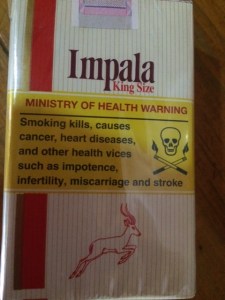 In my town, however, several times a week, I have seen a few Rwandan men (never a woman) come into my favorite little shop to purchase one or two Impala brand cigarettes for 50 francs (about 6 cents) each and then leave with the cigarette or two in hand.
However, my google search found a March 31, 2017 article of the Rwandan on-line media outlet “Kigali Today” with more specifics about smoking in Rwanda. According to that article, a Rwandan government survey concluded that 12.8% of Rwandans between 15 and 59 years old had used tobacco products. Of those users, ten per cent were men and two per cent women.
Although I have heard that some tobacco is grown in Rwanda, I’ve never seen it. Instead, the main cash crops are tea and coffee; large tea and coffee plantations exist here. And, Rwandans, being amazing farmers, grow beans, peas, cassava and other food crops for their own consumption on every piece of bare land  (including this narrow strip of land sown with bean seeds next to my house) that they can find.
When my friend returned, I was surprised that she had an entire pack of cigarettes, because I’ve never seen anyone in Rwanda with an entire pack. Her pack cost 1,000 francs, which is about $1.14. The cigarettes in that pack were manufactured by TabaRwanda, 70% of which is owned by the British American Tobacco Company, Ltd., according to an 8 Oct. 2001 article in the Ugandan Monitor. The cigarettes are manufactured in Kenya.
The brand name on the pack was “Intore,” which every Rwandan knows were traditional bare-chested, spear-wielding, intensely energetic male warrior dancers. They still perform at public events and are exciting to watch. Their waist-length, flowing blonde wigs made from a special tree are meant to resemble the mane of a lion – yet another symbol of masculinity.  The streaming gold lion manes make a spectacular sight as the dancers jump and whirl frenetically to the sound of drums and the bells on their ankles. The effect is electrifying and one cannot help but feel the dancers’ raw, masculine energy. Thus, I assumed that by calling the cigarettes “Intore,” the tobacco company hoped to evoke that same intense male energy and excitement in potential purchasers and to subliminally connect that feeling of masculinity to smoking.
I examined the warning label on the cigarette package my friend had just purchased; it is different from the one on American cigarettes, which is usually “Smoking Causes Lung Cancer, Heart Disease, Emphysema, And May Complicate Pregnancy.” 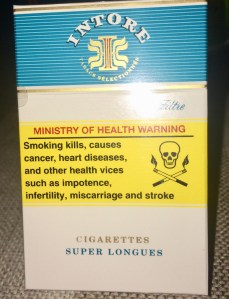 In contrast, the Rwandan warning (one side English and one side Kinyarwanda) is more vivid and appears next to a skull and crossbones made up of 2 lit cigarettes. It reads: “Smoking kills, causes cancer, heart diseases, and other health vices such as impotence, infertility, miscarriage and stroke.”
Impotence? I found the addition of impotence interesting – especially since impotency is the polar opposite of the image of the young and hyper-masculine Intore dancers conjured up by the cigarettes’ name. And, I wondered if seeing the impotency warning would reduce men’s desire to smoke or cause men to quit. I also wondered why the U.S. did not require that warning and whether any other country required a similar warning. It turns out that America’s friend to the north, Canada, includes an even more eye-catching warning: a picture of a bent, flaccid cigarette next to an impotency warning that does not mince words. 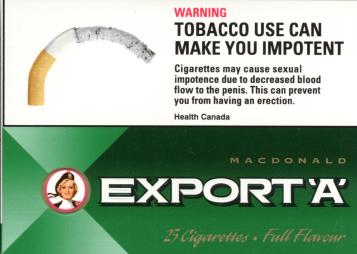
Back to the United States, I found that the government’s attempts to require more specific and graphic warnings have been met with lawsuits. In 2009, the U.S. Congress passed the Family Smoking Prevention and Tobacco Control Act, a law giving the Food and Drug Administration (FDA) power to impose new cigarette warnings. About two years later, in 2011, the FDA devised new warning labels that would have required more graphic text and images on cigarette cartons. However, none of the new warnings included any mention of impotency. Still, the tobacco companies were unhappy and sued the FDA, claiming that the warnings violated their First Amendment rights because they went beyond providing information and required the tobacco companies to advocate against smoking. One appellate court agreed with the tobacco companies that the law was unconstitutional, but another appellate court reached the opposite conclusion, while deciding that a few of the FDA’s requirements went too far. In 2013, the United States Supreme Court refused to break the tie, when it declined to hear the appeal. Therefore, the FDA was forced back to the drawing board to come up with new warnings, which they have not been in any hurry to do. According to the FDA’s website, the “FDA has been undertaking research related to graphic health warnings since” 2013. Notably, there is no indication that the FDA is considering adding an impotency warning.
So, if you want to know the truth about smoking’s effects on your sex life, you’ll have to travel to Canada or Rwanda. And, in Rwanda, if you buy Intore cigarettes, you’ll be conflicted, as you are warned about potential impotency while presented with a brand name that symbolizes hyper-masculinity. It made me recall the ubiquitous rugged Marlboro man in American smoking advertisements, and I wondered how, after decades of smoking, the alpha-male Marlboro man dealt with his impotency.
 Ruminations from Rwanda
Thank you Pat, Very interesting, informative and amusing! I love the cigarette on the Canada package warning.
LikeLike
Wow. This was great as all your report!
LikeLike
Fascinating. Nicotine constricts blood vessels, leading to “health vices”. Now I wonder what the labels say in the EU nations.
LikeLike
I just checked. Each unit packet of tobacco products intended to be smoked must carry both a general health warning (“Smoking Kills/Smoking can kill” or “Smoking seriously harms you and others around you”) – covering at least a surface of 30-35% on the front – and one of the fourteen additional warnings set out in Annex I of the Directive covering at least a surface of 40-50% on the back. The following are the Annex I warnings that the manufacturer can choose from (& they probably never or seldom choose the last one):
‘ANNEX I
List of additional health warnings
(referred to in Article 5(2)(b))
(1) Smoking causes 9 out of 10 lung cancers
(2) Smoking causes mouth and throat cancer
(3) Smoking damages your lungs
(4) Smoking causes heart attacks
(5) Smoking causes strokes and disability
(6) Smoking clogs your arteries
(7) Smoking increases the risk of blindness
(8) Smoking damages your teeth and gums
(9) Smoking can kill your unborn child
(10) Your smoke harms your children, family and friends
(11) Smokers’ children are more likely to start smoking
(12) Quit smoking – stay alive for those close to you (1)
(13) Smoking reduces fertility
(14) Smoking increases the risk of impotence
LikeLike
Loving your interesting reads
Miss ya!
LikeLike
Hello Pat, your report is not surprising. Sadly smoking is not the only thing we ingest that is not being correctly marketed. D
On Sun, Nov 4, 2018, 08:38 Ruminations from Rwanda ruminationsfromrwanda posted: “Because I have never smoked, I don’t now > think much about smoking – and that is despite the impact that smoking has > had on my life. Smoking killed my father at an early age. Second-hand > smoke from my father’s addiction to Camels likely diminished my lung” >
LikeLike