
Weddings are important everywhere, but they are especially big in Rwanda. Every weekend, I see people happily on their way to or from weddings, dressed in finery, carrying elegantly wrapped presents. During our Peace Corps orientation, we were told that we are not part of Rwanda until we’ve attended a wedding. In June, when I was invited to a wedding to take place on August 11th, it seemed so far away, but I was glad that it would give me much needed time to make sure I did everything right for the wedding.
The wedding invitation was unexpected. It was from someone I barely knew. Indeed, at that time, I didn’t even know her name. I was working in my office one evening when a young woman entered. I recognized her as an employee of the food service company that provides meals for the school. Now and then she would be assigned to the dining hall, where I took lunch with the faculty and staff of the school. She approached me with an envelope that she handed to me. Between her limited English, my limited Kinyarwanda and the beautiful invitation, we were able to communicate. She made it clear that she would be honored by my presence at her wedding, and I, in turn, told her that I would be honored to attend.

Going to a Rwandan wedding required at least two things of me. First, to find the appropriate attire. For Rwandans, the most important thing is how one dresses. And, for weddings, women usually wear umushanana, which is the elegant Rwandan traditional dress. I would have to wear umushanana. Second, I would have to find the right present and a wedding card.
I started with the card and the present. First, the card. I searched and searched market stalls and shops in my town, but could not find any. I was resigned to making my own. However, a week before the wedding, I saw a wedding card  in a shop and immediately snapped it up. I didn’t bother reading it, because I did not care what it said; it was enough that it was a wedding card.
As for the gift, I assumed that would be an easy task; I would simply ask my friends what an appropriate present is for a wedding. I started with Olivier, who said, “Inzoga,” which means beer. I told him “I am NOT giving beer as a wedding present!! What else can I give?” “Well,” he replied, “they would be very happy to get beer as a present. But, if you don’t want to give beer, you can give Omo.” “Omo?” I inquired incredulously. “Yes,” he explained, “you would give Omo and wrap it very beautifully.” Omo is a laundry detergent, so giving Omo as a wedding present would be like giving a box of Tide with elegant wrapping paper and a beautiful bow. I was not ready to believe Olivier on this subject and so asked other people, who confirmed that “Yes, the wedding couple would be very pleased to receive Omo because it would save them from having to buy laundry detergent.” Still, I was not about to give Omo as a wedding gift. Of course, there was always money. Everyone I spoke to said that money would be an appropriate gift. When I asked how much, I got various responses, with the maximum at 5,000 francs, which is a little less than $6. Giving money would be easy, of course, but I wanted to give something memorable. But what?
Wherever I went, every shop I happened to be in, I scoured the shelves for an appropriate wedding gift. Someone had suggested a clock as a good gift. In the shops, I saw many wall clocks of different designs (some modern, some with flowers, some of bright colors, others metallic), but I was ignorant of the couple’s taste in clocks and thought, “What if someone else gives them a clock? Who would want multiple wall clocks?” So I gave up on the clock idea and one Saturday wandered around the Nyanza market looking for an appropriate gift. A male vendor stopped me. He spoke a little English so I told him what I was looking for and asked him what the perfect wedding gift would be. Without hesitation, he responded, “A wristwatch.” “A wristwatch?” I parroted, not sure I’d heard correctly. To me, that seemed even more implausible than giving beer. “Yes,” he calmly replied. “But, there are two people. How can a wristwatch work for two people?” I just as calmly inquired. He explained, as if I were a child, that they could share it, or, if I were feeling particularly generous, I could give two wristwatches. No, I told him, I did not like the wristwatch idea. Any other ideas? Again, without hesitating, he replied, “Tee shirts.” “Tee shirts?” Really? I explained that I did not know the man’s size. “No problem,” he said, “Just get a large one.” I thanked him for his suggestions and moved on, but no one else gave me better ideas.
Thus, the wedding present weighed heavily on my mind for weeks, until Umuganura, just 9 days before the wedding. Umuganura is a Rwandan holiday similar to our Thanksgiving, as it celebrates the harvest. I’ve heard it described as Thanksgiving and New Years rolled into one. Because Nyanza, the town where I live, is where the last King resided, there is a huge festival with singing and dancing and a fair. I got to the festival late, so there was not a single place to sit or even stand to watch the ceremonies, so I went to the fair, stopping in each booth to talk to the vendors. And, of course, the wedding present was foremost on my mind. In the Rwanda Correctional Services booth, I browsed through wood carvings and other art made by prisoners. It was there that I spotted the perfect present: a shellacked wooden wall hanging that had two hands holding a heart and a wedding ring, plus places for two photographs. “How perfectly sweet,” I thought as I purchased it for 10,000 francs (less than $12). Mission accomplished, I mistakenly mused.
That evening, I proudly showed my prized wedding gift to Olivier, who promptly dashed my hopes that the wedding present was done. He explained that I could not give the plaque without putting photographs in it. “But, I hardly know Nicole,” I whined, “And, I certainly don’t have photographs of her. Besides, that’s not the point. The point of the gift is that she and her husband can add the photos they want.” However, he insisted that I would be violating every gift giving rule of Rwanda, and even possibly causing an international incident, if I gave the plaque without first inserting photos. I was sure he was wrong. So, the next workday, I brought the plaque to work to show some of the staff and get their more reasoned opinions. Unfortunately, everyone agreed that, although the plaque was certainly lovely, giving it as a gift without first inserting photographs was taboo. I thought of all of those picture frames in U.S. stores with photos of unknown people in them that I had given or received as presents. That just wouldn’t work in Rwanda.
So, I went from person to person at work looking for someone who had pictures of Nicole and her fiancé in her cell phone. I found someone who happily searched through hundreds of photos in her phone to find two perfect pictures of the smiling couple and then texted them to me. Voila! I thought my problem was solved, as I could simply print the photos and insert them. Not to be. The printed copies, for some reason, were so grainy that it appeared to be raining on the happy couple in the photos. “Drats,” I thought. So, I transferred the photos to a flash drive and walked into town to my favorite “fotocopy” store to ask if they could print the photos for me. The proprietor of the store, a man who looks to be between 50 and 60, was marvelous. He had Adobe Photoshop on his computer and meticulously photo-shopped the 2 photos, erasing all of the extraneous background matter of other people and objects so that only the future bride and groom were in the photos. It was much more than I had hoped for. It took him about thirty minutes, as I sat by his side. He printed the photos on photo paper and charged me only 1,000 francs (a little over $1) because, he said, I was a regular customer.
So, with the wedding present finally accomplished (and looking smashing, I might say), it was time to have it wrapped. In Rwanda, there are professional present wrappers. I had been eyeing them in the market and various shops for weeks, knowing that I would eventually need one. Interestingly, before the wedding invitation, I had never even noticed the professional gift wrappers. Now, however, I spotted them in every other store and many market stalls. So I selected one in a shop and, using the Kinyarwanda word for gift (impano) 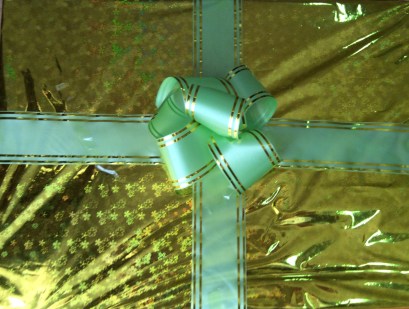 and miming how one wraps a present, I got my point across to the proprietress. She gave me a choice of several sheets of gorgeous paper and fancy ribbons. I made my selections, she carefully wrapped the present, and charged me 3,000 francs (about $3.50).
When I returned to work, I realized that I had forgotten to take a photo of the wedding present. A colleague insisted I needed to go back to the present wrapper and pay her 1,000 francs to unwrap the gift so I could take a photo and then rewrap it. That’s where I finally put my foot down and said I would live without a photo of the present.
Now, I was all set. I had the wedding present. I only needed to address and sign the wedding card. When I opened the card, I read the message inside for the first time. It began, “May this day be the beginning of reak happiness for you.” Reak happiness? What is that? The card likely was made in China, where most of Rwanda’s imported items are from. Probably, no one in the card factory had proofread the words before printing the cards en masse. Did reak mean great? I debated whether I should scratch out “reak” and write “great.” 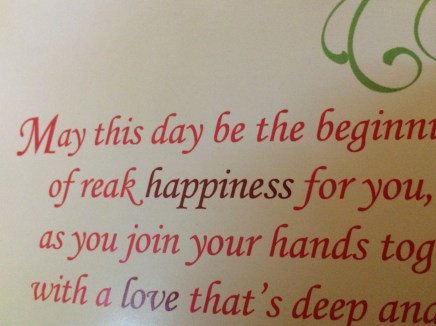 Ultimately, I decided to leave the card as it was. Better to have a grammatically incorrect card that looks pretty than to have a grammatically correct card that looks, well, sloppy. And, the couple was not likely to notice the error. And, who knows? Maybe, in Chinese, reak happiness is a higher level of happiness. But one thing I do know; if I’m ever invited to another Rwandan wedding, I’m bringing laundry detergent as my present.
 Ruminations from Rwanda
What an absolutely wonderful story Pat! I think you should write a memoir of your adventures you really are a gsntastic writer. I really enjoyed this story.
🙏
LikeLike
Pat, I agree with Michele. This story was such fun to read, and it was so well written. What an adventure you are having, and thank you so much for sharing it so elegantly with us! Keep writing, please!
LikeLike
Pat, I loved the story. I loved the way to expressed it. Perhaps you want to publish them in a book.
LikeLike
Very exciting. I couldn’t wait to find out what you finally did. Yeah, laundry soap would have been easier, but I think you will be remembered for your thoughtful and very special gift.
Marianne
LikeLike
Weddings are amazing. Customs are more amazing. your enthusiasm and tenacity are even more amazing. How enriching to encounter a ceremonial event of the first time. xo h
LikeLike