

The Huye Mountain Coffee Plantation is only about one and a half hours from where I live. So it was time for a visit. And what a visit it was! Five Hours of coffee tasting (cupping), hiking and learning about the history and production of coffee. I expected just to learn about coffee, but we also had a wonderful hike in Rwanda’s famous hills.
Our visit began with a freshly brewed cup of hot, delicious coffee. Then, we met our guide, Aloyse, a/k/a “Mr. Coffee,” who speaks four languages (Kinyarwanda, Kiswahili, French and English, which he taught himself by watching English language movies, after he realized that most of his customers were English speakers). Mr. Coffee told us the  story of how coffee was first discovered in Ethiopia by a goat herder who observed that, when his goats ate coffee beans, they acted crazy and stayed awake all night. The goat herder decided to try eating the beans himself and found that the beans had the same effect on him, keeping him awake all night so that he could pray. He liked the effect and, thus, the news of coffee’s amazing ability to keep one awake spread far and wide so that today so many of us depend on our morning cup of coffee to start our day or our evening cup so that we can stay up all night studying for a test.
Mr. Coffee also pointed out the awards that Huye Mountain Coffee has received for its coffee, despite being a recent entrant in the coffee business.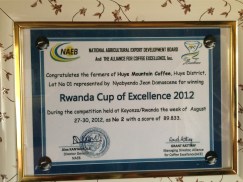
Then, we were given handsome, shiny black walking sticks for our hike to the plantation. The hike started out easy, allowing me to appreciate the beautiful mountain views of the many farms and houses scattered throughout the hills. We passed homes and people, some walking, but most working on their family farm plots. We began to ascend the mountain at an easy pace, while Mr. Coffee pointed out some of the plants we were passing – cassava, sweet potatoes (different from American sweet potatoes but also tasty). Although we are in the midst of the dry season, everything but the brown dusty road or paths was still green – just not as bright green as during the rainy season.


Our first stop was an experimental coffee plot where new plants of different varieties of coffee are planted. Once we began our ascent, we started to see the actual coffee trees. Because the harvest occurred months ago, there were not many berries on the trees. However, there were still enough left for us to pick a few and break them open to  taste the juice and extract the beans to chew. We ascended to an altitude of about 4,000 feet, where we stopped for Mr. Coffee to lecture us on the enemies of the coffee trees – insects and fungi. Mr. Coffee explained that Huye Mountain Coffee (HMC) has its own trees, but also buys coffee from neighboring coffee farmers. However, it inspects the coffee on those farms to ensure that their coffee meets its high standards. HMC is not yet certified organic, but in actuality is and will soon have its certification. It expects that in four years all of its farms from which it buys coffee will also be organic.
We also observed the trenches created to handle Rwanda’s enormous amounts of rain during its long rainy season.


HMC exports most of its coffee, but it can be found in some specialty shops in Rwanda. Most of the coffee goes to England, Switzerland, Japan and, of course, 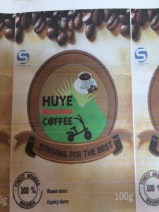 the United States. The U.S. importer is Stumptown Coffee of Portland, Oregon. Mr. Coffee explained that the quality and cost of HMC coffee is too high for Starbucks.
After hiking for some time, the ascent got steeper, and we reached an area shaded by a a huge Acacia tree with cute Rwandan stools and a small, blazing fire on which sat a squat, black cauldron. Mr. Coffee opened his backpack and took out a laptop and two speakers and played some peppy Rwandan pop music. Then, he got to work.


He took out some green coffee beans, poured them into the cauldron and began stirring them with a long wooden stick. Each of us thereafter took turns stirring the beans until they were evenly roasted. 
Mr. Coffee removed the sizzling hot cauldron from the fire with his bare hands and poured the roasted beans onto a large platter made of plant fibers to cool the coffee. We each sampled a roasted bean, which was hard and crunchy. 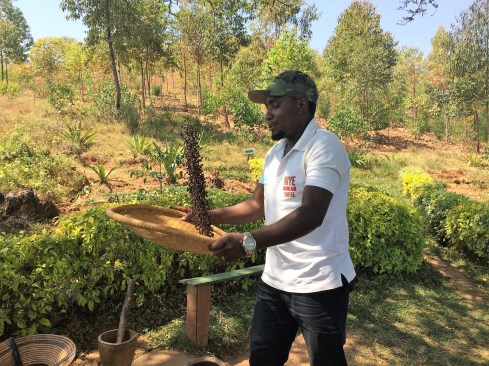 Mr. Coffee then collected the cooled roasted beans and we packed up and continued our ascent up the mountain, which got steeper and steeper, as mountains do. We crossed a few very short bridges made out of tree branches. We also passed some amazingly beautiful rock, which was probably just quartz, but still beautiful.
Then, we reached a large ledge, where we all sat and looked down on the houses and people so far below us, while Mr. Coffee told us the story of a battle in the 1400s between Rwandans and an invading Burundian army. (This area is very close to the current border between Rwanda and Burundi). The Rwandans were losing that battle. So, they cast a spell on a chicken and then sent the dead chicken with one of their most beautiful young women to the Burundian commander, who of course, fell immediately in love with her and brought her into his bedroom where she put the chicken on his bed. The commander promptly died due to the chicken’s spell. Of course, when the dead commander’s soldiers realized what had happened, they killed the young woman. However, the spell worked because the now leaderless Burundian army was not effective in battle and were easily overcome by the Rwandans, who swiftly defeated them and recovered the body of the woman, who was now a martyr. They covered her body in a shroud, put her in a cave in the mountain and sealed it with a boulder somewhere in the area where we were sitting. It reminded me of the burial of the Chiracahua Apache Chief Cochise in the Dragoon Mountains in Arizona. The graves of both are secret and not ever found.
After the story, we left the rock ledge and continued our ascent, which got even steeper, and I was glad to have my walking stick, which was more like a cane. Finally, we reached the top of the mountain, where there were benches surrounding a gigantic urn or pot with a coffee plant growing inside.  On one side of the urn was the HMC logo, which includes a depiction of an old-fashioned wooden Rwandan bicycle. In olden times, such bikes were used to transport the coffee beans down the mountain. Of course, now trucks are used. On the other side of the urn was a painted picture of coffee farmers. The 360 degree views from the top were spectacular. Because Rwanda is so hilly, we saw more hills in every direction.
At first, our descent was steep. We passed groves of eucalyptus trees. We passed through a small village and eventually to the coffee drying facility, where Mr. Coffee explained the washing

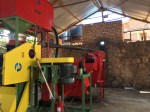

and drying process and showed us a large washing machine, as well as the rows and rows of sheets of drying beans. Then, he showed us their large roaster. Finally, he took out the coffee beans that we had roasted on the mountain. He ground them and packed them in cute bags for us. The wonderful smell of coffee was everywhere.
From there, we walked the fifteen minutes back to HMC’s office, where we rested on comfy couches, were given another complementary bag of coffee and were presented with another piping hot cup of world class coffee.
I’ve been on coffee tours before, but this was by far the best because it included a hike in the mountains (my first since arriving in Rwanda) and a friendly, knowledgeable and fun guide.


Thank you so much Pat for taking the time to share this adventure with us. Amazing.
LikeLike
Thank you Pat
What a wonderful day you had hiking and learning about Rwanda’s coffee and history. Nice pictures!
LikeLike
Very interesting! The photos are great. Thank you for sharing! Tess
LikeLike
Pat, what an interesting report. I could go for that cup of coffee! What a great day! Are you going to drink more coffee now?
Gerri
Sent from my iPhone
>
LikeLike
How would you rate their coffee in comparison to Arbuckles or Bisbee coffee? I enjoyed reading about your experience. I am over my fiasco and on the way to walking and hiking some at a slow rate and intend to build up as I progress. We all were together again in Bisbee last Friday morning. We are having a few rains, but no great monsoons. It will be another “female” season. We all miss you, Rosanna
>
LikeLike
Lovely Pat, and I hope you are really as content as you sound. You are one amazing woman!
On Sun, Jul 15, 2018, 12:18 Ruminations from Rwanda wrote:
> ruminationsfromrwanda posted: “The Huye Mountain Coffee Plantation is only > about one and a half hours from where I live. So it was time for a visit. > And what a visit it was! Five Hours of coffee tasting (cupping), hiking > and learning about the history and production of coffee. I ex” >
LikeLike