
One of my big disappointments in Rwanda has been the night sky. I know next to nothing about stars, but I love to look at them and try to identify a few favorites, like Orion and Cassiopaeia and, of course, the Big Dipper. The Arizona sky is wonderful for stargazing, and I expected Rwanda to be even better, due to less light pollution. However, the climate of Rwanda with its extended rainy season (almost three-quarters of the year) generally does not make for good stargazing. Every night, when I looked up at the sky, all I saw were clouds. On the few occasions when clouds were absent, the sky was amazing. However, with the exception of Orion, I did not know what I was looking at. My self-imposed mission was to find the Southern Cross, which is visible south of the equator, and Rwanda is barely south of the equator.
In June, much to my excitement (but to the chagrin of the many farmers who need rain for their family farm plots), the rainy season stopped and the dry season began. Now, almost every night, the sky is clear, and I can see multitudes of stars. There is some light pollution from the tall streetlights in front of my house, but if I go to the back of my house I can see more clearly.
I needed help to identify what I saw, so I researched the various on-line star-gazing programs. And, there are a lot! As with most research on the internet, there was way too much information for this human mind. It was so overwhelming that, after a week of intermittent research, I simply picked an app called “Pocket Universe” because I liked the name, and downloaded it to my iPad.
One of my biggest problems here was confusion over directions. I was completely upside down. What I had assumed was north turned out to be south. My friend, Olivier, set me straight. But, until I started looking at the night sky, it didn’t feel right.
Just like Americans, most people here do not seem interested in the night sky. However, I have two friends who speak some English and are very interested in the night sky. The first is Olivier and, together with the help of the Pocket Universe on my iPad, we identified Venus hanging low in the sky in front of his sister’s shop. Olivier had read about horoscopes and wanted to know his. Later, when I told him he was a Leo (the lion) and gave him his horoscope of the day that I found on the internet, he was elated. The second budding astronomer is Jared, the young night watchman at my house. Jared and I easily found Jupiter and then searched for the Southern Cross, looking southward from the back of my house. With the help of the Pocket Universe, we found it directly over my house, as if it was guarding us.
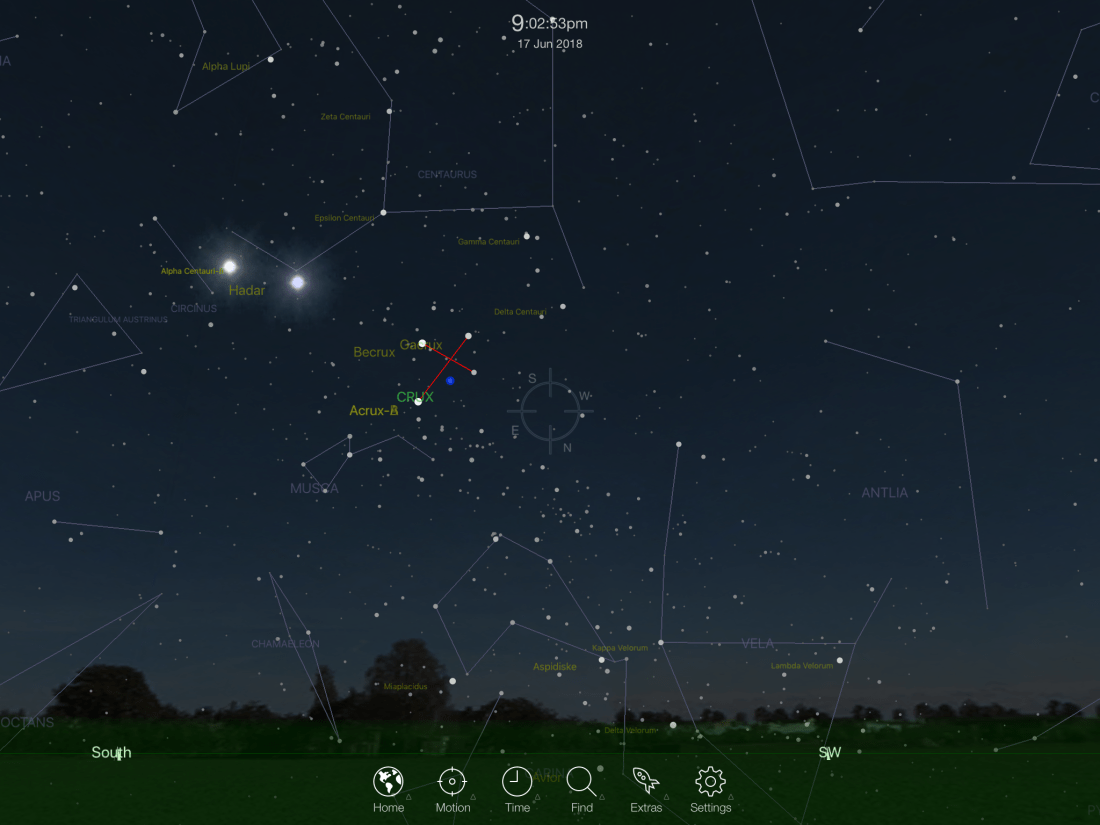
The Southern Cross constellation is so named because the four stars comprising it look like a cross when connected top to bottom and side to side. Actually, however, if one visually connects the dots (stars), it looks more like a kite. (But Southern Kite doesn’t have the panache of Southern Cross.) Thus, once one knows where to look for it, the Southern Cross is easily visible. The proper name of the constellation is simply Crux (Latin for cross) The four stars composing Crux have Greek letter names of A, B, C, D: Alpha Crucis, Beta Crucis, Gamma Crucis and Delta Crucis, conveniently abbreviated as Acrux, Becrux, Gacrux and Decrux. The Southern Cross is so popular in the Southern Hemisphere that several countries include it on their flags: Australia, Brazil, New Zealand, Papua New Guinea and Samoa.
When I come home at night, I look up at the sky to see if stars are visible. Then, after I greet Jared, I say in Kinyarwanda: “Hari inyenyeri mu ikyereri” (There are stars in the sky), and we look for the Southern Cross. Below is a picture of the Southern Cross (the red cross) from Pocket Universe; it is more or less what the view of the night sky from my backyard looks like.
 Ruminations from Rwanda
HOW INTERESTING. THANK YOU. YOU WIIL BE AN EXPERT IN STAR GAZER!😊
LikeLike
I never knew what the Southern Cross was. Thank you for the education! Marianne
LikeLike
You certainly are learning a lot in Rowanda and you are sharing it very well with us! Thank you.
LikeLike