
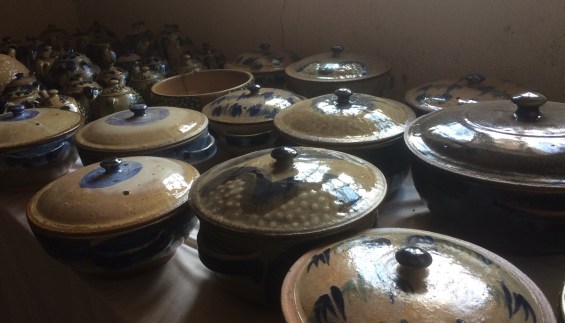
I finally finished grading 87 papers & am back to blogging. Last Saturday, my friend convinced me to take a break from grading to meet her at the Gatagara Pottery Works, which is halfway between our towns. The pottery works are less than 10 miles from Nyanza, the town where I live, so I hopped on a bus and quickly was there. The place where the bus stopped is nondescript. 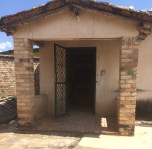 From there, we walked 2 kilometers through an interesting village to get to the pottery, which was locked. However, a man who saw us agreed to find a worker with a key. Soon, a man who worked at the pottery opened the door to the pottery for us. First, he took us to the shop
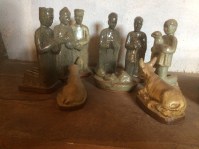
where we saw so many beautiful objects – cups, glasses, teapots, bowls, casserole dishes, vases, candle holders, a creche, and even ashtrays with built in holders for four cigarettes. (I had to ask what they were. I thought they might be incense holders.) The ashtrays were no doubt popular in 1979, when the pottery was established by Belgian ceramists, and eventually employed up to thirty workers.
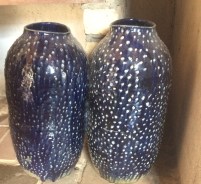
During the 1994 Genocide against the Tutsi, some of the potters were killed, and the business halted. Fortunately, three years later, it resumed. Today there are twelve pottery workers, plus an accountant. Louis, whom we did not meet, 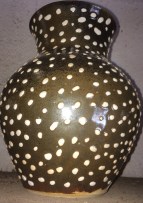 is the only worker who has been there since the beginning. The workers are Batwas (sometimes known as Pygmies), a minority group in Rwanda, comprising approximately one per cent of the population. Traditionally, pottery was their main occupation. The clay is local, from the surrounding hills. However, the colors are imported from Belgium. I’ve been told that some of their items are sold in the tourist venues in the capital city. Their main clientele are tourists, because the items are much more expensive than what is available in the local markets for the average person. However, the ceramics are rather impractical for tourists because of their weight. Each item is quite heavy for its size. Although I wanted to buy one of everything, after considering the weight and the difficulty of transportation back to the states without breakage, I settled for two beautiful ceramic mugs, from which I’ve since been drinking my coffee and tea everyday.


Below are more photos of the pottery whose official name hails back to its Belgian founding: Cooperative Poterie Local de Gatagara. Everyone we met there spoke Ikinyarwanda, and many spoke French. Fortunately, my friend spoke fluent French and was able to ask on my behalf whether lead was used in the pottery making. She assured me that the answer was non/no.


 Ruminations from Rwanda
So nice to see artists making beautiful pottery. To bad it’s so heavy.
Michele
LikeLike
Wow Pat. It is like being there.
LikeLike
Beautiful pottery! I’m glad you’re done grading and back to blogging.
LikeLike
I loved your article and the pictures are awasome. Saludos de Puerto Rico.
LikeLike
Good to hear from you again. I missed your ruminations but empathize with having to grade 87 papers!
LikeLike