

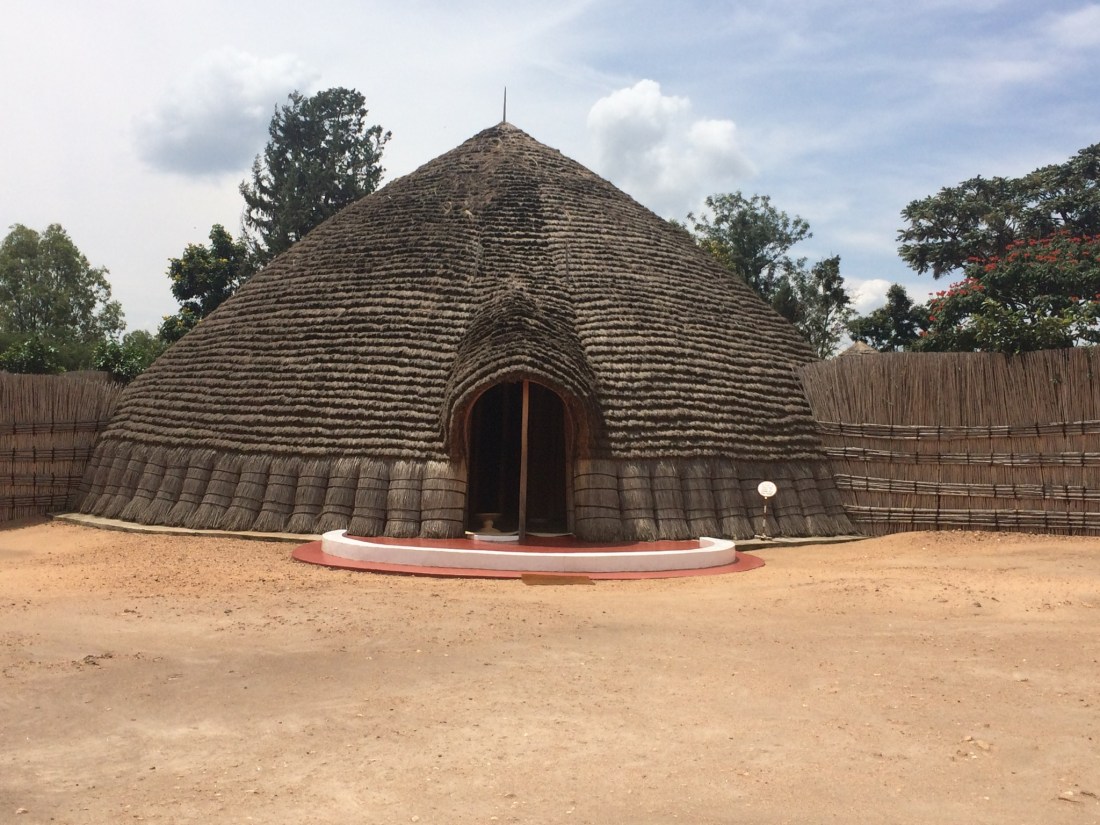
The town I live in is called Nyanza. Its major attraction is the King’s Palace Museum, so of course I had to visit it. Coincidentally, it’s only 1 1/4 miles from my house, on the same road as my house. The entrance fee is 6,000 Rwandan francs, which is about $7, and includes a guide. As no other visitors were there, I had the place and the guide all to myself. The guide first took me to a replica of the traditional king’s house, where he lived before 1932, when he built a large modern house. The traditional house is round and made of thatch. It was large so that it could accommodate meetings with his subjects. It also had a large comfortable bedroom.
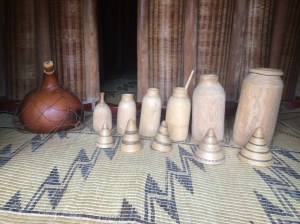
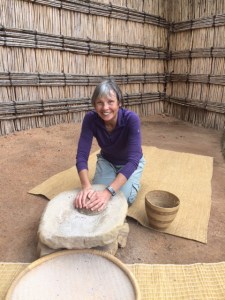
Next to the King’s quarters was a smaller house for the maker of the King’s fermented milk and yogurt, still Rwandan staples. The yogurt maker was a very important person. On the other side of the King’s quarters was a house for the sorghum beer maker, an early brewmaster and another very important person. I tried my hand at grinding sorghum on a stone, purportedly in preparation for sorghum beer, which I have yet to taste.
Next was the most exciting part of the tour – cavorting with the Inyambo cattle. Inyambo means “cows with long, long horns,” and the horns are super long. I read that they can be as long as 12 feet. The horns are supposed to act as a natural cooling system by circulating the cow’s blood to the ends to disperse the heat before returning it to the cow’s body. The cattle are reddish brown and huge, and their horns make them appear even bigger. Inyambo cattle were so special that only the King and his chiefs were permitted to raise them. In bygone days, the Inyambo were treated like royalty, which in fact they were, and still are. They are decorated with colorful beaded necklaces and headbands. The cattle keeper sings to them, and in return, they dance. Today, special parades of the Inyambo are periodically held at the palace.
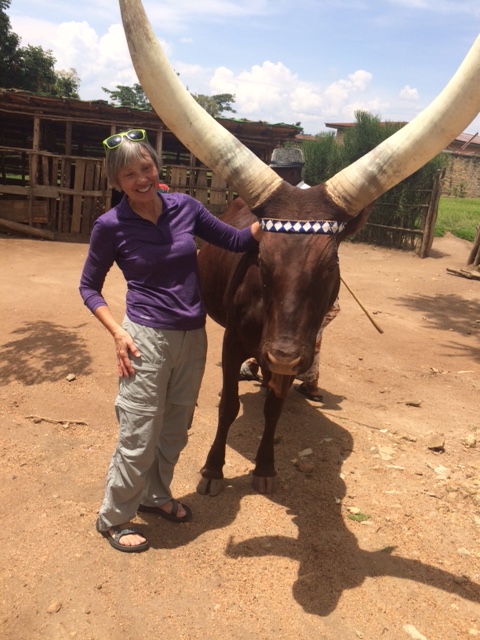
When I first approached the Inyambo, I was intimidated by their size, but my guide encouraged me to pet one of them and so I did. The cattle keeper moved around the cow and sang in Kinyarwanda what sounded like a lullaby to the cow to calm it.
Inyambo are the pride of Rwanda. However, they are also in the neighboring countries of Tanzania, Uganda, Burundi and Kenya. They are sometimes called Ankole or Watusi cattle. The bulls can weigh up to 1,600 pounds, but the average weight is between 800 and 1,200 pounds. Newborns weigh 30-50 pounds.
Our next stop was the modern and very large house built for the king around 1932. It has beautiful furnishings, a large kitchen and a courtyard. In front of the house are exquisite gardens with a walkway taking visitors to the lovely and comfortable outdoor coffee shop and restaurant with a full menu of delicious meals and desserts, 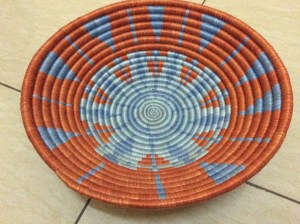 as well as the tiny gift shop, where I bought a Rwandan bowl.
If you would like to read more about Inyambo, click on the following link:
http://www.watusi.org/2012/05/17/a-short-history-of-watusi-cattle/
 Ruminations from Rwanda
Inyambo looks like an amazing animal. You look good Pat. I love all your posts. M
LikeLike
Wow what a change of pace and lifestyle you’re having. Sounds like hard work that will make good memories.
LikeLike
So very cool Pat! I love those cattle. I’ve seen them at county fairs and wonder how they carry those massive horns around. Do you know how much they weigh?
LikeLike
Hey Pat:
You write as if you were speaking to me in the same room. I love the photos and see how happy and excited you are in this special journey you’re on. Please include me in your list.
LikeLike
what are the hours of operation
LikeLike
I am no longer living in Rwanda, so I checked the web and found that it is open 9-5 pm 7 days a week, which is what I remembered. I also found a phone number for the palace (+250 738 742 026), which you could try calling. Also, if you are in Nyanza town, the Heritage Hotel has info on the museum, as well as a good bakery. Enjoy!
LikeLike