A Rwandan First – Medical Drones


7F4B0C63-12E0-428D-B602-7A92B075FB17Yesterday, while in town visiting a friend, I saw my first drone flying in Nyanza.  I couldn’t contain my excitement when I heard the buzz of a low- and fast-flying drone just overhead.  My friend was nonplussed.  “Oh, that,” she said, “It’s just a drone.  We often see them.  They deliver blood to the Nyanza Hospital.”

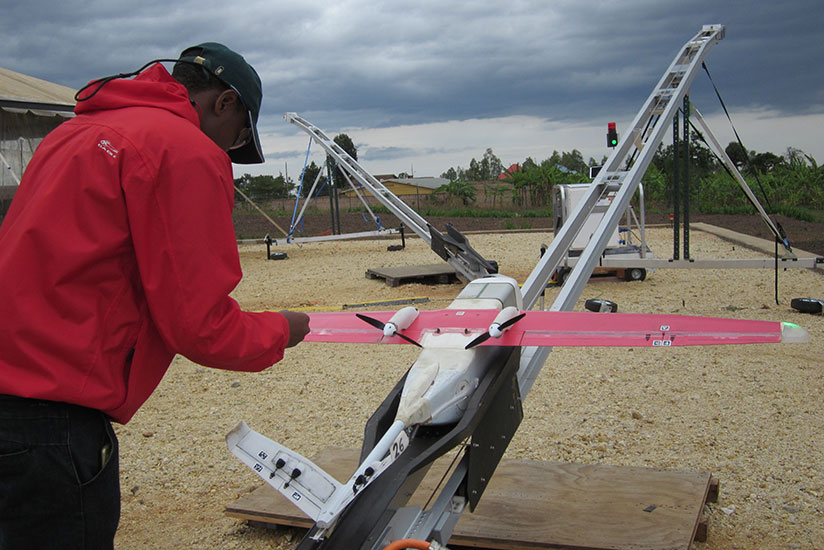
I had to learn more.  According to an article in the New Times of Rwanda, the drones are based in a town about an hour’s drive away from Nyanza.  The drones are the result of a partnership between the Government of Rwanda and Zipline, Inc., a California-based “automated logistics company,” to deliver blood to Rwandan hospitals.  Here’s how it works.  The requests for blood are sent to Zipline via a text on WhatsApp.  When Zipline receives a text for blood, it literally buzzes into action, readying the drone for flight.  The drone drops the box containing the blood at the designated hospital, where a hospital worker is waiting to collect it.  Below is a photo from the New Times of Rwanda showing a hospital worker picking up the box that was parachuted from the drone.

B4D9C85C-D915-453F-A1F1-E127A01B24CB

Since last October, the drones have made about 2,000 deliveries of blood to 12 hospitals.  Rwanda hopes to increase the number of hospitals served by drones to 21 by the end of 2018.  It is a cost-effective and fast way of delivering blood over long distances.   Although the drones currently deliver only blood, Rwanda is thinking about other medical supplies that drones can deliver.  A Zipline employee explained that Rwanda is the only country in the world using drones in this way.  However, Tanzania (Rwanda’s next door neighbor to the east) and Zipline recently announced that they have partnered to launch an even larger drone delivery service to fly medicine on an emergency basis where needed in Tanzania.

It’s a relief to see drones used for a positive, life-enhancing purpose, instead of for delivering bombs.  Zipline has used its interest in robotics to make a difference in Africans’ lives.  If you are interested in learning more, take a look at this video of Rwanda’s drones.

My First Rwandan Rainbow

6804270D-9274-4185-8CB6-1184CEB9B592It rains for hours almost everyday here, making everything lush and green, and muddy.  The Kinyarwanda word for rain is imvura.  Today, as I was walking home, I looked up and saw this rainbow.  This is the view from the back of my house.  The wires are my wire clotheslines in my backyard.  Hopefully, I will see many more rainbows.  The Kinyarwanda word for rainbow is umukororombya.

UMUGANDA

Umuganda is a Kinyarwanda (Rwanda’s local language) word meaning “coming together in common purpose to achieve an outcome.” It is a government-mandated once a month morning of community service. Every household is required to send at least one member to Umuganda. If they fail to participate in Umuganda, they can be fined. Umuganda occurs on the last Saturday of every month. During Umuganda, the streets are empty and the shops are closed, as everyone is expected to participate in Umuganda. It lasts from 8 a.m. till noon, with the last half hour dedicated to a community meeting. The work is planned by a community leader and can be anything that the community needs, e.g., weeding, planting trees or picking up litter, which is perhaps one reason Rwanda is so clean.

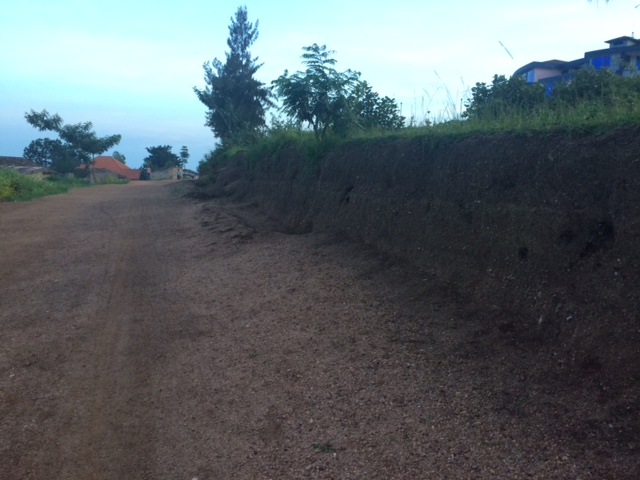
Thus, on the last Saturday of February, I donned my hiking boots, blue jeans, a tunic top and work gloves and set out for Umuganda, which was widening a dirt road not far from my house. We used pick axes, shovels, machetes and hoes to do the work. Everyone worked hard, and the number of workers kept increasing until there were well over a hundred workers. I used a hoe that was handed to me, but the handle kept separating from the blade, giving me an excuse to take a break while the kind worker beside me fixed it for me. My work gloves were very popular, as none of the other workers had them. When I saw a hard-working man rubbing his sore hands, I loaned him my gloves, and he was very grateful. I was amazed at how much physical work was accomplished in so short a time. Some of the students and staff from my school also attended and worked hard. Indeed, it was an international event with the following countries represented: Rwanda, South Sudan, Kenya, Ghana, Cameroon, Uganda and me for USA. Afterwards, there was a community meeting. I could catch only a few words of what was said in Kinyarwanda. However, at one point, the community leader began to sing and everyone stood up to sing, clap and dance. Of course, I joined in the clapping and dancing. Umuganda is a wonderful way of bringing the community together and getting needed work done.

Umuganda reminds me of that song about housework by Carol Channing on the Free-to-be-You-and-Me album in the 1980s. Nobody likes housework, she sang, but housework is not so bad when done together. That’s what I thought of Umuganda. No one likes the back-breaking work of widening a road by hand, but when done with over a hundred other people, it’s fun, and the time goes by lickety-split.

Here is the result of our work:

231F506C-28CB-48EB-847D-1B79B980B602

If you would like to read more about Umuganda, you can click on the following link:

http://perilofafrica.com/umuganda-rwandas-day-community-cleaning/

My office

I just completed my first day of work.  I met many friendly and helpful staff members and had the opportunity to say “good morning,” “good afternoon,” “how are you” and “I’m fine” (mwaramutse, mwirire, amakuru & ni meza) in Kinyarwanda scores of time.  Here is a photo of the office that I share with two other staff members. My desk is the one on the left near the window. It is on the second floor of a four story building. The other two photos are of the view from my office window. The construction in the last photo is for a large new wing for the institute.  It will be attached to the building I am in.  My desk computer has a sticker that reads “US AID From the American people.”  So I thank you very much for my desktop computer. I dressed up today in a pant suit and spiffy shoes only to find out when I got to work that it was casual Friday.


Black Panther

8DB3CFF5-12DD-4FEA-BCC7-09D2DBA78DECBlack Panther is playing at the cinema in Kigali.  Several of us volunteers went to see it at a cost of 6000 RWF (Rwandan francs, which is about $7), which included a soft drink or water.  We had tried to go the night before, but it was sold out, so we bought advance tickets for the next night.  The seats were comfortable.  The theater was again sold out.  After the movie, everyone applauded.   On their way out, many people, including us, took photos in front of this poster.  If you haven’t seen the movie, it’s fun – part Marvel comic book hero and part sci-fi.

My First Week in Rwanda

I arrived in Kigali (prononounced Chigari), Rwanda’s capital city, about 10:30 p.m. on Monday, February 12.  While clearing Immigration, I connected with the other Peace Corps Response volunteers. After picking up our luggage, we left the airport, and the first things I noticed was how pleasant the weather was and that we were surrounded by hills that I could not quite see because of the darkness but saw the lights from the many buildings on the hills. What a beautiful sight.

We were met by our Peace Corps Program Manager and a volunteer who had been living here since last August. Each of us was given about 12,000 RWF (Rwandan francs, which is almost $14). We stopped at a very small grocery store not far from the airport and bought food and instant coffee or tea for the next day’s breakfast. (I had money left over.) We then drove to the Peace Corps Transit House, which is really just a hostel, with three bedrooms containing multiple bunk beds (each equipped with a mosquito net) and shared bathrooms, a common sitting area and a common kitchen. The sitting area is stocked with hundreds of books from volunteers who have passed through, and the kitchen is basic and stocked with kitchenware left by prior volunteers. It has a small electric stove with four burners, which several of us manage to use simultaneously while preparing our individual breakfasts.  It has WIFI, but it’s incredibly slow and it keeps crashing.  Thus, I see it’s going to be difficult to publish blog posts.

By staying in this communal setting, our group of 8 volunteers rapidly bonded. Everyone in our group has extensive experience living abroad, including Mexico, France, Turkey, Senegal, Namibia, Zanzibar, Cameroon, Burkino Faso, Kenya, Macedonia, Thailand, Korea and, for me, Ghana. Most of us will be teaching and assisting with English at various institutions. Not surprisingly, I, at 68, am by far the oldest of my group, though not the oldest volunteer currently in Rwanda, who is 72.

Almost as soon as we arrived at the hostel, we were given stick mosquito repellant and our first dose of an anti-malarial drug, as well as our Peace Corps settling-in allowance and first month’s stipend. After our long journeys to get here, we slept soundly in our mosquito net-covered beds.

The next morning, we rose early, as our training started at 8:15 a.m. We breakfasted outside on our large patio, overlooking a lush yard and listening to the unfamiliar sounds of many birds. My first avian observation had to do with crows; I was told that the crows here are pied crows -black and white and very pretty. They have a more pleasant sound than our American crows. I also saw a bird that I thought was a skinny robin with a long tail, but was told that it is an African thrush.

The first item on our agenda was to meet our Peace Corps Country Director, who welcomed us and gave us the oath, swearing us in as Peace Corps volunteers. We also filled out lots of paperwork to open Rwandan bank accounts.  Later, we lunched at lovely restaurant with a typical Rwandan buffet, including pumpkin soup, shredded carrots, a green vegetable ressembling creamed spinach, mashed plantain, boiled plantain, roasted potatoes, beef and a drink. The cost of that lunch was 4000 RWF (less than $5). Then we visited MTN (the phone store), where most of us purchased sim cards and minutes for our phones. So now I have a Rwandan phone number. In Rwanda, almost everyone uses the WhatsApp app to send free text messages, so those volunteers who had not already installed that app did so. I had already installed WhatsApp because my friend, Delfina, told me that it was indispensable for living abroad and my friend, Shary, ensured that it worked on my phone.

In the afternoon, we had an extensive medical briefing by the Peace Corps Rwanda doctor and his staff. They spent a lot of time discussing malaria and emphasizing the importance of taking our anti-malarial drugs and using our mosquito bed nets. Because I’ve had malaria twice (as a result of my prior Peace Corps Service in West Africa in the early 1970s), I did not need to be persuaded. We were given our choice of anti-malarial pills. I chose the one with the least negative side effects. However, I have to take it every day. So far, however, I have seen few mosquitos, but I’m sure that won’t last. The Medical Office issued supplies for us to take to our sites, including a mosquito bednet, a 2-month supply of anti-malarial pills, and a very large and complete first aid kit that includes a malaria test kit. The staff instructed us on how to use the test kit if we believed we had malaria. We also received a large water filter, which ressembles an old-fashioned coffee urn (the kind used by Americans for parties before Keurig became popular). Importantly, we were trained in how to use the filter to ensure that our drinking water is safe, including adding a few drops of bleach.

Our second day of training began with training in iKinyarwanda (the language of Rwandans). The class ratio is four students to one teacher. Our teacher is very energetic, she even danced, trying get us to say the words with the proper rhythm and accent on the correct syllable. The first word we learned was “Muraho,” which means hello, but is used only for the first time you meet someone or when you have not seen someone for a very long time. We all mastered that one easily, but the next words “Mwaramutse” (good morning) and Mwirwe (good afternoon) were more challenging. Later, we met with the U.S. Ambassador to Rwanda Erica Barks-Ruggles, who reminded us that we all represented the United States and were all ambassadors to Rwanda.

Later in the week, we had safety and cultural briefings. On Friday, we met our counterparts for the first time and lunched with them. We obtained Tap N Go cards for the city busses, which don’t take cash – only the Tap N Go cards. The rate is 240 rwf per ride, which is about 27 cents. On Saturday morning, we went to the Rwanda Genocide Museum.  Afterwards, we went into the center of Kigali to buy kitchenware for our sites. The shops, especially T 2000, a huge 2-story Chinese owned department store, were bustling. Before entering the shop, we passed through a metal detector and placed our handbags and backpacks on the a conveyor belt to be scanned. One can purchase just about anything at the T 2000 store, but the quality is generally low (think a gigantic dollar store) and yet expensive. Another store, called Nakumatt, had higher quality items. One reason for the expense is that Rwanda is a land-locked country. Imported goods generally must first be shipped to the neighboring country of Tanzania and then transported overland by truck to Rwanda. Rwanda hopes to partner with Tanzania to build a railroad to speed up and reduce the cost of such transport in the future.

Today, we visited the African market, which was a lot more fun.  I was able to buy a phone charger that fits in Rwanda electrical outlets, as well as a power strip so that I can charge my phone, iPad and computer simultaneously.  I also bought a mango, a papaya and bananas for next week’s breakfasts.

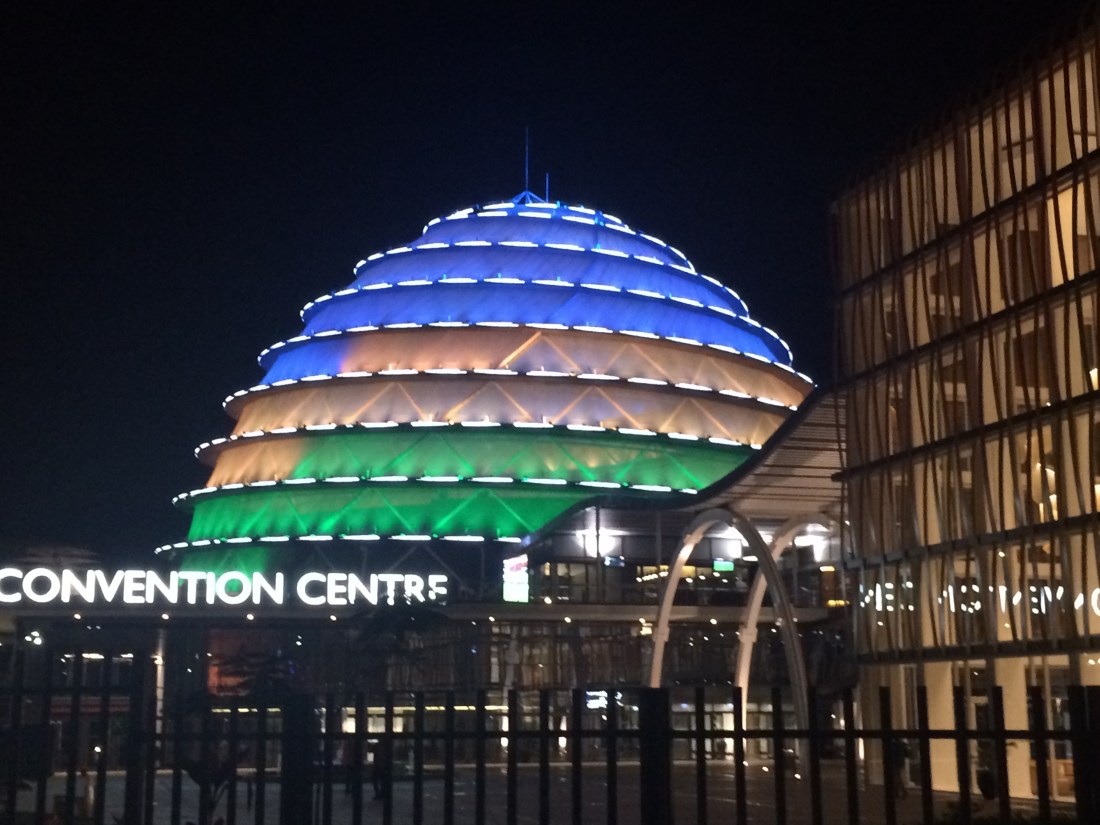
Tonight, we walked and walked around the city.  I was excited to walk near the Kigali Convention Center, which we had been observing from a distance.  It is shaped like a beehive buzzing with bees and it is lit up with constantly moving lights.  It is the most interesting building in Kigali.3E804DF3-E72B-4A0F-AA4A-F8C78D10867E


My Long Journey to Rwanda

I woke up on February 11, 2018, my departure date, at 2 a.m., so had 3 1/2 hours of sleep. I finished cleaning and moving out of my apartment, then left for the airport at 3:45 a.m. The drive from Sierra Vista to the Tucson International Airport is usually about 1 1/2 hours. However, on this very early Sunday morning with no traffic, it was shorter.

The Peace Corps pays for volunteers to bring two suitcases, each not exceeding 50 lbs, which is the airlines’ weight limit. I was concerned that I would be over that limit. Because my Peace Corps job involves teaching at a legal institute, I must dress in business attire. Thus, I had to pack several suits and pairs of dress shoes, in addition to my regular clothes. Plus, I packed many law books and several briefcases given to me by my generous friend, retired Judge Friedman. I had initially planned to mail the law books, but my Peace Corps coordinator suggested that instead I pay for a third suitcase, which I did with the help of a gift from my good friends, Terry and Diane Clemons. So I packed three suitcases and spread the books and legal briefcases among them. Law books are especially heavy, so I was very concerned that, even with three bags, I would exceed the weight limit. My friend, Steve Anderson, helped me pack and we checked each bag at least 5 times on his bathroom scale. Still, we were concerned that his scale might not match the airline’s. Once at the airport, we made a bee-line for the huge scale near the airport’s entrance doors and were relieved when each suitcase weighed in under 50 lbs. At the airline check-in counter, the airline attendant looked quizzically at the suitcases and reminded us of the 50 lb. limit. We assured her that each was under the limit. When we placed the bags on her scale, she was surprised that each came in about 2 lbs. under the limit. Whew! Step one of my journey successfully completed.

My first of four flights was from Tucson to Houston on Sunday morning. From Houston, I flew to Washington-Dulles, then to Brussels, Belgium, where I am sitting, waiting for the bus to take me to the Africa terminal as I write this.  The final 8 hour flight will be from Brussels to Kigali, which is the capital of Rwanda, where I am scheduled to arrive about 7:30 Monday night, likely quite exhausted from sitting on airplanes and in airports for well over a day.  But I had a little bit of luxury, as I met a lovely young woman who is also flying to Kigali and had a pass from her employer to an Airport Club.  So I breakfasted on a chocolate croissant and espresso – so French, or in this case, Belgian.

It’s been a long and sometimes arduous journey getting this far. I originally saw the Peace Corps Response position posted on the Peace Corps’ website in late 2016. The departure was scheduled for May of 2017. I contacted the Peace Corps recruiter to say I was interested in the position but could not leave until the first week of August of 2017. She told me to apply anyway, explaining that, if there were no other acceptable candidates, my request for a later departure would be considered. So, I applied, and in February the Peace Corps notified me that they selected another candidate. I did not think again about the position until May, when the Peace Corps notified me that the chosen candidate was unable to go and that the departure date had been extended to August. Was I still interested, they asked. Sure, I responded. They told me that there was at least one other candidate, and they set a time for my interview. I prepared for the interview by going to the local library and checking out and reading all seven of the library’s books, including a very good children’s book, on Rwanda. I also bought and read a travel guide on Rwanda Travel. Shortly after the interview, the Peace Corps selected me, thus starting the whirlwind process of submitting my legal and medical documentation by the end of June.

The legal clearance submissions were easy – getting my fingerprints taken at the local police station, sending them to the Peace Corps and filling out forms allowing the Office of Personnel Management to conduct a background investigation on me. The medical part, however, was much more complicated and time-consuming. The Peace Corps understandably wants its volunteers in top physical condition so that volunteers work hard and are not distracted by, or unable to work due to, medical issues. Therefore, the Peace Corps requires numerous dental and medical records and tests. I spent the entire month of June completing their requirements and uploading the reports and documentation to the Peace Corps’ medical portal for review by their nurse, doctor and dentist. The Peace Corps’ dentist required that I have additional dental work before approving my departure. I also had 13 vaccinations for everything from hepatitis to rabies. After I received my medical clearance, I had a problem with a finger. Two doctors misdiagnosed it as cellulitis, which held up my medical clearance. A third doctor finally correctly determined that I had arthritis in that finger (guess I’m getting old); he gave me documentation to submit to the Peace Corps, and the Peace Corps gave me final medical clearance. Also, despite my having had a top-secret security clearance with my prior federal jobs and a request by the Peace Corps to expedite my background investigation, the Office of Personnel Management did not complete their investigation in time for me to leave as scheduled in August. So, after insuring the legal institute still wanted me, the Peace Corps re-scheduled my departure to the next group departure date, which was six months later or February 11, 2018. Last August, that seemed so far away. A week after my first scheduled departure in August, my background investigation was completed and I finally received my legal clearance to depart.

I tried to use the time between August and February productively. I read more books about Rwanda and, several times a week, read Rwanda’s main newspaper “The New Times.” I bought a CD on Ikinyarwanda, Rwanda’s main language, and practiced. I bought and studied an English-Ikinyarwanda dictionary. (Thank goodness for Amazon.). I prepared flash cards of common words and phrases and memorized numbers up to a million. I got 2 more vaccinations. I bought a new computer, two new suitcases and last-minute clothing items; filed my taxes; had a final dental appointment; had my car serviced; discontinued my car insurance; cancelled my internet and electricity; suspended my cell phone plan; and affixed to my backpack the tiny but powerful flashlight that Martha was certain I’d find useful in Rwanda. Finally, in the days before my departure, I said farewell to my many friends and neighbors and, with the help of Steve, moved my car and all of my belongings into storage. The night before my departure, Steve and I were too busy to eat, but my next door neighbor, Mary, brought over two huge pieces of tiramisu for us to eat, and it was a delight.


At World Economic Forum, U.S. President’s speech to African leaders

On January 25, 2018, U.S. President Trump, while at the World Economic Forum in Davos Switzerland, gave the following speech to African leaders:

“I offer my deepest compliments as you gather in Addis Ababa for the 30th African Union Summit. I salute the leadership of Chairperson MoussaFaki in working to transform the Union into an increasingly effective institution to advance economic prosperity, strengthen peace and security, and deliver positive outcomes for Africa and the broader international community.

I congratulate His Excellency Paul Kagame on his accession as Chairman of the Assembly, and thank His Excellency Alpha Conde for his service.

The United States profoundly respects the partnerships and values we share with the African Union, member states, and citizens across the continent.

I want to underscore that the United States deeply respects the people of Africa, and my commitment to strong and respectful relationships with African states as sovereign nations is firm. Our soldiers are fighting side by side to defeat terrorists and build secure communities.

We are working together to increase free, fair, and reciprocal trade between the United States and African countries, and partnering to improve transportation security and safeguard legal immigration.

The challenges and opportunities this summit will address – advancing trade and development, resolving armed conflicts, and combatting corruption, among many others – are critical to the future of the African continent, and you can rely upon America’s partnership and support for the African Union’s leadership on these issues.

In the coming year, I look forward to building on relationships established during the African Leaders’ Lunch during the United Nations General Assembly, the Africa Ministerial in Washington, and engagements of Ambassador Nikki Haley, Deputy Secretary of State John Sullivan, and my Ambassadors throughout the continent.

Secretary of State Rex Tillerson will travel to Africa for an extended visit in March, and I look forward to welcoming many of you to the White House.

Please accept my greetings, highest regards, and best wishes for a successful Summit.”

Rwanda’s Flag

Lots of thought goes into a country’s flag.  After all, that simple rectangle known as a flag symbolizes what that country thinks is special, important and unique about it, what distinguishes it from other countries.  Thus, one of the first things I did, upon learning that the Peace Corps was sending me to Rwanda, was to check out Rwanda’s flag and then think about what its flag design said about Rwanda.

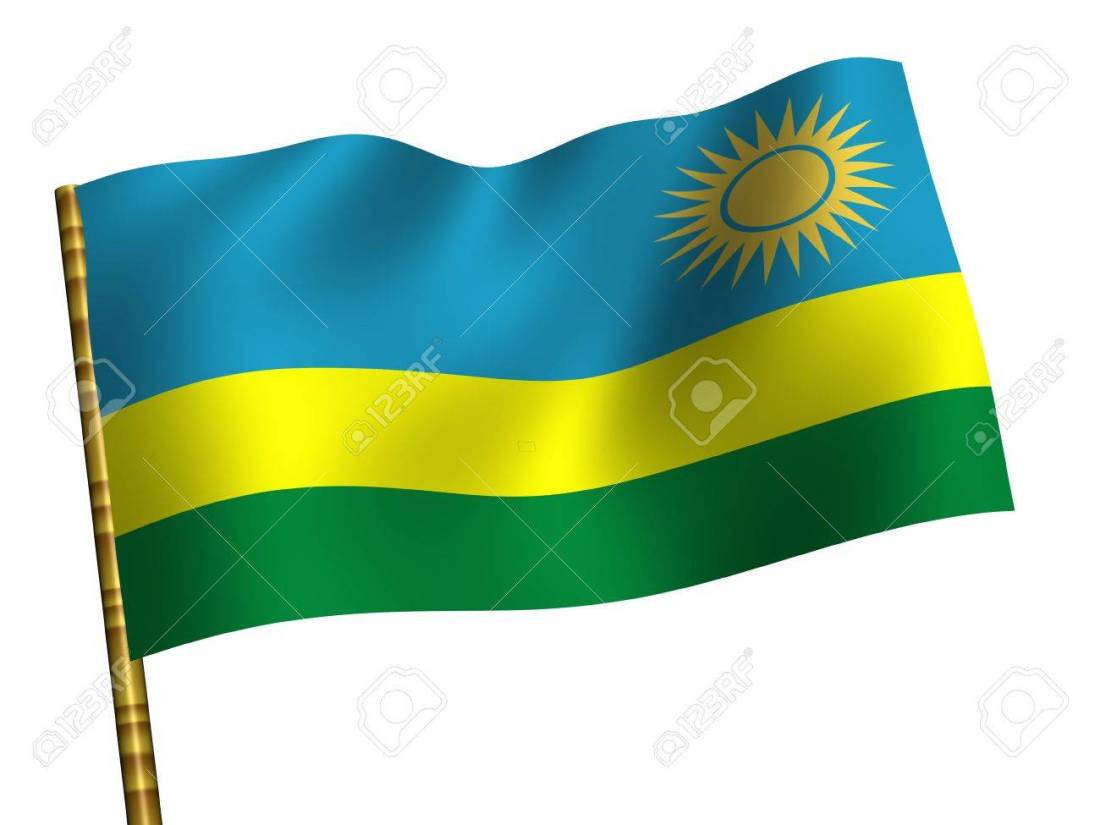
My first reaction to Rwanda’s flag was how gloriously bright it is.  Indeed, the flag is not only tri-colored (green, yellow and blue stripes) but also contains a bright gold-yellow sun and rays.  The radiant sun told me that Rwanda is a happy country and that its people are looking forward to a bright and sunny future.  The bottom band of Rwanda’s flag is green, which, according to Wikipedia, represents prosperity.  That makes sense because Rwanda has two rainy seasons and lush verdant mountains and abundant national parkland.  Its fertile soil supports agriculture, with its main exports being coffee (Starbucks is its major purchaser), tea and pyrethrum (a white daisy related to chrysanthemums and used as a natural insecticide).

The middle band on Rwanda’s flag is yellow, which, according to Wikipedia, stands for Rwanda’s potential and economic development.  Indeed, Rwanda has made great strides in economic development this century and its president plans to make it the “Singapore of Africa,” in other words Africa’s financial capital.  With the advances of computers and medical technology of the past decades making the world smaller, I believe that Rwanda’s potential is unlimited.

Rwanda’s flag’s top and widest band (double the width of the lower two bands) is blue, which Wikipedia says represents happiness and peace.  Blue is the color of serenity and calmness, of perfect skies and fair weather.  People cannot be happy without peace in their country.  For a country to place peace and happiness at the top of their flag and in the widest band means a lot.

Finally, Wikipedia says that the sun and rays in the upper right of the flag indicate enlightenment – unquestionably a lofty and esoteric goal.  While most of us readily admit to wanting to be happy and prosperous, few of us also seek the more arduous path of enlightenment, so I was impressed that Rwanda did so in so open a manner as embedding the goal as the centerpiece of their flag.   Now, despite being a yogi, I don’t pretend to know what enlightenment means, but I assume that it refers to a quest for knowledge – spiritual knowledge, as well as the type of knowledge we are most familiar with – education.  In fact, Rwanda has made education a priority, and the Peace Corps has assisted in Rwanda’s education transformation.  I also believe that enlightenment means thoughtfulness, as well as opening more opportunities for women, which Rwanda has done.  According to the United Nations, Rwanda was the first country in the world with more than fifty per cent of its members of Parliament female, and Rwandan women have the same rights as men to inherit property.  Now, that’s enlightenment, and I feel fortunate to be going to such an enlightened place.