TERRACING IN RWANDA

93B337C2-456C-4398-B9B2-9D9B0F202A3COn this monthly day of communal labor (always the last Saturday of the month), I walked down the road towards town and soon came to the Umuganda site, where already a large crew of townspeople were hard at work on the side of a dirt road, clearing away the weeds encroaching on the road.  I promptly relieved a woman who was taking a break; I reached  for her hoe, which she gladly released to me.  Wielding the hoe as I’d previously been taught, I scratched away at the weeds and pushed them off the road.  I must have finally mastered the technique because this was the first time people did not interrupt my work to show me how to do it.  Instead, they worked alongside me chattering among themselves in Kinyarwanda.  Soon, the muscles in the small of my back, used to sitting at a desk all day, let me know that they weren’t accustomed to such work.  After several whacks with the hoe, I switched arms and took a short rest to give my back some relief.  

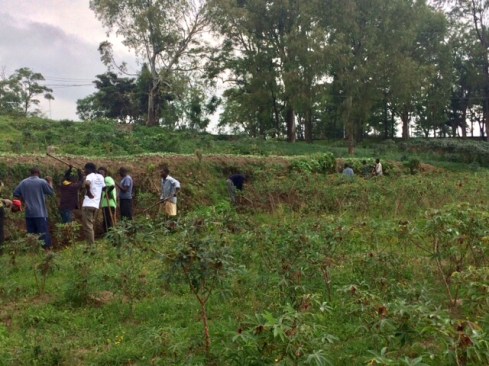
Fortunately, everyone else (except the two teenage girls next to me who were more interested in how they looked than work)  was working faster and harder than me, and we were soon assigned another task.  We moved off the road to the side of the hill. 3EED67BA-F4A5-43D0-9FBD-4F0A5DF00206 I could see hundreds of other workers further down the hillside already hard at work, burning trash and wielding their hoes high over their heads, hacking away at the side of the hill.  Others with shovels were removing dirt to form trenches.  Aha, I thought, so this is how terracing is done!  

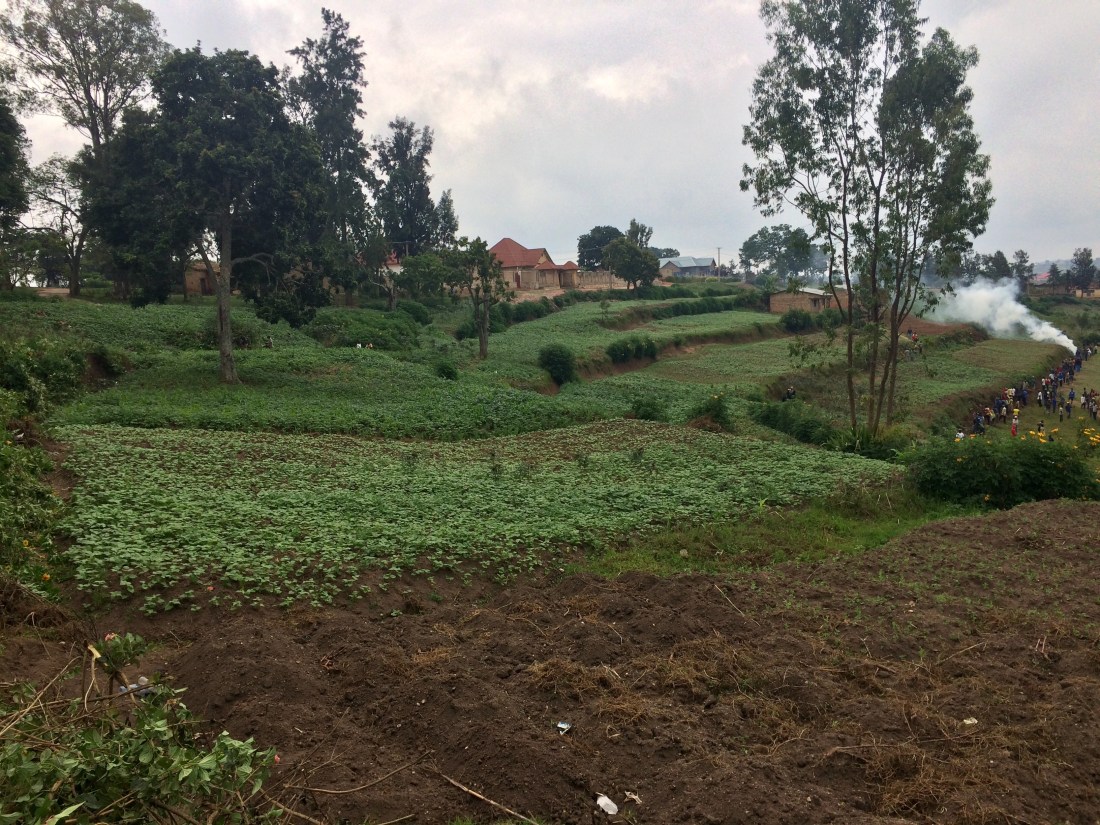
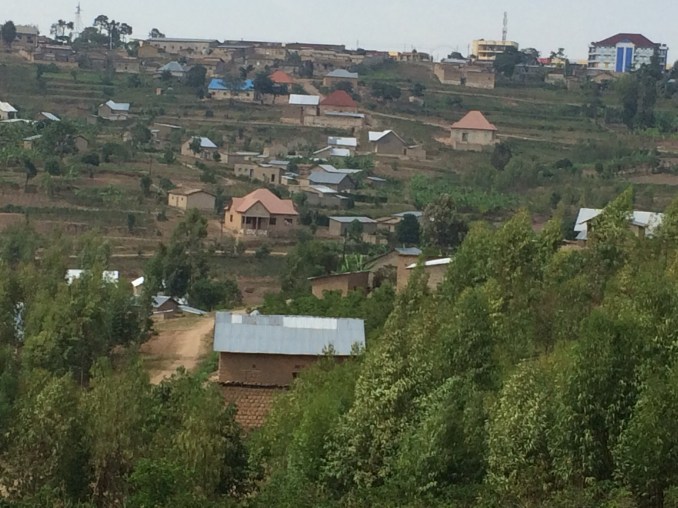
Rwanda is a land of undulating hills and an abundance of rain.  The rain, especially the crushing torrential rains during the heavy rainy season from February to June, is so intense that it floods the hills, removing topsoil as it gushes down the sides of the hills into the valleys.  Because Rwandans long ago deforested the hills to make farms, erosion is a huge problem.  To combat erosion, Rwandans terrace much of their land, cutting gigantic green steps into the sides of hills by hand and digging ditches at the base of each step to catch the rain and slow it down. In addition to serving important ecological and agricultural purposes, terracing makes the land look quite beautiful. 

Terraced agriculture, of course, is nothing new; it was employed even before the Incas in Peru and by the Mayans in Mexico.  It is widely used worldwide as an ecologically beneficial way to preserve soil health and increase farm production.  I was elated to have a tiny part in the ancient practice of terracing.  

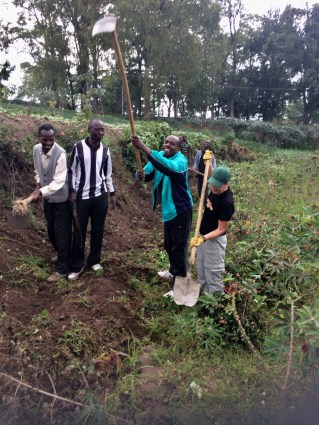
So, I joined the men and women already at work on the side of the hill with their shovels and hoes.  F42AB279-541C-4F5D-AA04-A1A0311BF53AThis hillside had previously been terraced some time ago.  However, with the passage of time, the neat terracing had become sloppy; the earthen steps had lost their sharp edges and the ditches at the bottom of each step for catching the rain had disappeared entirely, having been filled in with soil.  69297734-F581-4A50-A17B-4C2EFA882DF2Our mission was to cut into the side of the hill to make the steps square and sharp again and to dig a long trench at the bottom of each step to catch and slow down the pounding rain.  

We attacked our new job with gusto.  04710C9E-2A21-4BDD-89C0-1F40BFB14595I was handed a hoe and immediately began hacking away at the side of the hill to form the vertical five-foot riser. Men with muscular arms on either side of me were wielding their hoes with much more force and sometimes startling me as dirt flew my way.  On the steps below us, hundreds of other people were hard at work doing the same thing.  After taking a rest and relinquishing my hoe to another worker, I was given a shovel for digging the trench.  Not a deep trench, just deep enough to catch and slow the rainwater. Just below our step was a large field of beans waiting to take advantage of the longer lasting water that would result from our labor.  With so many enthusiastic workers, our task was quickly done.8F51A717-E5EB-462C-B972-C564583B1EAB

Now, it was time for the monthly meeting where information is shared. We reconvened a short distance from our work sites to a small hill on the side of the main road into town.  We sat in the shade of trees, even though it was cloudy and had been threatening to rain all morning.  Wearing only a cotton t-shirt, I felt cold as I sat on the ground with the other workers listening to speeches that I could not understand.  However, whenever I was able to pick out a word or phrase, I gave myself an imaginary pat on the back.  Soon, it started to sprinkle and the speeches came to an end.  After a five-minute walk as I arrived home, it began to pour.  I could not help but imagine our freshly terraced hillside robustly restraining and hindering the flow of the water, performing as terraced hillsides have been doing from time immemorial.   

B179C62E-D1D2-4F6B-9D20-3EBB7A7BBA92


The Birds and the Bees … and the Bats

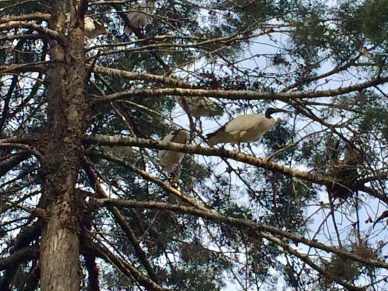
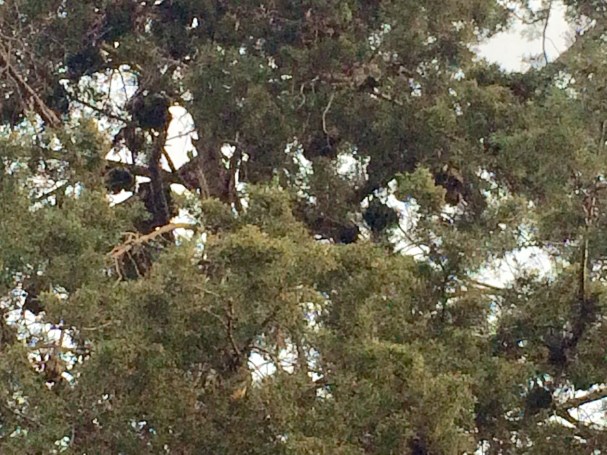
First, the birds. Last month, while walking home from town on the low road, I was surprised when a huge bird with a broad wingspan flew directly overhead and landed in a tall pine tree on the edge of the road. I looked up and saw that a row of six pine trees was serving as a bird condominium or maybe the neonatal care unit of a bird hospital.  A Rwandan man, also passing by, stopped and, intrigued by my curiosity, told me that the Kinyarwanda name for the birds was nyirabarazana.  B0A5F136-B03C-4233-88DA-97212B51A58BHe apologized for not knowing the English name, which seemed funny because I did not know the English or Kinyarwanda names. Once home, I looked up the name in a dictionary, studied my photos and determined that the huge birds were ibis – thankfully, a much easier to pronounce name than its Kinyarwanda counterpart. On line, I learned that ibises are common all over Africa. This particular species has a black beak and legs and is called the African Sacred Ibis because, in ancient Egypt, it was connected with the ancient god, Thoth, who is portrayed with the body of a man and the head of the ibis. Indeed, Wikipedia told me that Thoth’s name meant “He who is like the ibis.”  The Egyptians actually mummified ibis (the plural and singular are the same word) for burial as an offering to Thoth.  They killed so many ibis for sacrificial purposes that they established breeding farms of ibis.

In the top branches of the pine trees, there are at least 50 birds nesting or flying to and from their enormous nests that defy gravity as they splay out over the sides of the thin branches supporting them. I’ve walked this road dozens of times and had never before noticed these hard-to-miss birds. The reason was that these trees used to be inhabited by an enormous bat colony.  7CD5068F-8547-428D-AE2B-BC7D954216A8When the big, bully ibis arrived, they evicted the bats, forcing them to find a new home.  (More on that later.)  It seems that the ibis just came here to breed. They migrate with the rains and bear their young during the rainy season, which started in September and is still occurring. According to Wikipedia, each breeding season, female ibis lay one to five eggs, incubated by both parents for 21–29 days. After the eggs hatch, one parent continuously stays at the nest for the first week. The chicks fledge after 35–40 days and are independent of their parents after 44–48 days. Thus, I expect that these fascinating creatures will be gone within a month.  But, for now, I’m mesmerized by them. The Rwandans who see me staring and trying to photograph the birds laugh at my interest in what to them are ordinary birds.

Second, the bees.  Months ago, my house was invaded by armies of bees. They must have entered through the small gaps where the metal window edges don’t  fit snug against the metal frames.  (Those gaps also provide an opening for mosquitoes, which are much smaller than bees.)  Fortunately, soon after they stormed my house, the bees started to die, perhaps exhausted from trying to squeeze through the window gaps.  The result was that I came home to, or arose to, hundreds of dead or dying bees on the floor throughout my house.  The bees were so lifeless that I didn’t need to do anything other than to sweep them up and return them to the outside. I was never in danger of being stung. I didn’t know whether this was a normal seasonal phenomenon or something I should be concerned about.  So, I mentioned it to the school custodian who sent Issa, the head of the cleaning staff, to my home to investigate.  Issa came armed with a can of BOP, which I knew to be deadly because a fellow Peace Corps volunteer had recommended it to me to solve my ant problem, and it worked. Since the bees were already dead or almost dead, I hadn’t thought about bringing out the Bop. Issa, however, sprayed the BOP as if it was air freshener throughout my house, as I ran for cover. Even though the bee invasion continued for a few more days, I did not seek further assistance, as I thought cleaning up dead bees was better than inhaling the deadly BOP. The bee invasion lasted about ten days, each day seeing fewer dead and dying bees and, then suddenly the invasion was over, having stopped of its own accord. And, my bee-less life returned to normal.

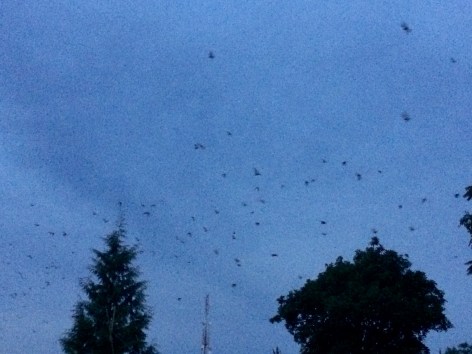
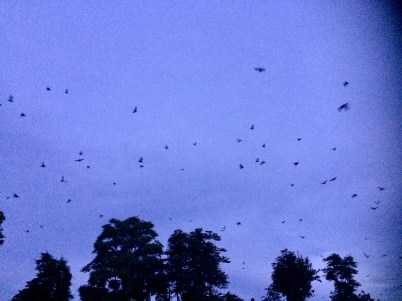
Last but not least, the bats.  They arrived last month, quite suddenly – around the same time that the ibis arrived in town.  In fact, I think that the burly ibis forced the bats to move from their condos on the other side of town to my neighborhood.  At first, I thought the noise awakening me at 5:00 a.m. was from particularly noisy birds.  Bu this cacophony of bubbly chatter was different.  When I pulled back the curtains to look through my bedroom window, I saw hundreds of bats frenetically flying everywhere.  Fortunately, they were high in the sky, or it would have felt like an attack of “The Birds” from Alfred Hitchcock’s movie of the same name.

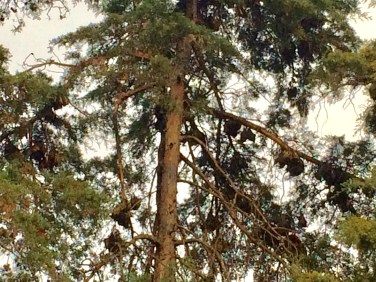
Around 5:00 p.m., the same thing occurred, except in reverse, as the bats were waking up, getting ready for their nightly foray into the Rwandan sky in search of a feast of mosquitoes and other tasty insects.  Now, the bats were even more visible in the sky.  Being outside, my curiosity impelled me to follow their clamor and walk the entire length of a row of about twenty towering scraggly pine trees where they had taken up residence, beginning with the tall tree in my front yard. In the highest branches of every pine tree were mobs of garrulous bats hanging upside down, filling the air with their sizzling sound and electric energy.  Being in October and before Halloween, it felt seriously spooky.  7A514FC3-6A93-4A60-8076-748F23447E7ECraning our necks to look straight up, my umuzamu, Jared, and I were awestruck by the thousands of bats flying about above us.  He told me that in Kinyarwanda, one bat is “agacurama” and the mass of bats captivating us were “uducurama.”  E66FF5B6-5352-4BCD-B306-9694627AE779

After weeks of observing my bat neighbors, I’ve grown accustomed to their comings and goings, as well as their rather exciting social lives. They are definitely social creatures, thriving by living in colossal communal societies.  A10750B4-DA81-4993-AF57-D8ED6C86B3CC


In fact, the bat colony that had taken up residence in the forty or so pine trees in the block around my house is a densely-populated bat metropolis. There are no lonely bats, no black-sheep-of-the-family bats, no fringe bats compelled to resort to Facebook or Gab posts to assuage their loneliness. Rather, every bat is an integral part of the humongous bat bureaucracy. Their daily lives are simple. They sleep during the day and start waking up around 4 p.m. At that time, 4CDC5CD7-2DAA-4793-9C23-20422C84A4BEtheir chatter gets louder and louder until it is a raucous roar, as the bats begin about 4:45 p.m. to leave their roosts one by one and head into the sky, circling above my house while chatting with one another before flying off into in search of their mosquito meals. I tried to take photos, but with my camera the bats only appear as globs in the tree branches.

At 5 a.m., the bats return in droves to their roosts, noisily greeting each other as they reunite above my house after an exhausting night of hopefully gorging themselves with mosquitoes and begin to settle down for bed during the day. Their early arrival each morning is so boisterous, it is like an alarm clock awakening me.

Because I now reside in the bat part of town, I thought I should get to know more about my new neighbors. As I couldn’t ask them, I turned to Wikipedia to learn that bats are the only mammals naturally capable of flight and that bats comprise 20% of all mammals –  meaning there a whole lot of them. Indeed, there are about 1,300 species of bats and 48 subspecies of bats with descriptive names, such as the straw-colored fruit bat, the Rufous mouse-eared bat, the Cape hairy bat, the Butterfly bat, the African yellow bat, the Dragon tube-nosed fruit bat, the New Georgian monkey-faced bat, the black-bearded flying fox bat and Peter’s epauletted fruit bat. 0C279D1D-6F24-4EA3-8DDD-44A4C8933F69According to Bat Conservation International, Africa is home to more than 269 species of bats, and Rwanda is in a belt across Africa with the highest bat population.  Bats are usually divided by what they like to eat: the insect eaters (insectivores), the nectar, pollen and fruit eaters (frugivores) and the blood eaters (vampire bats – yes, they are real), which savor the blood of cattle or birds.  Bats have teeth, mostly for eating crunchy insects. The fastest bat ever is the Mexican free-tailed bat, common in Texas, which can fly up to 99 mph. (Don’t tell ICE.)  Bats can live to be 30 years old, but that’s not common.  Despite my research, I don’t know the name of my bat neighbors.  I know only that they are black with no descriptive markings .  They look like the common bats we are familiar with in the U.S., thought their wingspan here is bigger.  I don’t know for sure what my bats eat, but I hope their favorite food is mosquitoes.  I do believe that, since they moved in, the mosquito population has decreased.

Wikipedia informs us that bats are among the most vocal of mammals, even more garrulous than humans, and I know that to be true from listening to them day and night. So, what do they talk about? Perhaps they are squabbling over food, jostling over position in their tight-knit sleeping cluster, protesting over mating attempts, gossiping or arguing?  In flight, some of their sounds are for traffic control.  With so many bats in the air and no traffic lights, you can imagine the confusion. Thus, when bats are on collision course with one another, they make sounds that are the human equivalent of honking a horn. Even during the day, when they are supposedly sleeping, I hear a constant low-key buzz coming from the trees, perhaps from bat babies refusing to sleep.

During the day, as they sleep, they hang upside-down from the tree branches, which to us humans would be an impossible way to sleep.  However, bats have tendons in their feet that allow them to lock their feet closed when hanging upside-down, so, unlike us, they don’t need any muscle power to grasp or hold on to their perch.  Instead, they only use their muscles to release their feet.  0F5E57EB-5D3F-4EB7-A288-0430D5BABF07One would also think how impossible it would be to take off in flight from an upside-down position.  But not for bats – because their femur bones are attached to their hips in a way that allows them to bend outward and upward so that they can easily fly from their upside-down roosts.

Some bat colonies have over a million bats. For bats, there is safety in very large numbers; the more bats the less likely they will be attacked by a predator.  My neighboring bat colony easily has thousands of bats.

Bat Conservation International’s website teaches that most bats are polygamous, and matrilineally-related females and their offspring form long-term relationships with one another, which probably accounts for the large groups of bats hanging in clusters from tree branches.  Female bats are ingenious; no matter when they are impregnated, they can control the timing of the birth of their young to make delivery coincide with the maximum availability of food. In the Southern Hemisphere, births usually occur in November and December. 01D2B529-B19D-4485-93D4-1EE13B51F7D8


In Rwanda, which is just south of the equator, that means towards the end of the first rainy season, when mosquitoes are abundant. Bats usually have a single pup (yes, that’s what bat babies are called) per birth.  The moms give birth in maternity colonies and assist one another in birthing.  Then it takes about 80 days to wean the pups.  I wonder, once the pups are weaned, will the bats migrate.  Or, if the ibis migrate, will the bats return to their old neighborhood?  I’ll have to wait and see.

When the bats first moved in as my neighbors, I found them creepy, and I recalled my first days as a 21-year old Peace Corps volunteer in 1971 in Ghana, when my house (which had been vacant for the year before I arrived) was inhabited with a small bat population.  I couldn’t sleep at night because the bats were buzzing around above me, as I lay in bed with the sheet covering my head.  After weeks of barely sleeping (I was shy then), I reported the matter to the head of the school.  He and all of the teachers trotted across town to inspect my bat-infested house and then sent the school carpenter to remove the bats, which he successfully did, and I lived happily ever after.  I later got even with my bats by eating a bit of bat, as some Ghanaians eat bats.  What do they taste like? Chicken, of course.  In contrast, in Rwanda, bats do not appear to be a delicacy, which is fine with me.

I don’t think that I’ll ever invite my new neighbors for tea or drinks, as I want to keep my distance from them.  But, so long as they stay in the trees and out of my house and keep down the mosquito population, we will peacefully co-exist and both be happy.

Smoking and Masculinity in Rwanda and America

Because I have never smoked, I don’t now think much about smoking – and that is despite the impact that smoking has had on my life.  Smoking killed my father at an early age. Second-hand smoke from my father’s addiction to Camels likely diminished my lung capacity and perhaps caused my mother’s lung cancer. My ex-husband’s mother’s smoking probably caused his lifelong asthma and COPD problems, of which he recently died – despite being a non-smoker. His mother’s lifelong smoking caused her own slow and agonizing death, which I witnessed firsthand. Smoking killed his dad in his mid-forties.  And, my oldest son is addicted to smoking (albeit e-cigarettes now), despite my encouragement to quit.  

However, last night I began to think again about smoking. My 30-ish American friend and I were sitting at an outdoor table in a hotel bar, having a drink.  For some people, having a drink and having a cigarette go hand in hand.  And, so, my friend excused herself to go to a nearby shop to buy cigarettes.  

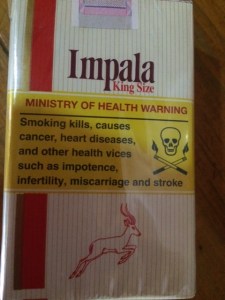
While waiting for her return, I thought about smoking in Rwanda. To smoke in Kinyarwanda, Rwanda’s language, is “kunywa itabi,” which literally means to drink tobacco. (Because cigarettes were introduced by Europeans, Rwandans lacked a word for smoking, and the act of smoking a cigarette seemed like drinking it.)  My experience was that very few Rwandans smoke. In fact, I’ve never seen a Rwandan actually smoking.  But then I don’t frequent the many bars and night spots of the capital city where I would imagine that smoking is more common. 8A5DBE7D-519A-489D-9EB7-809BCE8A1E5DIn my town, however, several times a week, I have seen a few Rwandan men (never a woman) come into my favorite little shop to purchase one or two Impala brand cigarettes for 50 francs (about 6 cents) each and then leave with the cigarette or two in hand. 

However, my google search found a March 31, 2017 article of the Rwandan on-line media outlet “Kigali Today” with more specifics about smoking in Rwanda.  According to that article, a Rwandan government survey concluded that 12.8% of Rwandans between 15 and 59 years old had used tobacco products.  Of those users, ten per cent were men and two per cent women.  

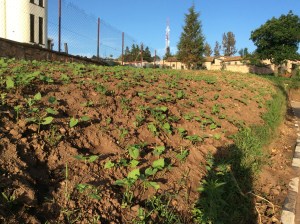
Although I have heard that some tobacco is grown in Rwanda, I’ve never seen it.  Instead, the main cash crops are tea and coffee; large tea and coffee plantations exist here.  And, Rwandans, being amazing farmers, grow beans, peas, cassava and other food crops for their own consumption on every piece of bare land 8AAC6427-5243-49A8-B93F-3A116F0C41EE(including this narrow strip of land sown with bean seeds next to my house) that they can find. 

When my friend returned, I was surprised that she had an entire pack of cigarettes, because I’ve never seen anyone in Rwanda with an entire pack.  Her pack cost 1,000 francs, which is about $1.14.  The cigarettes in that pack were manufactured by TabaRwanda, 70% of which is owned by the British American Tobacco Company, Ltd., according to an 8 Oct. 2001 article in the Ugandan Monitor.  The cigarettes are manufactured in Kenya.

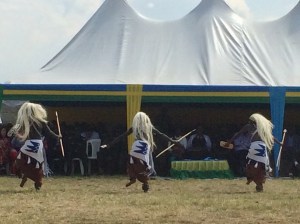
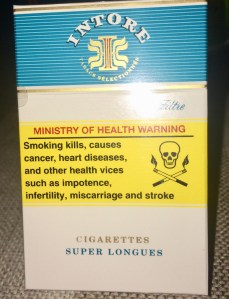
The brand name on the pack was “Intore,” which every Rwandan knows were traditional bare-chested, spear-wielding, intensely energetic male warrior dancers. They still perform at public events and are exciting to watch.  Their waist-length, flowing blonde wigs made from a special tree are meant to resemble the mane of a lion – yet another symbol of masculinity.  63139955-72FA-45A2-853B-3CA2ABD2F235The streaming gold lion manes make a spectacular sight as the dancers jump and whirl frenetically to the sound of drums and the bells on their ankles.  The effect is electrifying and one cannot help but feel the dancers’ raw, masculine energy. Thus, I assumed that by calling the cigarettes “Intore,” the tobacco company hoped to evoke that same intense male energy and excitement in potential purchasers and to subliminally connect that feeling of masculinity to smoking.  

I examined the warning label on the cigarette package my friend had just purchased; it is different from the one on American cigarettes, which is usually “Smoking Causes Lung Cancer, Heart Disease, Emphysema, And May Complicate Pregnancy.” 77B009FE-D07C-4703-B5F6-471EDA34F0FFIn contrast, the Rwandan warning (one side English and one side Kinyarwanda) is more vivid and appears next to a skull and crossbones made up of 2 lit cigarettes.  It reads: “Smoking kills, causes cancer, heart diseases, and other health vices such as impotence, infertility, miscarriage and stroke.” A063BC89-D22C-42EF-B7C3-CA16D5973E60


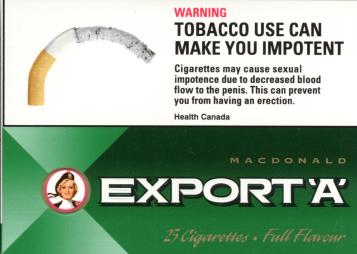
Impotence?  I found the addition of impotence interesting – especially since impotency is the polar opposite of the image of the young and hyper-masculine Intore dancers conjured up by the cigarettes’ name.  And, I wondered if seeing the impotency warning would reduce men’s desire to smoke or cause men to quit.  I also wondered why the U.S. did not require that warning and whether any other country required a similar warning.  It turns out that America’s friend to the north, Canada, includes an even more eye-catching warning: a picture of a bent, flaccid cigarette next to an impotency warning that does not mince words.  A6C46AE1-89DD-41A9-B76A-FAD46E19D1BC

Back to the United States, I found that the government’s attempts to require more specific and graphic warnings have been met with lawsuits.  In 2009, the U.S. Congress passed the Family Smoking Prevention and Tobacco Control Act, a law giving the Food and Drug Administration (FDA) power to impose new cigarette warnings.  About two years later, in 2011, the FDA devised new warning labels that would have required more graphic text and images on cigarette cartons.  However, none of the new warnings included any mention of impotency.  Still, the tobacco companies were unhappy and sued the FDA, claiming that the warnings violated their First Amendment rights because they went beyond providing information and required the tobacco companies to advocate against smoking.  One appellate court agreed with the tobacco companies that the law was unconstitutional, but another appellate court reached the opposite conclusion, while deciding that a few of the FDA’s requirements went too far.  In 2013, the United States Supreme Court refused to break the tie, when it declined to hear the appeal.  Therefore, the FDA was forced back to the drawing board to come up with new warnings, which they have not been in any hurry to do.  According to the FDA’s website, the “FDA has been undertaking research related to graphic health warnings since” 2013. Notably, there is no indication that the FDA is considering adding an impotency warning. 

So, if you want to know the truth about smoking’s effects on your sex life, you’ll have to travel to Canada or Rwanda.  And, in Rwanda, if you buy Intore cigarettes, you’ll be conflicted, as you are warned about potential impotency while presented with a brand name that symbolizes hyper-masculinity.  It made me recall the ubiquitous rugged Marlboro man in American smoking advertisements, and I wondered how, after decades of smoking, the alpha-male Marlboro man dealt with his impotency.

My Umuzamu

When I first was given an umuzamu, I felt uncomfortable.  It seemed strange to have a man hanging around my house all night.  After a few weeks, however, I found that having an umuzamu was comforting.  And, now, I don’t know what I’d do without my umuzamu.  

It all started a few weeks after I moved into my two-bedroom house. That Sunday morning, I walked into the extra bedroom and saw that the bed, which had been perfectly made the last time I’d entered the room, was bare with only the naked mattress.  I instinctively looked at the window and saw broken glass on the floor.  But, the window had bars, so how had someone stolen the sheets and comforter on the bed?  I phoned the director of facilities at my school. He immediately sent someone to my house, who explained that, after breaking the glass, the thief had opened the window and then reached in with a pole with a hook and pulled the sheets and comforter through the bars of the window. A not uncommon type of theft here I was told, but still unsettling.  Nothing besides the bedding was missing, so I felt lucky.  

I happened to have saved a piece of cardboard, which I taped to the window to keep out mosquitoes.  However, by late afternoon, the school had replaced the window for me and helped me clean up the glass.  To avoid future smash and grabs, I moved the bed as far from the window as possible. A few weeks later, I replaced the stolen items with colorful sheets and a comforter than I bought in the market.  

Although my house is next to the school, it is not private.  Anyone, and everyone, can walk up to, and around, my house at any time of the day or night. Yet, I never felt unsafe because of the bars on the windows. 56186DCC-540D-4C97-8569-3683E9443FFAStill, as a result of the incident, the school assigned an umuzamu to guard my house at night.

My umuzamu, Jared (no, not Kushner), looks to be in his mid-twenties. He works for Top-Sec, the same security firm that provides the school with guards during the day and night for the four-story office building where I usually work and the school’s compound that houses the main classroom, the library, additional offices and some dormitories. The Top-Sec guards wear smart-looking forest green Top Sec uniforms with a red stripe on the side of the pants, with a cute Top-Sec baseball style cap and even Top-Sec sweaters for cold nights.  They carry a black stick that resembles a billy club, but my umuzamu, fortunately, has never used it to my knowledge.  

After I got over my initial reluctance at having a handsome young man hang around the outside of my house all night, I embraced the idea.  What if I had a cockroach or a mouse, or worse, a rat (like several of my fellow volunteers in other towns have had to contend with)?  If I encountered such a trespasser, I could simply call my umuzamu for help. Now, that was a comforting thought! Fortunately, I’ve had none of those interlopers. However, one dark night, I surprised what I thought was a mouse in my bathroom, but happily it turned out to be a short, fat, fast-moving lizard that sporadically appeared over the next two weeks and then was never seen again.  (I don’t mind sharing space with lizards because they eat mosquitoes and other insects).

I usually do not get home after work until about 8:00 p.m., by which time it is quite dark.  Before having my umuzamu, I was always a bit nervous arriving home in the dark and unlocking my backdoor (my front door is taped shut to keep out mosquitoes). AB266550-D542-4F68-A056-67609CAFD898 But now, my umuzamu is always there to greet me with a smile and ensure that no harm comes to me.  

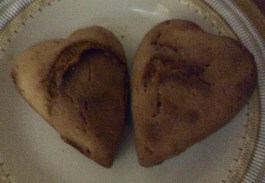
Each night, after work, I go for a bite to eat in the same tiny shop across the street from my school.  I make sure to buy something for my next day’s breakfast, as well as a snack for my umuzamu. Sometimes, I buy samosas (little packets of fried dough with spicy meat inside). Other times, I buy chapatis or the popular little heart-shaped cakes (called keke, which is pronounced kay-kay). 4F350BFE-205D-4329-A335-9FF07967F976But, most often, I buy amandazi, the Rwandan equivalent of donuts, but without the hole. When I arrive home each night, I hand my umuzamu his nightly snack, which of course makes him always eager to see me.  9923238A-1BC0-482C-B78F-7BDA17B3A276And, we chat. I practice my limited Kinyarwanda with him, and he practices his limited English with me.

On clear nights, I greet him by saying, “Hari inyenyeri mu ikerere.” (There are stars in the sky.)  Then, we gaze at the stars together. Sometimes, we talk about the ukwezi (moon).  On the night of the total lunar eclipse in July, we gazed at the sky together on and off for hours, and I tried to explain what the lunar eclipse was, even though I didn’t clearly understand it myself.  Often, I open my iPad with my star guide so that we can try to identify stars and planets together.  We often see the Southern Cross, and Mars is easy to spot because of its red glow.  And, when it’s cloudy, we shake our heads and say, “Hari ibicu byinshi” (There are too many clouds).  

My umuzamu uses an extra room attached to my house (conveniently to the left of my back door), where he has stored some old chairs and keeps some warm clothes for cold nights.  After someone stole his extra sweater from that room during the day, I had a key made for him.  

I don’t see my umuzamu in the morning because he leaves at 6:00 a.m.  But, when I wake up at 5:30 a.m., I hear him moving about, locking up his room and getting ready to leave.  It’s reassuring to know that he was there all night and to know that, when I arrive home in the dark that evening, he will again be there to greet me and gaze at the stars, the moon or the cloudy sky for a few minutes with me.  I don’t know how I ever lived without an umuzamu. 

The Backroads of Ruhango


75F45D3E-3AE5-4FF5-8BAD-2A7EA81002FDRising up from the town of Ruhango is a dirt road that snakes up the hillside to a tree  at the very top of a hill.  That was our goal – to hike up that road to the meandering paths adjoining it and finally reach the tree.  It was a warm morning, but my ever ready friend, Bene, had packed plenty of water for us.

As we left town, the houses and people became fewer and fewer.  Sometimes we were alone, but usually we saw people in the distance walking or working.  A few children tended a goat or cow.  DAEA4754-C45D-45D1-9226-934586C85B2FSome walked with us a short distance, chattering in Kinyarwanda and trying out the few English words they learned in school on us.

We passed occasional well-kept  houses.

When we reached the tree, we found it was an avocado tree, loaded with large, ripe avocados, which now are plentiful in the markets.  We spent some time admiring the tree with friendly residents.

075CED01-4B55-4DD7-9C46-787552804228

On our way down, we sat on a rock ledge and snacked on the trail mix of nuts and raisins that Bene had made for us and enjoyed the lovely views.

And, I stopped to chat with some inquisitive children.  23A8A836-C2AA-4B72-A8F0-A5BFBAE122AD


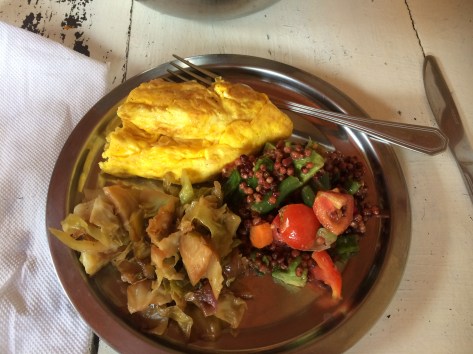
Back in town, I stopped at a tiny bar to buy two bottles of Primus Citroen, a lemon-flavored beer that Bene and I enjoy when we are together.  I paid for the beer, as well the bottle deposit, which I later got back when I returned the empty bottles.  We took the bottles to the kitchen of Bene’s cute three-room cottage, where Bene made a colorful and tasty lunch for us: omelette, sautéed cabbage and a sorghum (the small red balls that look like beans) salad.  Sorghum is a popular grain in Rwanda and frequently used to make sorghum beer.

C0C09E3F-8A8A-4E40-8F06-249A6ACD67F4

So ended a lovely hike and lunch in Ruhango, Rwanda.

MUHANGA AND THE BUMBLE BEE SHOES

Muhanga is Rwanda’s second largest city, located just one hour from the capital, which is the largest city, and an hour and a half bus ride from my town. The population is around 100,000.  I had ridden through Muhanga a few times on my way to somewhere else, but I had never stopped to explore it. Because my friend Bene and I both live in small towns, we decided to spend a day in the city of Muhanga.  

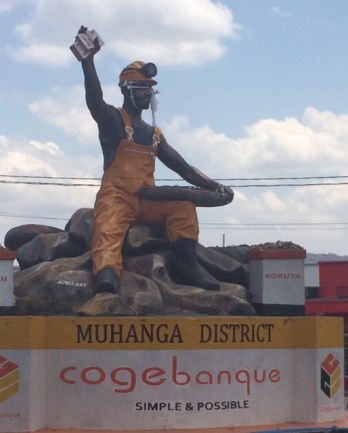
Miner

At an intersection in the center of town, one can’t help but notice this imposing statue, which recognizes the importance of the mining industry in the Muhanga District. The statue, commissioned by a Rwandan bank, is of a miner with a fistful of money.  Unfortunately, on the day I visited, someone (likely mischievous teens) had put toilet paper in the miner’s nose, proving that teenagers in Rwanda are no different from teenagers everywhere else.

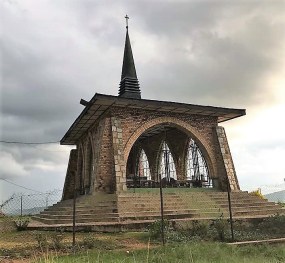
Our first objective was to walk to the small Catholic chapel that sits atop a hill and can be seen from IVAQ6524 (2)everywhere in the city. Because its architecture is so unusual, the chapel acts like a magnet drawing people like us to hike up the hill to take a closer look.  The walls are glass.  Thus, although it was closed, the chapel’s transparent walls and open design allowed us to see inside and take photographs of the beautiful black madonna which is its centerpiece.  A young woman was sitting outside on the steps. We interrupted her praying to ask the name of the chapel.  “Chapelle of our Lady of Fatima,” she replied.  The chapel is simple and very small, yet classically elegant.

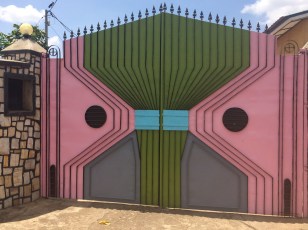
I later searched the internet for something about why this charming chapel was built, but could find nothing at all on it.  On the way down the hill, we came upon this artistic gate.

19A396DB-76A7-49AB-AD3B-93F5F28ADB9F

Next, we tackled Muhanga’s large, crowded, colorful and chaotic outdoor market that has everything from fruits and vegetables to household goods to clothes, fabric and shoes.  Bene, being half French, found the most amazing mushrooms.  I got some cucumbers.

Bene, unlike me, is an amazing shopper and eagerly took up the challenge to help me look for a pair of simple black flat shoes for work. Shoes in Rwanda are an important status symbol, and the shoes I had brought with me for work and teaching were wearing out and starting to look shabby.  Buying shoes here is nothing like in the states. First, one doesn’t sit down and wait for a salesperson to bring boxes of shoes to you. Nor does one casually look at rows of shoes neatly grouped by sizes on racks.  Instead, here, one walks through the market checking out the displays of shoes on the ground or on a table, all styles and sizes mixed together, in each small market stall. The minute you show any interest (the slightest pause or the absent-minded touching of a shoe), the vendor bombards you with scores of shoes she or he thinks you will love.  Stall after stall of shoes beckoned us, and it seemed like there were millions of pairs of shoes to sort through – too overwhelming for me. But not for Bene.  She homed in on a pair of black flats that I might like, but they were too small. I felt like one of Cinderella’s stepsisters trying to force my foot into tight-fitting shoes to prove to the vendors that the shoes were indeed too small and that I needed a larger size.  

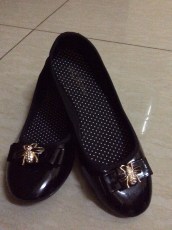
All of the shoes we saw used the European shoe size system and it appeared I needed a size 42, of which there was a scarcity.  However, one young man stuck to Bene and me like glue, as we roamed from stall to stall. He was what I have come to call a shopping assistant: a young man who latches onto a shopper to help them find exactly what they are looking for in the seemingly disorganized market. They are quite common. My shopping assistant was determined to find the perfect shoe for me.  Quickly gathering that Bene, not me, was the one to please, he had shown her a black patent leather shoe with a rhinestone bumble bee on the toe. 91C14B37-06F4-43FA-AB81-3AC8B1EA1345Bene instantly decided that was the shoe for me, but the size was way too small. Our shopping assistant finally found a size 42 from one of the vendors, which he ecstatically presented to me, but surprisingly it was too large. So, back he went running from vendor to vendor, frantically searching for a smaller size of the bumble bee shoe.   Finally, he found a size 40.  By this time at least a dozen people were crowded around me, watching intently as I slipped my foot into the shoe.  When it fit, I felt like Cinderella.  “Aha, at last!” I grinned, and the crowd around me breathed a sigh of relief.      

I smugly thought I was a shrewd bargainer getting our shopping assistant down to half the price he originally demanded. However, later when I showed the shoes to my friend, Olivier, and his sister, they said I paid twice what I should have. We all got a big laugh out of it.

With shoes and vegetables in our backpacks, Bene and I found an out-of-the-way shop selling juice and water, so took a short break before exploring more of the town.  We walked to the edge of town and then beyond, looking for a foie gras farm that Bene had heard about. The French part of Bene impelled her to find the farm – foie gras being that outrageously expensive French delicacy produced from the fatty liver of  force-fed geese or ducks.  It seemed to me absurdly  improbable that Rwanda would have a foie gras farm, but then I remembered its Belgian colonial past and the huge influence of the French here decades ago and thought, “Why not?” 7FC7420E-EDAA-4D55-9F71-F7B999E51E69As we wandered further from the city center, Bene brightened when she saw a sign for the farm, pointing down a narrow dirt road, which we immediately embarked on.  We walked at least a mile down that road but saw no evidence of the foie gras farm. I was secretly relieved, not relishing the thought of seeing force-fed ducks. Instead, we observed beautiful scenery and Rwandans hard at work in rice fields. We also stumbled upon a chicken and turkey farm and were given a quick tour by the young woman in charge of it.  But no ducks were to be found.  Failing in our goal to find the foie gras farm but having worked up a substantial appetite, we sauntered back to the city center and headed for the Muslim quarter, hoping to find some good food for lunch. We had imagined sizzling goat kebabs, but found not a single restaurant. We did, however, see an interesting mosque

and a particularly pretty house and garden.

AA910738-B197-4A49-880B-B5BD247EF4A8

On our way back to the bus station, hungry from walking, we stopped in the restaurant of the Splendid Hotel, hoping for a splendid lunch. Because it was late afternoon, we were the only customers.  Bene had a beef steak with a salad and fries, and I had onion soup and a cheese pizza which, compared to what I usually eat, was quite exotic. We toasted ourselves with Primus Citroen (a lemon-flavored Rwandan beer that Rwandan men eschew but Bene and I like) for having had a splendid day of sightseeing and shopping in Muhanga.

On Monday, I wore my new bumble bee shoes to work in my office.  Fanny, the young woman who cleans our offices each morning and who had never before commented on my shoes, clapped, squealed and broke out into a little dance as she spotted my sparkling new shoes. I had finally arrived in Rwanda!

The Wedding Present: Part 2

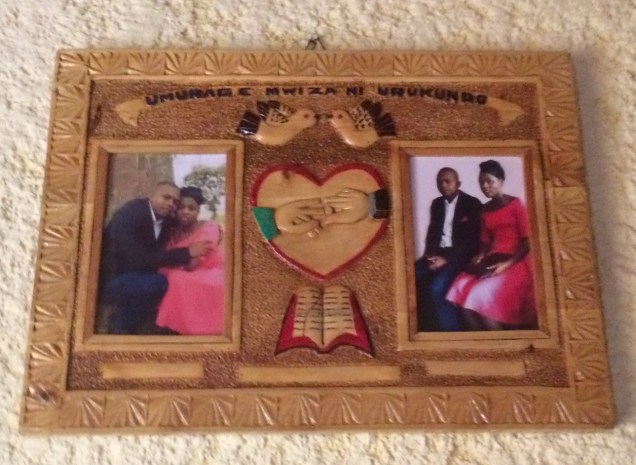
The bride invited me to her new home on the other side of town.  And what a lovely home it is.  The small front yard has an avocado tree, a papaya tree and a banana tree.  The newlyweds are blissfully happy.  As soon as I walked into the living room, the first thing I noticed was a large wall clock with a gold-colored metal rim. Now, I knew the couple’s taste in wall clocks and was glad that I had not given a clock as a present because they would now have at least two wall clocks.  Then I noticed Nicole’s wrist; she was wearing a wristwatch.  A good thing I also rejected the wristwatch idea for a gift.  And, then, I spotted it – my wedding present hanging in a prominent place on the wall above the couch. I took this snapshot. 0c220307-97a1-4e99-97a9-e735627a31f4.jpeg

The couple was elated with the present and thanked me again and again for it.  The gift turned out to be even more perfect than I’d imagined because the photos were of the couple during their civil wedding ceremony, which I had not previously known. Thus, there would be no reason for them to replace the photos that I had painstakingly obtained for the plaque. The wall hanging was inscribed with the phrase “Umurage mwiza ni urukundo,” which literally means “Good inheritance is love.”  There was no question that this house was filled with love. 70588750-35D3-43C0-9674-E252AFAA9768

Nicole (pronounced “Nikoray” because Rwandans pronounce Ls like Rs and pronounce the last vowels in words) served tea.  On the small TV in the living room, the DVD of the wedding played. It was fun to re-live the wedding and see myself as part of it.  On the coffee table was my wedding card wishing the couple “reak happiness.” Fortunately, the grammar mistake seemed to have passed completely unnoticed.  

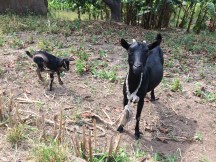
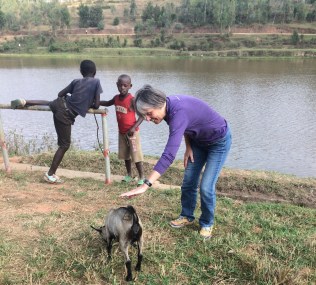
Nicole invited me to go for a walk, which turned out to be quite a hike around a part of town I had not previously explored.  As we walked around the “lake,” which is actually a dammed pond, I foolishly stopped to pet a goat (ihene).  Nicole is a fast walker and, feeling my age, I sometimes struggled to keep up with her 3B25F440-CE3C-4AAB-9B6D-686745140E21on the narrow, winding paths and many steep hills in our town. She periodically asked with concern in her voice if I was tired, and I always replied too quickly that I was not, saying “Oya, nabwo ndananiwe” in Kinyarwanda, which she no doubt knew was a lie.  So ended another lovely afternoon of perfect weather in Nyanza.


My Umushanana and the Wedding

For the wedding, I needed to wear umushanana, the traditional Rwandan formal dress for women. Fortunately, there are special wedding and formal occasion shops that rent umushanana and even wedding dresses.  I was told that renting the attire should cost me between 2,000 to 3,000 francs (between $2.30 to $3.50), depending on the fabric.  So, two weeks before the wedding, I scoped out the several shops in town for the most stunning umushanana and decided on one shop.  The young and fashionable proprietress held up several fabrics to see how they looked against my pale skin.  Together we settled on what I thought to be a lovely umushanana. But, when I held it up to my waist, it seemed too long. “Oya,” meaning no, she insisted, it’s fine.
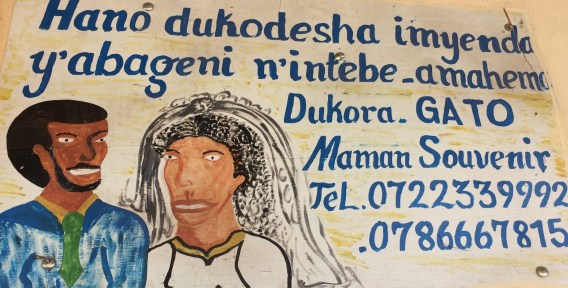
880AB778-F984-42B5-A843-E4135224C965

Above is the wedding shop sign that attracted me to the store where I rented my umushanana.  The sign says that the shop rents clothes for the bride and groom, as well as tables and tents.  It also makes wedding cakes.  “Gato” is the Kinyarwanda word for cake, borrowed from the French word “gateau.” However, sometimes Rwandans use the English word “cake,” but Kinyarwanda-ized as “Kaykay.”

Next, I needed an appropriate blouse to wear with it. The proprietress instantly handed me a skin tight, long-sleeved, lacy white blouse.  Rwandans love their clothes skin tight, so I was delighted to be fitting in. Fortunately, the blouse was made of a stretchy fabric so that I could get it over my head.  She said she would charge me 3,000 francs, which I found reasonable, and told me I could return a few days before the wedding to pick up the items and pay at that time.

Shoes were another problem. Rwandans are crazy about proper, spotlessly clean, “smart” looking footwear.  Indeed, the first thing they look at when meeting someone is that person’s shoes.  For weeks, I had been looking in the market for the right shoes to wear with my umushanana but could find none that looked comfortable.  Comfort, as opposed to looks, was my most important criterion in shoes because I knew I’d have to walk in them.  The church was about a mile and a half from my home.  Rwandans would take one of the ubiquitous motorcycle or bicycle taxis. However, because Peace Corps prohibited volunteers from taking either, I would have to walk, and I was determined to walk in comfortable shoes.

Three days before the wedding, I sauntered into town to the rental shop to pick up my outfit.  I paid my money and took my outfit away in my shoulder bag.  When I returned to my office, I ran into my friend Charles and excitedly showed him my outfit and expressed my concern that it was way too long.  He agreed and said that I would need to hike up the skirt at the waist to avoid tripping over it.  I tried on the skirt portion of the outfit and hiked it up to a walkable level.  However, it made my waist so thick that I looked like Humpty Dumpty. So, I asked my very fashionable female colleague, JJ (who I’ve seldom seen wear the same outfit twice), to take a look at my bunched up umushanana. Immediately, she exclaimed it was all wrong. The white blouse looked terrible; it did not go with the design or colors of the umushanana. There was no white in the umushanana.  I should take it back and get a black blouse, or a blouse that picked up one of the several colors of the umushanana.  As for the length, she unrolled the fabric from my waist and let it fall to the floor and said it was perfect, that it was supposed to cover my shoes.  I might trip over the long skirt, but at least it solved the problem of what shoes to wear.  I would wear my old, comfy, broken-in Teva sandals since they would be hidden by the flowing gown.

My next question was how to hold up the top piece of fabric. “With a safety pin,” JJ responded.  Since we had no other safety pins, I took the large safety pin that secured my trousers around my waist (the safety pin being a necessary addition since I’ve lost enough weight here that, in the absence of suspenders to hold up my pants, a safety pin has done the trick). JJ used the safety pin to attach the top fabric, but said I needed to go back to the shop and get a tiny, discreet safety pin.

Because I liked the white, lacy, stretchy blouse, I didn’t take JJ’s advice about replacing it, but I did go back to the rental shop to ask for the tiny safety pin, since even I agreed that a big safety pin on my shoulder would look gauche. The proprietress sold me two tiny pins for 100 francs, the equivalent of 12 ½ cents.

On the morning of the wedding, I looked at my mangy purse and realized I needed to get a new one for the wedding. I had ordered a new purse from Amazon in June. Because Amazon refuses to ship to Rwanda, I had the purse sent to my son in Washington State and he resent it to me. However, it still hadn’t arrived in Rwanda.  My ragtag purse was being held together with scotch tape, and was clearly not fit for a wedding, so I made an emergency trip to the market to look for a suitable replacement.  When I entered the market, a young man asked me what I was looking for.  When I told him “a purse” and pointed to my raggedy old one, he immediately took me to his friend’s stall, where at least fifty purses were on display.  Again pointing, I made it clear that I wanted a small one.  The two men found the perfect purse: small and a neutral beige that would blend nicely with my multi-colored umushanana.  Plus, it had a shoulder strap. We bargained for at least five minutes over the price.  He started at 7,000 francs, but finally came down to 3,000 francs (just over $3), which seemed reasonable.

When I arrived home, I took out my stylish new purse, preparing to transfer the contents of my old purse into it.  However, before I even removed the new purse from the bag, the shoulder strap fell off.  I noticed that the few stitches holding the strap to the purse had come loose.  Well, I would either have to use it without the strap or use my large safety pin to reattach the strap, which of course would completely ruin the stylishness of the purse. To make matters worse, there was now a hole where the strap had been attached.  Then I touched the tab to the zipper to open the purse, and it came off in my hand.  This purse was definitely rebelling against going to the wedding.  I repressed my anger over having paid 3,000 francs for a useless purse and considered, but decided against, using scotch tape to hold the new purse together.  Instead, I decided to go with my old unsightly purse.

Later that morning, I prepared to get ready for the big event.  However, the electricity stopped working, making it impossible for me to heat water for my bath.  Not being in the mood for an ice-cold bath yet being resourceful, I took a sponge bath.  Next, I put on my long skirt, which extended nicely over my Teva sandals, completely concealing them. The skirt, however, was a wrap-around.  Depending on how I moved, it unfashionably exposed one pasty white leg.  What to do?  I needed to wear something underneath. I happened to have a pair of black fleece tights that on cold nights I wore as pajamas. I put them on and that solved the problem.  Next, I put on my stretchy white blouse, and last the top fabric, which I secured with my tiny and discreet new safety pin.  I was ready to go to my friends’ shop.

Clarisse had insisted that I stop by her shop before the wedding so that she could inspect me.  As soon as I entered, she raced from behind the counter and untied my skirt.  It was all wrong, she said. She then re-wrapped the skirt twice around me so that the slit exposing my leg disappeared.  She pulled the waist tie so taut that I gasped for breath.  One of the customers in her shop jumped up from the table where she’d been taking tea to assist Clarisse in re-dressing me.  They removed the tiny and discreet safety pin in the shawl portion of the outfit and handed it to me, asking what was I thinking to use a safety pin.  They then secured the top piece by tying it in a tight and tiny knot that I had to admit looked better than a safety pin. They then ran their hands over my hair and body, smoothing every part of me.  Next, they sent me outside, so they could take my photo.  As I was posing, a funny coincidence happened.  A woman, whom none of us 3E6E615C-A00F-4A7D-8DC8-C3F03F5E5A66knew, happened to walk by wearing the exact same umushanana fabric that I was wearing. Fortunately, she was going to a different wedding and, thus, would not take away from the uniqueness of my umushanana.  She, of course, joined me for a photo.  I noticed that her blouse was a t-shirt, but, being black, it blended in with the colors of the umushanana better than my lacy, stretchy white blouse.


Finally, Clarisse released me to begin my mile and a half walk to the wedding. To avoid tripping on the long skirt that concealed my sandals, I grabbed part of the skirt and pulled it above my ankles.  Within minutes, a woman came running up to me and tried to get me to release the skirt.  Although I couldn’t understand her words, I knew she was trying to tell me that the skirt should cover my shoes.  I was unable to tell her that, if it covered my shoes, I’d surely trip. However, I knew that would make no sense to her because Rwandans walk extraordinarily slowly – so slow that, sometimes when walking with colleagues from my school, I find myself taking one step forward and one step back just to keep the same pace.  I let go of the fabric and let it drape over my feet until I could get ahead of her and then I hiked up the fabric again only to be stopped by another woman.  If women were not stopping me to force me to allow the skirt to drape over my feet, they stopped me to either take a photo of me in my umushanana or to take a photo with me.  I chuckled at the thought of how many Rwandan smart phones now contained photos of me in my umushanana.  On and on this went until I got to town.  Once I got past the town, there were fewer people on the road, but everyone stopped me to say, “Wambaye neza,” meaning that my umushanana was beautiful.  Of course, it was the hottest time of the day, and, as I was wearing fleece tights under my umushanana, I was sweating profusely.

The invitation said that the wedding would begin at noon. Not wanting to be late and desiring to get a good seat, I got to the church at 11:45 a.m. Of course, I was the first one there.  A88EF899-A7CF-40C9-8E4A-C8EE19E13A97E0EBF51D-541A-4652-94BD-FC28EDF825B4
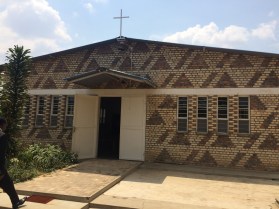


The wedding did not start until an hour and five minutes later.  So, I used the extra time to wander the grounds and take photos of the lovely chapel where the wedding would be held.  The chapel is called St. Antoine’s.  4A108CE7-D1BF-486B-8403-BDD1804A2936I later learned that St. Antoine’s is an orphanage and that the bride had been raised there2885AF39-B7CA-41D2-965A-9422EC7ABC6D.
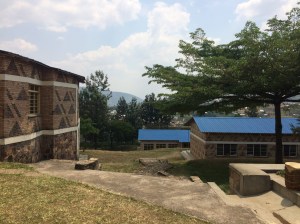
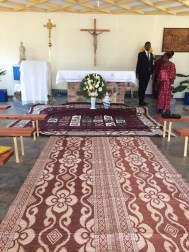


All the buildings were handsome and neat; the landscaping meticulous.  The pastor, who later introduced himself to me, spoke English and was from Slovakia.  He also spoke fluent Kinyarwanda.


Suddenly the chapel was filled with people, and the crowd overflowed outside.  I looked around at the crowd of over 200 guests to observe how they were dressed.  Almost all of the women were wearing umushanana, and I could not help but notice that none of them used safety pins to secure the top piece of fabric.  Instead, most made do with a tight and tiny knot like the one Clarisse had tied for me.  A few, however, used an especially stylish brooch; “Something to think about for next time,” I thought.  The men mostly were dressed in suits. I was happy to have arrived early and secured an aisle seat.  Before the ceremony began, the wedding videographer went around the audience taking videos.  He spent way too long on me, and, as I squirmed, he said, referring to my umushanana, “Jolie,” which, I recalled from my high school French, means “pretty.”

Finally, the bride and groom entered in an elaborate procession up the aisle to the altar. The maid of honor and best man followed directly behind the wedding couple to attend to them.  The music was amazing: a keyboard, several tambourines, tall African drums and a guitar.  Plus, beautiful singing in Kinyarwanda, during which I detected the word “God” (Imana) in every other sentence.

Because St. Antoine’s is Catholic, the wedding ceremony included a mass, complete with multiple priests and altar boys.  Before the service began, I’d noticed the lack of kneelers and the concrete floor; instinctively, I dreaded the thought of kneeling on it.  Fortunately, when it came time for the kneeling part of the mass, only a few very old women, likely with iron knees, knelt on the cement floor; the rest of us wimps remained standing. The most fun part of a Catholic mass is when you turn to greet all the people around you; this mass was no exception, as lots of smiling guests gladly shook my hand.

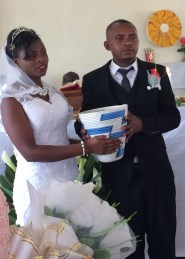
The service was beautiful, with the only difference from an American wedding being the 49AD4EF4-062E-40A2-BA20-8D9861635491part where the bride and groom receive money gifts. The bride holds a traditional Rwandan basket, while the guests line up to put cash in the basket.  Although I was giving a present, I was also giving a card with money in it.  So, I carefully untaped the card from the present, and stood up to get into the line to drop my card into the basket.  However, several people informed me that only money, not cards, went into the basket, so I dourly returned to my seat and re-secured the card to the present. No one else had presents with them, so I was confused.
 

1F9942DE-170D-499E-9C5C-317B8EEBEFB4

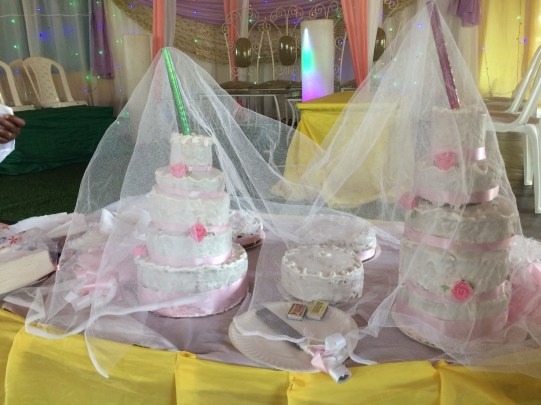
After the ceremony concluded, everyone retired outside to mill around the lovely grounds while the wedding party and family posed for the obligatory outdoor photographs.  Later, we reconvened in the reception hall to ooh and aah over the wedding cakes and to be entertained by African drums and traditional Rwandan dancing.


The wedding couple were served champagne, and there were numerous speeches and toasts in Kinyarwanda to them.  The guests. sitting in chairs and observing the wedding party on the stage, were served soft drinks (Fanta) and wedding cake.
D99BF8DB-E955-456A-A009-86AED3550551

Finally, it was time for the gift giving.  Out of nowhere, gifts magically appeared.  Where had the guests been hiding the gifts all this time?  A long line formed.  The bride and groom received each gift-giver and gift individually and the professional photographer took a photograph of each guest presenting the gift.  Most were large 

beautifully wrapped gifts, but a few were simply brown paper bags. I can’t say what was in any of the gifts because none were opened, but I imagined most of them to contain beer or laundry detergent. When my turn finally arrived, the bride and groom seemed genuinely delighted to receive my gift (even without knowing what it was, and perhaps secretly hoping it was laundry detergent). When I tried to leave, the photographer pulled me back for a few more photographs.

With my mission finally accomplished, I exited the hall and walked the mile and a half back through town to my home.  Along the way, every person I met stopped me to tell me how beautiful my umushanana was.

9E7EF5A6-677E-4E08-B383-45B8099A2BCB

The Wedding Present

Weddings are important everywhere, but they are especially big in Rwanda. Every weekend, I see people happily on their way to or from weddings, dressed in finery, carrying elegantly wrapped presents.  During our Peace Corps orientation, we were told that we are not part of Rwanda until we’ve attended a wedding. In June, when I was invited to a wedding to take place on August 11th, it seemed so far away, but I was glad that it would give me much needed time to make sure I did everything right for the wedding.  

The wedding invitation was unexpected.  It was from someone I barely knew.  Indeed, at that time, I didn’t even know her name. I was working in my office one evening when a young woman entered.  I recognized her as an employee of the food service company that provides meals for the school.  Now and then she would be assigned to the dining hall, where I took lunch with the faculty and staff of the school.  She approached me with an envelope that she handed to me. Between her limited English, my limited Kinyarwanda and the beautiful invitation, we were able to communicate.  She made it clear that she would be honored by my presence at her wedding, and I, in turn, told her that I would be honored to attend.  

3e93c47e-98b8-4324-9e2c-22fc2a682863-e1534096805311.jpeg

Going to a Rwandan wedding required at least two things of me.  First, to find the appropriate attire. For Rwandans, the most important thing is how one dresses.  And, for weddings, women usually wear umushanana, which is the elegant Rwandan traditional dress.  I would have to wear umushanana.  Second, I would have to find the right present and a wedding card.

I started with the card and the present.  First, the card. I searched and searched market stalls and shops in my town, but could not find any.  I was resigned to making my own.  However, a week before the wedding, I saw a wedding card a93d9ba3-9fc3-493c-a8f3-1586f0fdfb24-e1534148345515.jpegin a shop and immediately snapped it up.  I didn’t bother reading it, because I did not care what it said; it was enough that it was a wedding card.
As for the gift, I assumed that would be an easy task; I would simply ask my friends what an appropriate present is for a wedding. I started with Olivier, who said, “Inzoga,” which means beer.  I told him “I am NOT giving beer as a wedding present!!  What else can I give?”  “Well,” he replied, “they would be very happy to get beer as a present. But, if you don’t want to give beer, you can give Omo.”  “Omo?” I inquired incredulously.  “Yes,” he explained, “you would give Omo and wrap it very beautifully.” Omo is a laundry detergent, so giving Omo as a wedding present would be like giving a box of Tide with elegant wrapping paper and a beautiful bow. I was not ready to believe Olivier on this subject and so asked other people, who confirmed that “Yes, the wedding couple would be very pleased to receive Omo because it would save them from having to buy laundry detergent.”  Still, I was not about to give Omo as a wedding gift.  Of course, there was always money.  Everyone I spoke to said that money would be an appropriate gift.  When I asked how much, I got various responses, with the maximum at 5,000 francs, which is a little less than $6.  Giving money would be easy, of course, but I wanted to give something memorable.  But what?

Wherever I went, every shop I happened to be in, I scoured the shelves for an appropriate wedding gift.  Someone had suggested a clock as a good gift.  In the shops, I saw many wall clocks of different designs (some modern, some with flowers, some of bright colors, others metallic), but I was ignorant of the couple’s taste in clocks and thought, “What if someone else gives them a clock?  Who would want multiple wall clocks?”  So I gave up on the clock idea and one Saturday wandered around the Nyanza market looking for an appropriate gift.  A male vendor stopped me.  He spoke a little English so I told him what I was looking for and asked him what the perfect wedding gift would be.  Without hesitation, he responded, “A wristwatch.”  “A wristwatch?” I parroted, not sure I’d heard correctly. To me, that seemed even more implausible than giving beer.  “Yes,” he calmly replied.  “But, there are two people.  How can a wristwatch work for two people?”  I just as calmly inquired. He explained, as if I were a child, that they could share it, or, if I were feeling particularly generous, I could give two wristwatches.  No, I told him, I did not like the wristwatch idea.  Any other ideas?  Again, without hesitating, he replied, “Tee shirts.”  “Tee shirts?”  Really?  I explained that I did not know the man’s size. “No problem,” he said, “Just get a large one.” I thanked him for his suggestions and moved on, but no one else gave me better ideas.

Thus, the wedding present weighed heavily on my mind for weeks, until Umuganura, just 9 days before the wedding. Umuganura is a Rwandan holiday similar to our Thanksgiving, as it celebrates the harvest.  I’ve heard it described as Thanksgiving and New Years rolled into one.  Because Nyanza, the town where I live, is where the last King resided, there is a huge festival with singing and dancing and a fair.  I got to the festival late, so there was not a single place to sit or even stand to watch the ceremonies, so I went to the fair, stopping in each booth to talk to the vendors. And, of course, the wedding present was foremost on my mind.  In the Rwanda Correctional Services booth, I browsed through wood carvings and other art made by prisoners.  It was there that I spotted the perfect present: a shellacked wooden wall hanging that had two hands holding a heart and a wedding ring, plus places for two photographs.  “How perfectly sweet,” I thought as I purchased it for 10,000 francs (less than $12). Mission accomplished, I mistakenly mused.

That evening, I proudly showed my prized wedding gift to Olivier, who promptly dashed my hopes that the wedding present was done. He explained that I could not give the plaque without putting photographs in it. “But, I hardly know Nicole,” I whined, “And, I certainly don’t have photographs of her.  Besides, that’s not the point.  The point of the gift is that she and her husband can add the photos they want.”  However, he insisted that I would be violating every gift giving rule of Rwanda, and even possibly causing an international incident, if I gave the plaque without first inserting photos. I was sure he was wrong.  So, the next workday, I brought the plaque to work to show some of the staff and get their more reasoned opinions.  Unfortunately, everyone agreed that, although the plaque was certainly lovely, giving it as a gift without first inserting photographs was taboo. I thought of all of those picture frames in U.S. stores with photos of unknown people in them that I had given or received as presents. That just wouldn’t work in Rwanda.  

So, I went from person to person at work looking for someone who had pictures of Nicole and her fiancé in her cell phone. I found someone who happily searched through hundreds of photos in her phone to find two perfect pictures of the smiling couple and then texted them to me. Voila! I thought my problem was solved, as I could simply print the photos and insert them.  Not to be.  The printed copies, for some reason, were so grainy that it appeared to be raining on the happy couple in the photos. “Drats,” I thought.  So, I transferred the photos to a flash drive and walked into town to my favorite “fotocopy” store to ask if they could print the photos for me.  The proprietor of the store, a man who looks to be between 50 and 60, was marvelous.  He had Adobe Photoshop on his computer and meticulously photo-shopped the 2 photos, erasing all of the extraneous background matter of other people and objects so that only the future bride and groom were in the photos.  It was much more than I had hoped for.  It took him about thirty minutes, as I sat by his side. He printed the photos on photo paper and charged me only 1,000 francs (a little over $1) because, he said, I was a regular customer.  

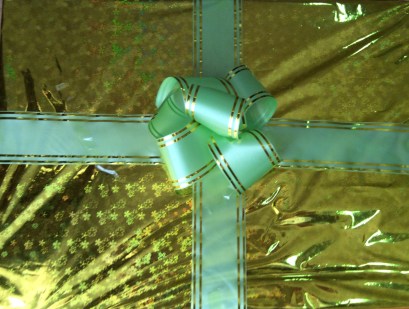
So, with the wedding present finally accomplished (and looking smashing, I might say), it was time to have it wrapped. In Rwanda, there are professional present wrappers. I had been eyeing them in the market and various shops for weeks, knowing that I would eventually need one. Interestingly, before the wedding invitation, I had never even noticed the professional gift wrappers. Now, however, I spotted them in every other store and many market stalls.  So I selected one in a shop and, using the Kinyarwanda word for gift (impano) b6934a84-2491-4632-a0c6-9c0fb3bc2980.jpegand miming how one wraps a present, I got my point across to the proprietress.  She gave me a choice of several sheets of gorgeous paper and fancy ribbons.  I made my selections, she carefully wrapped the present, and charged me 3,000 francs (about $3.50).  
 

When I returned to work, I realized that I had forgotten to take a photo of the wedding present.  A colleague insisted I needed to go back to the present wrapper and pay her 1,000 francs to unwrap the gift so I could take a photo and then rewrap it.  That’s where I finally put my foot down and said I would live without a photo of the present.

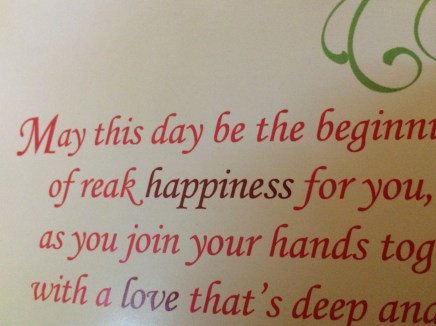
Now, I was all set.  I had the wedding present.  I only needed to address and sign the wedding card.  When I opened the card, I read the message inside for the first time.  It began, “May this day be the beginning of reak happiness for you.”  Reak happiness?  What is that?  The card likely was made in China, where most of Rwanda’s imported items are from.  Probably, no one in the card factory had proofread the words before printing the cards en masse.  Did reak mean great?  I debated whether I should scratch out “reak” and write “great.”  832C9AA6-E3C4-4813-A906-D8276E19B5DCUltimately, I decided to leave the card as it was.  Better to have a grammatically incorrect card that looks pretty than to have a grammatically correct card that looks, well, sloppy.  And, the couple was not likely to notice the error.  And, who knows?  Maybe, in Chinese, reak happiness is a higher level of happiness.  But one thing I do know; if I’m ever invited to another Rwandan wedding, I’m bringing laundry detergent as my present.


Water Water Everywhere

Water used to be a huge problem for Peace Corps volunteers in Africa.  When I was a Peace Corps Volunteer in Ghana, West Africa, in 1971, my method of ensuring that my water was safe to drink was to boil it over a small coal stove for 15 minutes.  Needless to say, it was always important to think ahead and make sure I had enough boiled water. Traveling presented major challenges because safe drinking water was always difficult to find. In those days, there was no such thing as bottled water, as that was well before the bottled water craze, before anyone thought to bottle water.  During my first year in Ghana, I was often sick with dysentery from drinking unclean water.  By my second year, my stomach had grown accustomed to the local bacteria, but I still boiled my water at home.  Fast forward to 2018 and Rwanda, where safe drinking water is not a problem at all for three reasons.  

The first is that access to water is easier and more dependable.  In 1971, in Ghana, we hoped it would rain to fill our large oil drums that were stationed next to our metal roofs to catch the rainwater.  Or we were especially grateful to the students who carried heavy metal buckets of water on their heads a great distance uphill from the stream to the homes of the teachers. Although there were community water taps in town, they seldom operated.  However, in 2018 in Rwanda, we have running water. Not everyone is as fortunate as I to have running water in their homes, but many do. And, in my town, running water from a nearby pipe is available.  I have seen some people purchasing water in buckets or plastic jerrycans from another person who has a pipe in their compound.  The ease of access to water makes life so much easier.  I almost always have running water in my house.  The few times the water stopped, the school staff carried buckets of water from the school to my house to fill a large bin in my kitchen. However, Peace Corps volunteers still must purify the water from the pipes. Even with more easily accessible water, purification and filtration are required to ensure healthy drinking water.

Second, the Peace Corps has provided each volunteer with a first-class water filter/purifier from a company called British Berkefeld, which began making water filters around 1827 to purify water from the Thames River in London. The filter/purifier is super easy to use and very effective. It consists of 2 stainless steel canisters, one atop the other.  The top canister contains three long ceramic tubes or candles that filter and purify the water using gravity and without removing beneficial minerals.  I simply fill the top canister with water, add a quarter capful of bleach (a few drops), and the filter does the rest.  The filtered and purified water collects in the bottom canister, which has a spigot for easy use.  I refill my water filter every other day with water from the faucet in the bathtub in my house.  After a little less than 5 months of use, I cleaned the extremely dirty candles or tubes that filter the water inside the top canister.  Here is a photo of my trusty water filter/purifier that has kept me healthy for the past six months.  The photo on the right shows the ceramic tubes that filter and purify the water.

Third, bottled water is ubiquitous in Rwanda.  It’s sold in almost every shop.  It’s provided with our staff lunches at my school.  A small plastic bottle of water costs 300 Rwandan francs, which is about 35 cents.  I’ve seen bottled water from two Rwandan companies.  The first is called Sulfo Rwanda Industries, Ltd., which makes bottled water called “Source du Nil” (I mistakenly thought that nil was French for nothing, which would be a very unusual name for a water source.  However, my intellectual friend, Deborah, set me straight, explaining that Nil in French is Nile River, a perfectly sensible source for water here, as Rwanda is part of the Nile River Basin and quite possibly the source of the Nile, as the river flows north to Egypt.   The Nile River’s source in Rwanda is in Nyungwe Forest, a national park, where monkeys, chimpanzees and baboons are the chief residents sharing habitat with over 300 species of birds.  According to Nil’s label, the water is subjected to a “rigorous, state-of-the-art ten-step process that includes Reverse Osmosis, other filtering and disinfection methods like Ultraviolet disinfection, Ozonation, etc.” I can’t imagine what the et cetera would include, as it seems they’ve already done everything possible to the water.  

The other, and more popular, company that bottles and distributes water is Inyange Industries.  The label points out that the bottle is “BPA-free,” describes the water as “natural mineral water” and goes on to explain that the water comes from the natural springs of Gasabo in the foothills of Rwanda’s thousand hills and is naturally purified by Mother Nature.  I had imagined that Gasabo was in a very remote and pristine part of Rwanda, with sky high waterfalls, no people and frolicking monkeys.  However, when I looked it up on the internet, I was surprised to find that Gasabo is a section of Kigali, the capital and most populous city.  So it’s like getting our water from the city river.  In addition to bottled water, Inyange Industries sells a variety of fruit juices and dairy products, including butter, milk and yoghurt.  Inyange is pronounced in-yahn-jay and means egret – specifically cattle egret, which is a type of heron. According to Wikipedia, cattle egrets eat worms and insects, especially grasshoppers, crickets, flies, maggots, moths, spiders and frogs.  They like to hang out around cattle because their food supply of tasty bugs is better where cattle graze. The logo on all of Inyange Industries’ products is the cattle egret.

So, unlike Samuel Taylor Coleridge’s famous poem “The Rime of the Ancient Mariner,” where there was water, water everywhere but not a drop to drink, here in Rwanda water is available  everywhere and there is plenty of safe water to drink.  

Plus, we drink coffee (mostly instant Nescafé), African tea (also known as milk tea because it is basically hot milk, black tea, spices and sugar), mukara (pronounced moo-car-ah, it is a spicy black tea and usually served with sugar already added) and, of course, my favorite ikivuguto (pronounced itchy-voo-goo-tow, which is kefir or liquid yogurt, which we drink by the cupful). And, Coke, Sprite and Fanta are available everywhere.