
Religion has always existed in Rwanda. Rwandans are exceptionally spiritual and have been so – well before colonial times. The Ikinyarwanda word for God is “Imana;” that word existed long before the arrival of the Europeans. The story of humans is, of course, of movement. As people move from one place to another, new ideas are shared. And, that is the story of religion as well.
The first missionaries to Rwanda were the Catholics, who arrived in 1900. However, they were not well received by the King, who lived in Nyanza, the town where I coincidentally am living and working. The Lutherans followed not long after in 1907. The Seventh Day Adventists arrived in 1919, the Baptists in 1920, the Anglicans in 1922 and the Methodists and Pentecostals in 1940. According to Wikipedia, Sunni Muslim traders coming from Zanzibar, which is now part of Tanzania, had contact with Rwandans in 1901 and built the first mosque known as Al-Fatah Mosque, in 1913. One can only imagine how confusing those years must have been for Rwandans contending with the onslaught of so many different religions and sects touting their belief as the best. As for Judaism, in September of 2019, the orthodox Jewish Hasidic movement Chabad opened the very first synagogue in Rwanda in the capital city of Kigali. And, in 2008, Agahozo-Shalom Youth Village, a Jewish orphanage modeled after the Israeli youth villages that were built for Jewish orphans after the Holocaust, opened in Rwanda.
Rwandans continue to be extremely religious. The vast majority are Christian. After all, we are usually the religion of the conquerors or our ancestors. In Rwanda, the conquerors were Belgian and Catholic. Thus, the Catholic Church was dominant here. However, I’ve seen numerous Christian churches in Rwanda (Presbyterian, Pentecostal (a/k/a ADEPR), Seventh Day Adventist, Catholic, Anglican and Jehovah’s Witnesses) and many mosques, large and small. Since the 1994 Genocide against the Tutsi, when many of the Christian churches failed to protect the victims, many Rwandans changed where they worship. According to a Wikipedia article, since the Genocide, the population of Muslims has doubled to 14% for that reason. It’s hard to say what percentage of the population practice Islam, but I do see a lot of Muslims and mosques. Muslim women here dress modestly, wearing a head scarf, long sleeves and blouses reaching their necks. However, otherwise, their dress can be as colorful as any other woman’s.
From my short time here, I haven’t seen any religious prejudice against anyone because of religion. Rwanda’s Constitution protects “freedom of thought, conscience, religion, worship and public manifestation thereof.” Rwanda’s official public holidays include both Christian and Muslim holidays. (In my opinion, the more public holidays, the better.) So, public institutions are closed on the Christian holidays of Good Friday, Easter Monday, Assumption Day (August 15) and Christmas, as well as the Muslim Holidays of Eid al Fitr, which was June 4th this year, and Eid al Adha, which was August 12th this year.
One of the first questions Rwandans ask when they meet you is “Which church do you go to?” I have always had a hard time lying, so, when I respond that I don’t go to a church, they are visibly upset – because they are genuinely concerned about anyone who might not be saved or go to heaven.
I have gone to official functions at five churches in Rwanda. The first was at the small but lovely Catholic chapel in Nyanza for my friend Nicole’s wedding. The second was at a huge Pentecostal church in the village of Save (pronounced Sah-vay and which coincidentally was the location of the first Catholic Church built in Rwanda because the King wanted the church far away from him) for a baby-naming ceremony for the newborn baby of a work colleague.
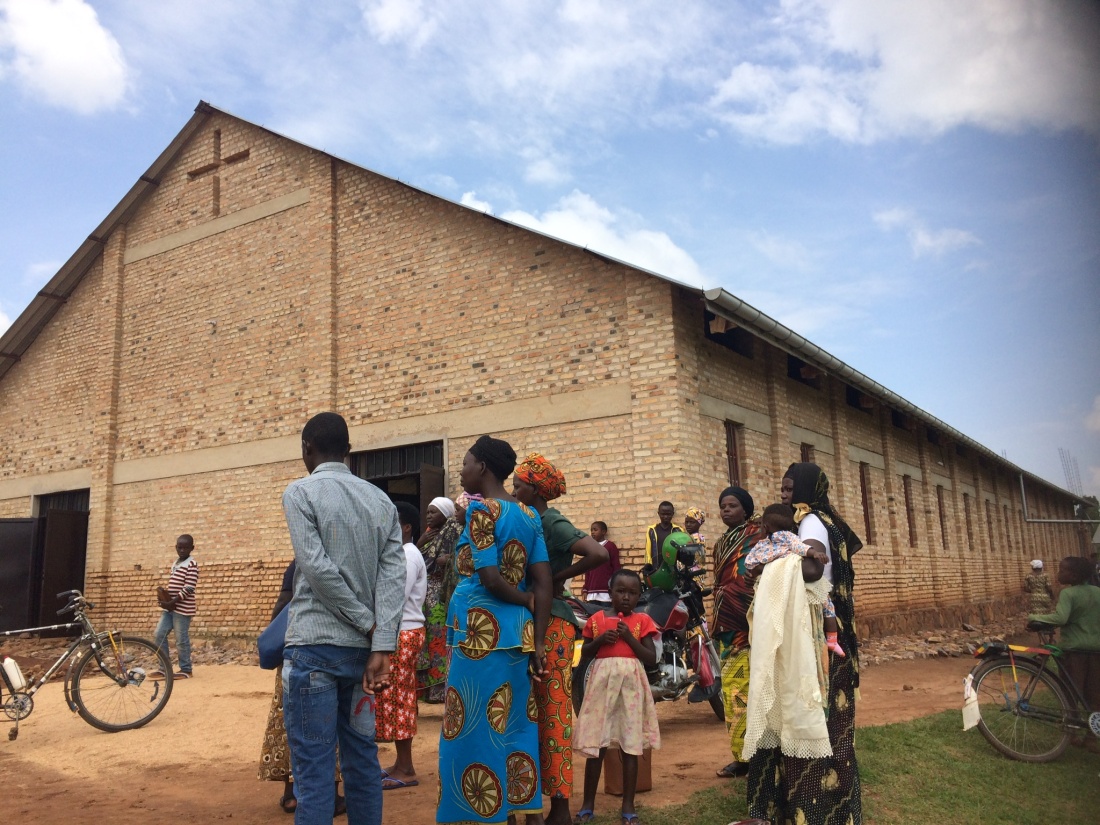 Pentecostals don’t baptize until the person is older and capable of understanding the significance of baptism, capable of voluntarily choosing to be baptized and able to profess his or her faith. That idea makes sense to me, because we all inherit the religions of our parents and have no choice at birth. Instead, they have a welcoming ceremony for new babies. After the hours-long church service, we went to my colleague’s home for the official baby naming ceremony, which is a very traditional Rwandan custom that existed well before the foreign religions invaded. That ceremony was followed by a feast of food.
My third Church visit was to an enormous Seventh Day Adventist Church in the capital city of Kigali for the very formal and modern wedding of a work colleague. Here I am in a traditional Rwandan formal dress with a fellow lecturer from my school.


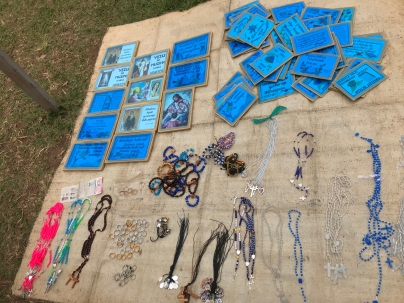
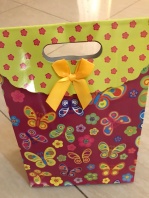
My fourth church visit was to the huge ornate Catholic Church in Nyanza for the first communion of my friend’s 7-year-old daughter, Michelle. On my way to the church, I passed a roadside stand where a young man was selling religious paraphernalia. I purchased a blue and white rosary to add to the gift bag I was carrying. Later, I saw that Michelle was wearing the exact same rosary around her neck, so I ran back to the stand and, fortunately, the seller was kind enough to let me exchange it for a solid blue rosary.
The little boys all wore dark suits and the girls wore gorgeous fancy, mostly white, dresses of organza-like fabric. Michelle wore an exceptionally fancy pink dress. I was glad to see that the girls wore no veils, as I had to when I made my first communion, the symbolism of the white dress and veil being that the little girls were brides of Christ. I always found that idea unsettling.
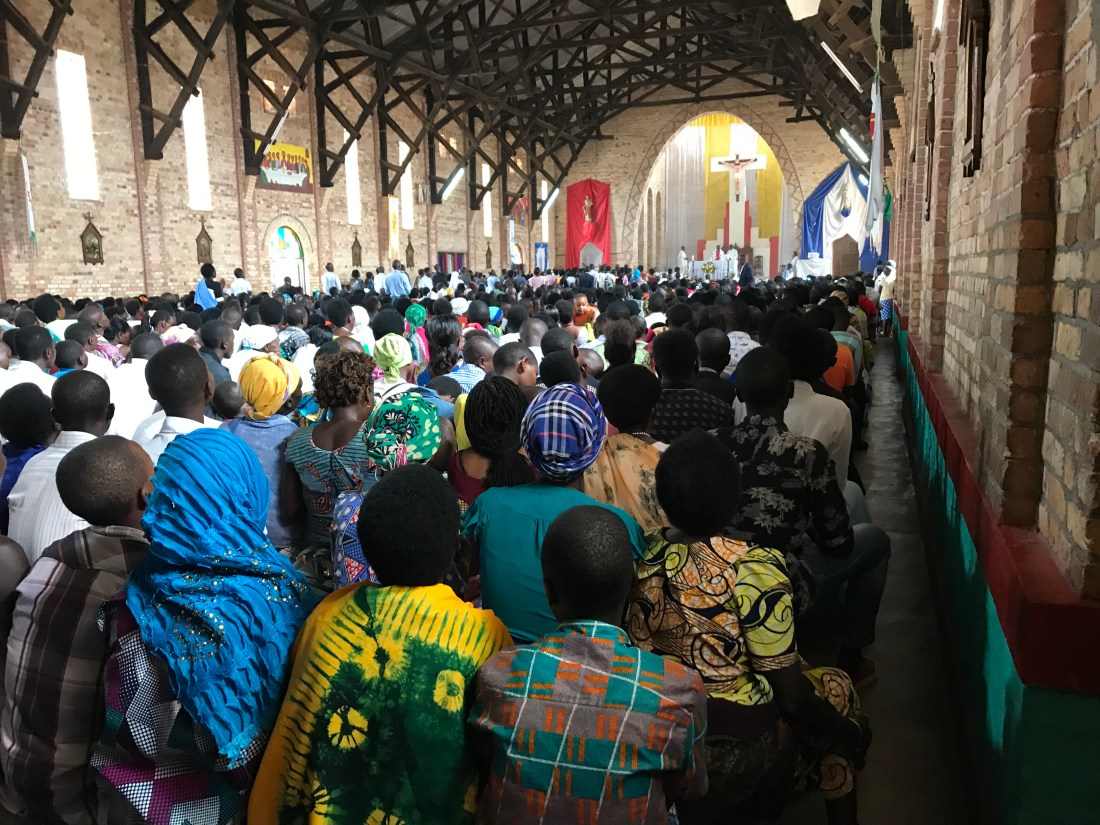
There was no organ music; instead, the music was provided by the congregation clapping their hands in unison as the well-rehearsed choir sang. Birds tweeting, singing and and soaring overhead in the rafters provided a pleasant addition.
I was impressed that the church had ushers whose job was to find seats for the elderly among the latecomers, like me. I was among the throng of those crushed standing in the back of the church, trying to get a glimpse of the action in the front of the church. I’m not good at estimating crowds, but there were clearly hundreds of people in this church, with an overflowing crowd of standing room only (SRO) attendees, like me, and even more people congregated outside, trying to squeeze in. I was at the back of the SRO crowd, as I came 45 minutes late because the thought of sitting through a multiple-hours-long mass was just too much. That the mass was in Kinyarwanda, a language in which I could only catch one or two words in each sentence, added to my reluctance.


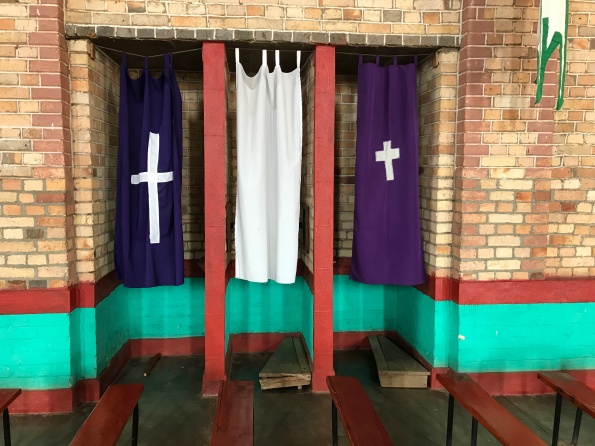
Below is some of the artwork.


My favorite part of the Catholic mass is the shaking hands part, which was instituted as a result of the Second Vatican Council in the 1960s. It’s the part where everyone turns and shakes hands with all those around him or her. Shaking hands is such an intrinsic part of Rwandan culture, that it seemed so natural to do so in church.
And of course there was the passing of the collection basket, which at this mass in Rwanda was a beautiful made-in-Rwanda basket. Afterwards, there was drumming outside, as families and friends reunited. And, similar to first communions in the U.S., after church concluded, friends and family members were invited to Michelle’s home for a huge feast to celebrate her first communion.


The last church that I visited was again a Catholic Church – this time sadly for the funeral of a friend’s mother who had been poisoned. That church, in a rural village outside of the city Muhanga, was a simple church (we sat on wooden benches) but the loveliest church I have ever been in. Its pastel-colored stained-glass windows were simple shapes, like crescents, triangles, squares, rectangles, diamonds and circles that let in just the right amount of sunlight.
 Ruminations from Rwanda
So wonderful! Thank you Pat.
LikeLike
Oh my, you make the world and culture in which you currently find yourself so alive for me, illustrated by all the photos and thoughtful details of history, practices, people, dress, architecture, customs. Thank you. xo h
LikeLike