
 On this monthly day of communal labor (always the last Saturday of the month), I walked down the road towards town and soon came to the Umuganda site, where already a large crew of townspeople were hard at work on the side of a dirt road, clearing away the weeds encroaching on the road. I promptly relieved a woman who was taking a break; I reached for her hoe, which she gladly released to me. Wielding the hoe as I’d previously been taught, I scratched away at the weeds and pushed them off the road. I must have finally mastered the technique because this was the first time people did not interrupt my work to show me how to do it. Instead, they worked alongside me chattering among themselves in Kinyarwanda. Soon, the muscles in the small of my back, used to sitting at a desk all day, let me know that they weren’t accustomed to such work. After several whacks with the hoe, I switched arms and took a short rest to give my back some relief.
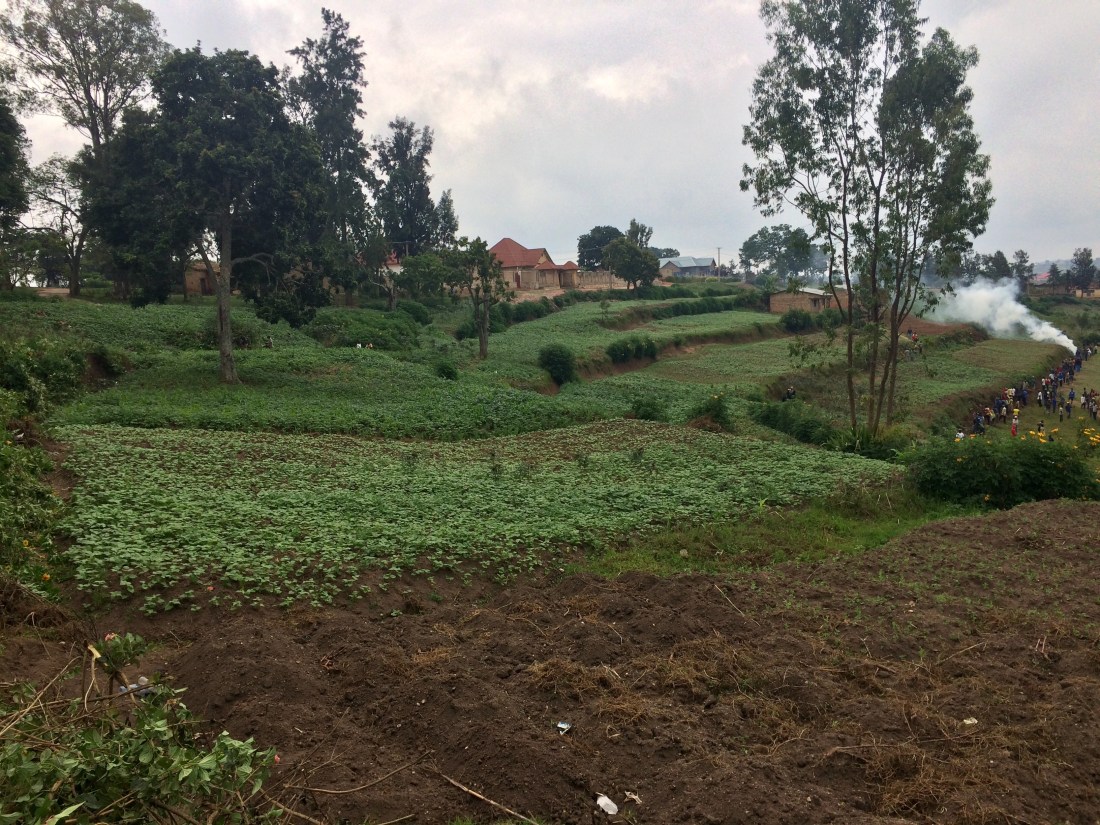
Fortunately, everyone else (except the two teenage girls next to me who were more interested in how they looked than work) was working faster and harder than me, and we were soon assigned another task. We moved off the road to the side of the hill.  I could see hundreds of other workers further down the hillside already hard at work, burning trash and wielding their hoes high over their heads, hacking away at the side of the hill. Others with shovels were removing dirt to form trenches. Aha, I thought, so this is how terracing is done!
Rwanda is a land of undulating hills and an abundance of rain. The rain, especially the crushing torrential rains during the heavy rainy season from February to June, is so intense that it floods the hills, removing topsoil as it gushes down the sides of the hills into the valleys. Because Rwandans long ago deforested the hills to make farms, erosion is a huge problem. To combat erosion, Rwandans terrace much of their land, cutting gigantic green steps into the sides of hills by hand and digging ditches at the base of each step to catch the rain and slow it down. In addition to serving important ecological and agricultural purposes, terracing makes the land look quite beautiful.
Terraced agriculture, of course, is nothing new; it was employed even before the Incas in Peru and by the Mayans in Mexico. It is widely used worldwide as an ecologically beneficial way to preserve soil health and increase farm production. I was elated to have a tiny part in the ancient practice of terracing.
So, I joined the men and women already at work on the side of the hill with their shovels and hoes. 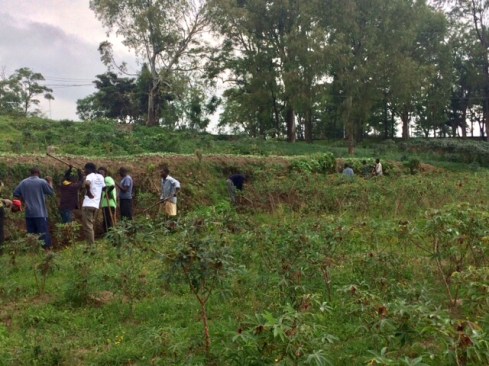 This hillside had previously been terraced some time ago. However, with the passage of time, the neat terracing had become sloppy; the earthen steps had lost their sharp edges and the ditches at the bottom of each step for catching the rain had disappeared entirely, having been filled in with soil.
  Our mission was to cut into the side of the hill to make the steps square and sharp again and to dig a long trench at the bottom of each step to catch and slow down the pounding rain.
We attacked our new job with gusto. 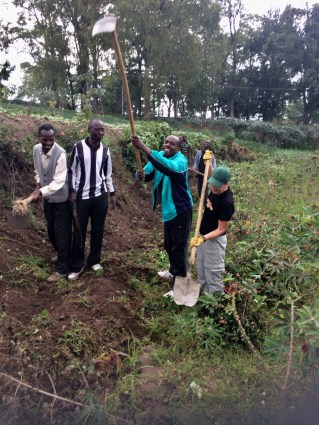 I was handed a hoe and immediately began hacking away at the side of the hill to form the vertical five-foot riser. Men with muscular arms on either side of me were wielding their hoes with much more force and sometimes startling me as dirt flew my way. On the steps below us, hundreds of other people were hard at work doing the same thing. After taking a rest and relinquishing my hoe to another worker, I was given a shovel for digging the trench. Not a deep trench, just deep enough to catch and slow the rainwater. Just below our step was a large field of beans waiting to take advantage of the longer lasting water that would result from our labor. With so many enthusiastic workers, our task was quickly done.
Now, it was time for the monthly meeting where information is shared. We reconvened a short distance from our work sites to a small hill on the side of the main road into town. We sat in the shade of trees, even though it was cloudy and had been threatening to rain all morning. Wearing only a cotton t-shirt, I felt cold as I sat on the ground with the other workers listening to speeches that I could not understand. However, whenever I was able to pick out a word or phrase, I gave myself an imaginary pat on the back. Soon, it started to sprinkle and the speeches came to an end. After a five-minute walk as I arrived home, it began to pour. I could not help but imagine our freshly terraced hillside robustly restraining and hindering the flow of the water, performing as terraced hillsides have been doing from time immemorial.
 Ruminations from Rwanda
Pat, what a beautiful article! I have been thinking of you and we should write more—right now I am waiting for a play we are ushering to begin. More later….. Gerri
Sent from my iPhone
>
LikeLike
Hey, terrace making expert, good job! When you’re done with teaching law, you’ll have a wonderful outdoor job waiting for you. When are you coming home? The slope in our backyard could use some terracing.
Hugs, Marianne
LikeLike