
First, the birds. Last month, while walking home from town on the low road, I was surprised when a huge bird with a broad wingspan flew directly overhead and landed in a tall pine tree on the edge of the road. I looked up and saw that a row of six pine trees was serving as a bird condominium or maybe the neonatal care unit of a bird hospital. A Rwandan man, also passing by, stopped and, intrigued by my curiosity, told me that the Kinyarwanda name for the birds was nyirabarazana. 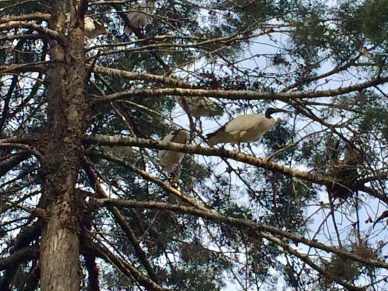 He apologized for not knowing the English name, which seemed funny because I did not know the English or Kinyarwanda names. Once home, I looked up the name in a dictionary, studied my photos and determined that the huge birds were ibis – thankfully, a much easier to pronounce name than its Kinyarwanda counterpart. On line, I learned that ibises are common all over Africa. This particular species has a black beak and legs and is called the African Sacred Ibis because, in ancient Egypt, it was connected with the ancient god, Thoth, who is portrayed with the body of a man and the head of the ibis. Indeed, Wikipedia told me that Thoth’s name meant “He who is like the ibis.” The Egyptians actually mummified ibis (the plural and singular are the same word) for burial as an offering to Thoth. They killed so many ibis for sacrificial purposes that they established breeding farms of ibis.
In the top branches of the pine trees, there are at least 50 birds nesting or flying to and from their enormous nests that defy gravity as they splay out over the sides of the thin branches supporting them. I’ve walked this road dozens of times and had never before noticed these hard-to-miss birds. The reason was that these trees used to be inhabited by an enormous bat colony.  When the big, bully ibis arrived, they evicted the bats, forcing them to find a new home. (More on that later.) It seems that the ibis just came here to breed. They migrate with the rains and bear their young during the rainy season, which started in September and is still occurring. According to Wikipedia, each breeding season, female ibis lay one to five eggs, incubated by both parents for 21–29 days. After the eggs hatch, one parent continuously stays at the nest for the first week. The chicks fledge after 35–40 days and are independent of their parents after 44–48 days. Thus, I expect that these fascinating creatures will be gone within a month. But, for now, I’m mesmerized by them. The Rwandans who see me staring and trying to photograph the birds laugh at my interest in what to them are ordinary birds.
Second, the bees. Months ago, my house was invaded by armies of bees. They must have entered through the small gaps where the metal window edges don’t fit snug against the metal frames. (Those gaps also provide an opening for mosquitoes, which are much smaller than bees.) Fortunately, soon after they stormed my house, the bees started to die, perhaps exhausted from trying to squeeze through the window gaps. The result was that I came home to, or arose to, hundreds of dead or dying bees on the floor throughout my house. The bees were so lifeless that I didn’t need to do anything other than to sweep them up and return them to the outside. I was never in danger of being stung. I didn’t know whether this was a normal seasonal phenomenon or something I should be concerned about. So, I mentioned it to the school custodian who sent Issa, the head of the cleaning staff, to my home to investigate. Issa came armed with a can of BOP, which I knew to be deadly because a fellow Peace Corps volunteer had recommended it to me to solve my ant problem, and it worked. Since the bees were already dead or almost dead, I hadn’t thought about bringing out the Bop. Issa, however, sprayed the BOP as if it was air freshener throughout my house, as I ran for cover. Even though the bee invasion continued for a few more days, I did not seek further assistance, as I thought cleaning up dead bees was better than inhaling the deadly BOP. The bee invasion lasted about ten days, each day seeing fewer dead and dying bees and, then suddenly the invasion was over, having stopped of its own accord. And, my bee-less life returned to normal.
Last but not least, the bats. They arrived last month, quite suddenly – around the same time that the ibis arrived in town. In fact, I think that the burly ibis forced the bats to move from their condos on the other side of town to my neighborhood. At first, I thought the noise awakening me at 5:00 a.m. was from particularly noisy birds. Bu this cacophony of bubbly chatter was different. When I pulled back the curtains to look through my bedroom window, I saw hundreds of bats frenetically flying everywhere. Fortunately, they were high in the sky, or it would have felt like an attack of “The Birds” from Alfred Hitchcock’s movie of the same name.
Around 5:00 p.m., the same thing occurred, except in reverse, as the bats were waking up, getting ready for their nightly foray into the Rwandan sky in search of a feast of mosquitoes and other tasty insects. Now, the bats were even more visible in the sky. Being outside, my curiosity impelled me to follow their clamor and walk the entire length of a row of about twenty towering scraggly pine trees where they had taken up residence, beginning with the tall tree in my front yard. In the highest branches of every pine tree were mobs of garrulous bats hanging upside down, filling the air with their sizzling sound and electric energy. Being in October and before Halloween, it felt seriously spooky. 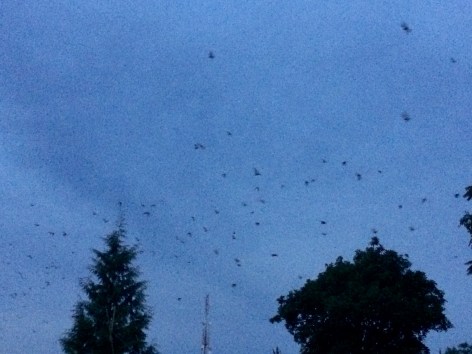 Craning our necks to look straight up, my umuzamu, Jared, and I were awestruck by the thousands of bats flying about above us. He told me that in Kinyarwanda, one bat is “agacurama” and the mass of bats captivating us were “uducurama.”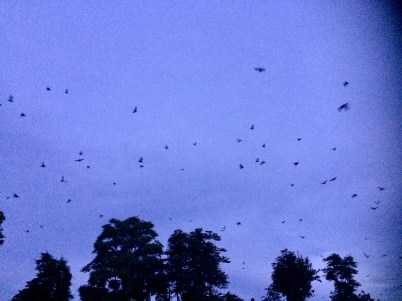
After weeks of observing my bat neighbors, I’ve grown accustomed to their comings and goings, as well as their rather exciting social lives. They are definitely social creatures, thriving by living in colossal communal societies. 
In fact, the bat colony that had taken up residence in the forty or so pine trees in the block around my house is a densely-populated bat metropolis. There are no lonely bats, no black-sheep-of-the-family bats, no fringe bats compelled to resort to Facebook or Gab posts to assuage their loneliness. Rather, every bat is an integral part of the humongous bat bureaucracy. Their daily lives are simple. They sleep during the day and start waking up around 4 p.m. At that time,  their chatter gets louder and louder until it is a raucous roar, as the bats begin about 4:45 p.m. to leave their roosts one by one and head into the sky, circling above my house while chatting with one another before flying off into in search of their mosquito meals. I tried to take photos, but with my camera the bats only appear as globs in the tree branches.
At 5 a.m., the bats return in droves to their roosts, noisily greeting each other as they reunite above my house after an exhausting night of hopefully gorging themselves with mosquitoes and begin to settle down for bed during the day. Their early arrival each morning is so boisterous, it is like an alarm clock awakening me.
Because I now reside in the bat part of town, I thought I should get to know more about my new neighbors. As I couldn’t ask them, I turned to Wikipedia to learn that bats are the only mammals naturally capable of flight and that bats comprise 20% of all mammals – meaning there a whole lot of them. Indeed, there are about 1,300 species of bats and 48 subspecies of bats with descriptive names, such as the straw-colored fruit bat, the Rufous mouse-eared bat, the Cape hairy bat, the Butterfly bat, the African yellow bat, the Dragon tube-nosed fruit bat, the New Georgian monkey-faced bat, the black-bearded flying fox bat and Peter’s epauletted fruit bat. 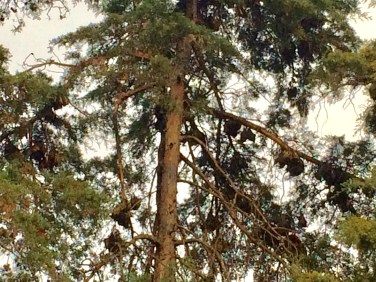 According to Bat Conservation International, Africa is home to more than 269 species of bats, and Rwanda is in a belt across Africa with the highest bat population. Bats are usually divided by what they like to eat: the insect eaters (insectivores), the nectar, pollen and fruit eaters (frugivores) and the blood eaters (vampire bats – yes, they are real), which savor the blood of cattle or birds. Bats have teeth, mostly for eating crunchy insects. The fastest bat ever is the Mexican free-tailed bat, common in Texas, which can fly up to 99 mph. (Don’t tell ICE.) Bats can live to be 30 years old, but that’s not common. Despite my research, I don’t know the name of my bat neighbors. I know only that they are black with no descriptive markings . They look like the common bats we are familiar with in the U.S., thought their wingspan here is bigger. I don’t know for sure what my bats eat, but I hope their favorite food is mosquitoes. I do believe that, since they moved in, the mosquito population has decreased.
Wikipedia informs us that bats are among the most vocal of mammals, even more garrulous than humans, and I know that to be true from listening to them day and night. So, what do they talk about? Perhaps they are squabbling over food, jostling over position in their tight-knit sleeping cluster, protesting over mating attempts, gossiping or arguing? In flight, some of their sounds are for traffic control. With so many bats in the air and no traffic lights, you can imagine the confusion. Thus, when bats are on collision course with one another, they make sounds that are the human equivalent of honking a horn. Even during the day, when they are supposedly sleeping, I hear a constant low-key buzz coming from the trees, perhaps from bat babies refusing to sleep.
During the day, as they sleep, they hang upside-down from the tree branches, which to us humans would be an impossible way to sleep. However, bats have tendons in their feet that allow them to lock their feet closed when hanging upside-down, so, unlike us, they don’t need any muscle power to grasp or hold on to their perch. Instead, they only use their muscles to release their feet.  One would also think how impossible it would be to take off in flight from an upside-down position. But not for bats – because their femur bones are attached to their hips in a way that allows them to bend outward and upward so that they can easily fly from their upside-down roosts.
Some bat colonies have over a million bats. For bats, there is safety in very large numbers; the more bats the less likely they will be attacked by a predator. My neighboring bat colony easily has thousands of bats.
Bat Conservation International’s website teaches that most bats are polygamous, and matrilineally-related females and their offspring form long-term relationships with one another, which probably accounts for the large groups of bats hanging in clusters from tree branches. Female bats are ingenious; no matter when they are impregnated, they can control the timing of the birth of their young to make delivery coincide with the maximum availability of food. In the Southern Hemisphere, births usually occur in November and December. 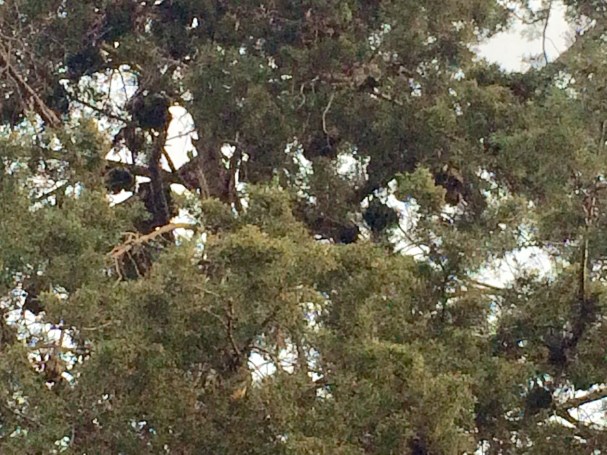
In Rwanda, which is just south of the equator, that means towards the end of the first rainy season, when mosquitoes are abundant. Bats usually have a single pup (yes, that’s what bat babies are called) per birth. The moms give birth in maternity colonies and assist one another in birthing. Then it takes about 80 days to wean the pups. I wonder, once the pups are weaned, will the bats migrate. Or, if the ibis migrate, will the bats return to their old neighborhood? I’ll have to wait and see.


When the bats first moved in as my neighbors, I found them creepy, and I recalled my first days as a 21-year old Peace Corps volunteer in 1971 in Ghana, when my house (which had been vacant for the year before I arrived) was inhabited with a small bat population. I couldn’t sleep at night because the bats were buzzing around above me, as I lay in bed with the sheet covering my head. After weeks of barely sleeping (I was shy then), I reported the matter to the head of the school. He and all of the teachers trotted across town to inspect my bat-infested house and then sent the school carpenter to remove the bats, which he successfully did, and I lived happily ever after. I later got even with my bats by eating a bit of bat, as some Ghanaians eat bats. What do they taste like? Chicken, of course. In contrast, in Rwanda, bats do not appear to be a delicacy, which is fine with me.
I don’t think that I’ll ever invite my new neighbors for tea or drinks, as I want to keep my distance from them. But, so long as they stay in the trees and out of my house and keep down the mosquito population, we will peacefully co-exist and both be happy.
 Ruminations from Rwanda
Wow Pat! Lots of good info. The bats look big like fruit bats. Bat guano is great for gardening so scoop it up and use it in your garden if you have one or give it to someone that does.
LikeLike
Lucky you are to have effortless all natural mosquito control!
LikeLike
I love that you have the curiosity to research whatever seems to attract your attention. I enjoyed the rumination about all those flying animals and with special interest on how all they are thought of in the local culture.
BTW, I’m sorry about Thoth, “who is like an ibis”. Either Thoth had an enormous beak (nose?) or he spent large amounts of time on tree branches.
Vincent V.
LikeLike
Good post, headed to Spain on Thursday. Ole
Sent from my iPad
>
LikeLike
I am overwhelmed by your tolerance and appreciation of bats!!! Take a selfie. Miss you. How is the trial? 😘
Shelly
>
LikeLike
What an interesting life you are experiencing! Thank you for sharing your experiences. When I lived in Mexico part time we had bats coming and going in the morning and evening and making high pitched sounds. I put up a bat house which many bats came to look at but never moved in. I loved watching them. With regard to bees – a few years ago a swarm of bees 🐝 entered the inside of a bedroom in our house. There were thousands of them mostly attached to the windows. A beekeeper told us they would die inside because some bees must go out and bring stuff back to the others and that they wouldn’t be aggressive. So we waited a few days and a lot were still alive so we sprayed them and vacuumed with a shop vac. The trouble was that they had pooped all over everything in the room and it was sticky like 🍯 honey! Barry and I spent three days scrubbing walls, floors, furniture, etc. It was fortunate that you could sweep up your bees and didn’t have sticky stuff to clean up!
LikeLike