
For the wedding, I needed to wear umushanana, the traditional Rwandan formal dress for women. Fortunately, there are special wedding and formal occasion shops that rent umushanana and even wedding dresses. I was told that renting the attire should cost me between 2,000 to 3,000 francs (between $2.30 to $3.50), depending on the fabric. So, two weeks before the wedding, I scoped out the several shops in town for the most stunning umushanana and decided on one shop. The young and fashionable proprietress held up several fabrics to see how they looked against my pale skin. Together we settled on what I thought to be a lovely umushanana. But, when I held it up to my waist, it seemed too long. “Oya,” meaning no, she insisted, it’s fine.
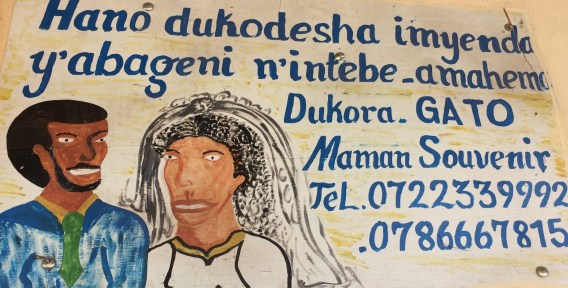
Above is the wedding shop sign that attracted me to the store where I rented my umushanana. The sign says that the shop rents clothes for the bride and groom, as well as tables and tents. It also makes wedding cakes. “Gato” is the Kinyarwanda word for cake, borrowed from the French word “gateau.” However, sometimes Rwandans use the English word “cake,” but Kinyarwanda-ized as “Kaykay.”
Next, I needed an appropriate blouse to wear with it. The proprietress instantly handed me a skin tight, long-sleeved, lacy white blouse. Rwandans love their clothes skin tight, so I was delighted to be fitting in. Fortunately, the blouse was made of a stretchy fabric so that I could get it over my head. She said she would charge me 3,000 francs, which I found reasonable, and told me I could return a few days before the wedding to pick up the items and pay at that time.
Shoes were another problem. Rwandans are crazy about proper, spotlessly clean, “smart” looking footwear. Indeed, the first thing they look at when meeting someone is that person’s shoes. For weeks, I had been looking in the market for the right shoes to wear with my umushanana but could find none that looked comfortable. Comfort, as opposed to looks, was my most important criterion in shoes because I knew I’d have to walk in them. The church was about a mile and a half from my home. Rwandans would take one of the ubiquitous motorcycle or bicycle taxis. However, because Peace Corps prohibited volunteers from taking either, I would have to walk, and I was determined to walk in comfortable shoes.
Three days before the wedding, I sauntered into town to the rental shop to pick up my outfit. I paid my money and took my outfit away in my shoulder bag. When I returned to my office, I ran into my friend Charles and excitedly showed him my outfit and expressed my concern that it was way too long. He agreed and said that I would need to hike up the skirt at the waist to avoid tripping over it. I tried on the skirt portion of the outfit and hiked it up to a walkable level. However, it made my waist so thick that I looked like Humpty Dumpty. So, I asked my very fashionable female colleague, JJ (who I’ve seldom seen wear the same outfit twice), to take a look at my bunched up umushanana. Immediately, she exclaimed it was all wrong. The white blouse looked terrible; it did not go with the design or colors of the umushanana. There was no white in the umushanana. I should take it back and get a black blouse, or a blouse that picked up one of the several colors of the umushanana. As for the length, she unrolled the fabric from my waist and let it fall to the floor and said it was perfect, that it was supposed to cover my shoes. I might trip over the long skirt, but at least it solved the problem of what shoes to wear. I would wear my old, comfy, broken-in Teva sandals since they would be hidden by the flowing gown.
My next question was how to hold up the top piece of fabric. “With a safety pin,” JJ responded. Since we had no other safety pins, I took the large safety pin that secured my trousers around my waist (the safety pin being a necessary addition since I’ve lost enough weight here that, in the absence of suspenders to hold up my pants, a safety pin has done the trick). JJ used the safety pin to attach the top fabric, but said I needed to go back to the shop and get a tiny, discreet safety pin.
Because I liked the white, lacy, stretchy blouse, I didn’t take JJ’s advice about replacing it, but I did go back to the rental shop to ask for the tiny safety pin, since even I agreed that a big safety pin on my shoulder would look gauche. The proprietress sold me two tiny pins for 100 francs, the equivalent of 12 ½ cents.
On the morning of the wedding, I looked at my mangy purse and realized I needed to get a new one for the wedding. I had ordered a new purse from Amazon in June. Because Amazon refuses to ship to Rwanda, I had the purse sent to my son in Washington State and he resent it to me. However, it still hadn’t arrived in Rwanda. My ragtag purse was being held together with scotch tape, and was clearly not fit for a wedding, so I made an emergency trip to the market to look for a suitable replacement. When I entered the market, a young man asked me what I was looking for. When I told him “a purse” and pointed to my raggedy old one, he immediately took me to his friend’s stall, where at least fifty purses were on display. Again pointing, I made it clear that I wanted a small one. The two men found the perfect purse: small and a neutral beige that would blend nicely with my multi-colored umushanana. Plus, it had a shoulder strap. We bargained for at least five minutes over the price. He started at 7,000 francs, but finally came down to 3,000 francs (just over $3), which seemed reasonable.
When I arrived home, I took out my stylish new purse, preparing to transfer the contents of my old purse into it. However, before I even removed the new purse from the bag, the shoulder strap fell off. I noticed that the few stitches holding the strap to the purse had come loose. Well, I would either have to use it without the strap or use my large safety pin to reattach the strap, which of course would completely ruin the stylishness of the purse. To make matters worse, there was now a hole where the strap had been attached. Then I touched the tab to the zipper to open the purse, and it came off in my hand. This purse was definitely rebelling against going to the wedding. I repressed my anger over having paid 3,000 francs for a useless purse and considered, but decided against, using scotch tape to hold the new purse together. Instead, I decided to go with my old unsightly purse.
Later that morning, I prepared to get ready for the big event. However, the electricity stopped working, making it impossible for me to heat water for my bath. Not being in the mood for an ice-cold bath yet being resourceful, I took a sponge bath. Next, I put on my long skirt, which extended nicely over my Teva sandals, completely concealing them. The skirt, however, was a wrap-around. Depending on how I moved, it unfashionably exposed one pasty white leg. What to do? I needed to wear something underneath. I happened to have a pair of black fleece tights that on cold nights I wore as pajamas. I put them on and that solved the problem. Next, I put on my stretchy white blouse, and last the top fabric, which I secured with my tiny and discreet new safety pin. I was ready to go to my friends’ shop.
Clarisse had insisted that I stop by her shop before the wedding so that she could inspect me. As soon as I entered, she raced from behind the counter and untied my skirt. It was all wrong, she said. She then re-wrapped the skirt twice around me so that the slit exposing my leg disappeared. She pulled the waist tie so taut that I gasped for breath. One of the customers in her shop jumped up from the table where she’d been taking tea to assist Clarisse in re-dressing me. They removed the tiny and discreet safety pin in the shawl portion of the outfit and handed it to me, asking what was I thinking to use a safety pin. They then secured the top piece by tying it in a tight and tiny knot that I had to admit looked better than a safety pin. They then ran their hands over my hair and body, smoothing every part of me. Next, they sent me outside, so they could take my photo. As I was posing, a funny coincidence happened. A woman, whom none of us  knew, happened to walk by wearing the exact same umushanana fabric that I was wearing. Fortunately, she was going to a different wedding and, thus, would not take away from the uniqueness of my umushanana. She, of course, joined me for a photo. I noticed that her blouse was a t-shirt, but, being black, it blended in with the colors of the umushanana better than my lacy, stretchy white blouse.
Finally, Clarisse released me to begin my mile and a half walk to the wedding. To avoid tripping on the long skirt that concealed my sandals, I grabbed part of the skirt and pulled it above my ankles. Within minutes, a woman came running up to me and tried to get me to release the skirt. Although I couldn’t understand her words, I knew she was trying to tell me that the skirt should cover my shoes. I was unable to tell her that, if it covered my shoes, I’d surely trip. However, I knew that would make no sense to her because Rwandans walk extraordinarily slowly – so slow that, sometimes when walking with colleagues from my school, I find myself taking one step forward and one step back just to keep the same pace. I let go of the fabric and let it drape over my feet until I could get ahead of her and then I hiked up the fabric again only to be stopped by another woman. If women were not stopping me to force me to allow the skirt to drape over my feet, they stopped me to either take a photo of me in my umushanana or to take a photo with me. I chuckled at the thought of how many Rwandan smart phones now contained photos of me in my umushanana. On and on this went until I got to town. Once I got past the town, there were fewer people on the road, but everyone stopped me to say, “Wambaye neza,” meaning that my umushanana was beautiful. Of course, it was the hottest time of the day, and, as I was wearing fleece tights under my umushanana, I was sweating profusely.
The invitation said that the wedding would begin at noon. Not wanting to be late and desiring to get a good seat, I got to the church at 11:45 a.m. Of course, I was the first one there. 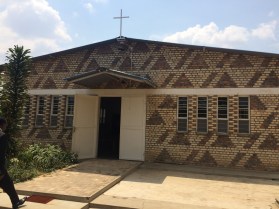
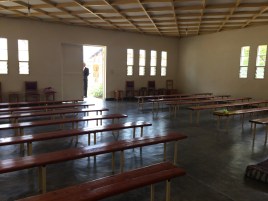
The wedding did not start until an hour and five minutes later. So, I used the extra time to wander the grounds and take photos of the lovely chapel where the wedding would be held. The chapel is called St. Antoine’s. 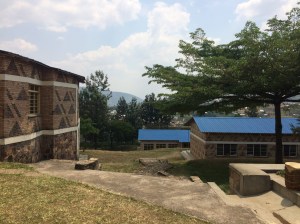 I later learned that St. Antoine’s is an orphanage and that the bride had been raised there
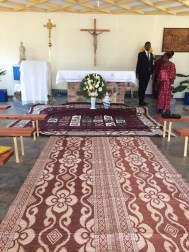 .
.
All the buildings were handsome and neat; the landscaping meticulous. The pastor, who later introduced himself to me, spoke English and was from Slovakia. He also spoke fluent Kinyarwanda.


Suddenly the chapel was filled with people, and the crowd overflowed outside. I looked around at the crowd of over 200 guests to observe how they were dressed. Almost all of the women were wearing umushanana, and I could not help but notice that none of them used safety pins to secure the top piece of fabric. Instead, most made do with a tight and tiny knot like the one Clarisse had tied for me. A few, however, used an especially stylish brooch; “Something to think about for next time,” I thought. The men mostly were dressed in suits. I was happy to have arrived early and secured an aisle seat. Before the ceremony began, the wedding videographer went around the audience taking videos. He spent way too long on me, and, as I squirmed, he said, referring to my umushanana, “Jolie,” which, I recalled from my high school French, means “pretty.”
Finally, the bride and groom entered in an elaborate procession up the aisle to the altar. The maid of honor and best man followed directly behind the wedding couple to attend to them. The music was amazing: a keyboard, several tambourines, tall African drums and a guitar. Plus, beautiful singing in Kinyarwanda, during which I detected the word “God” (Imana) in every other sentence.


Because St. Antoine’s is Catholic, the wedding ceremony included a mass, complete with multiple priests and altar boys. Before the service began, I’d noticed the lack of kneelers and the concrete floor; instinctively, I dreaded the thought of kneeling on it. Fortunately, when it came time for the kneeling part of the mass, only a few very old women, likely with iron knees, knelt on the cement floor; the rest of us wimps remained standing. The most fun part of a Catholic mass is when you turn to greet all the people around you; this mass was no exception, as lots of smiling guests gladly shook my hand.
The service was beautiful, with the only difference from an American wedding being the 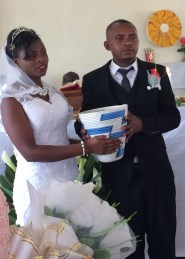 part where the bride and groom receive money gifts. The bride holds a traditional Rwandan basket, while the guests line up to put cash in the basket. Although I was giving a present, I was also giving a card with money in it. So, I carefully untaped the card from the present, and stood up to get into the line to drop my card into the basket. However, several people informed me that only money, not cards, went into the basket, so I dourly returned to my seat and re-secured the card to the present. No one else had presents with them, so I was confused.

After the ceremony concluded, everyone retired outside to mill around the lovely grounds while the wedding party and family posed for the obligatory outdoor photographs. Later, we reconvened in the reception hall to ooh and aah over the wedding cakes and to be entertained by African drums and traditional Rwandan dancing.


The wedding couple were served champagne, and there were numerous speeches and toasts in Kinyarwanda to them. The guests. sitting in chairs and observing the wedding party on the stage, were served soft drinks (Fanta) and wedding cake.
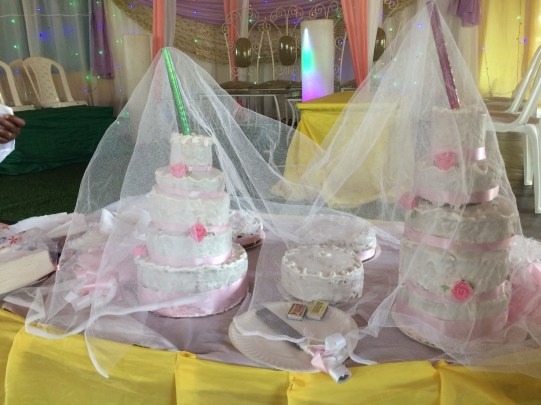
Finally, it was time for the gift giving. Out of nowhere, gifts magically appeared. Where had the guests been hiding the gifts all this time? A long line formed. The bride and groom received each gift-giver and gift individually and the professional photographer took a photograph of each guest presenting the gift. Most were large
beautifully wrapped gifts, but a few were simply brown paper bags. I can’t say what was in any of the gifts because none were opened, but I imagined most of them to contain beer or laundry detergent. When my turn finally arrived, the bride and groom seemed genuinely delighted to receive my gift (even without knowing what it was, and perhaps secretly hoping it was laundry detergent). When I tried to leave, the photographer pulled me back for a few more photographs.
With my mission finally accomplished, I exited the hall and walked the mile and a half back through town to my home. Along the way, every person I met stopped me to tell me how beautiful my umushanana was.

 Ruminations from Rwanda
EXCELLENT PAT!
LikeLike
I really enjoy following you around on your adventures. You describe everything so well, it’s like being there with you.
LikeLike
Another good read and une tres jolie umushanana.
LikeLike
OMG you are the best!!! you are quite the documentarian of foreign and wonderful and magical events, and all those who make them so! So glad Clarisse tied it properly for you! I know you had a ball! ;xo h
LikeLike
What a learning experience!
LikeLike
Hi Pat, I follow your blog and love being on your list! You are truly amazing, which I knew before but is reconfirmed with each post.
I wanted to extend my heartfelt condolences on your loss. I am thinking of you and holding you close in my heart ❤️.
Sharon (Shelly’s daughter) >
LikeLike
Umushanana has nothing to do with kinyarwanda culture because everything has been westernized.
LikeLike