
I arrived in Kigali (prononounced Chigari), Rwanda’s capital city, about 10:30 p.m. on Monday, February 12. While clearing Immigration, I connected with the other Peace Corps Response volunteers. After picking up our luggage, we left the airport, and the first things I noticed was how pleasant the weather was and that we were surrounded by hills that I could not quite see because of the darkness but saw the lights from the many buildings on the hills. What a beautiful sight.
We were met by our Peace Corps Program Manager and a volunteer who had been living here since last August. Each of us was given about 12,000 RWF (Rwandan francs, which is almost $14). We stopped at a very small grocery store not far from the airport and bought food and instant coffee or tea for the next day’s breakfast. (I had money left over.) We then drove to the Peace Corps Transit House, which is really just a hostel, with three bedrooms containing multiple bunk beds (each equipped with a mosquito net) and shared bathrooms, a common sitting area and a common kitchen. The sitting area is stocked with hundreds of books from volunteers who have passed through, and the kitchen is basic and stocked with kitchenware left by prior volunteers. It has a small electric stove with four burners, which several of us manage to use simultaneously while preparing our individual breakfasts. It has WIFI, but it’s incredibly slow and it keeps crashing. Thus, I see it’s going to be difficult to publish blog posts.
By staying in this communal setting, our group of 8 volunteers rapidly bonded. Everyone in our group has extensive experience living abroad, including Mexico, France, Turkey, Senegal, Namibia, Zanzibar, Cameroon, Burkino Faso, Kenya, Macedonia, Thailand, Korea and, for me, Ghana. Most of us will be teaching and assisting with English at various institutions. Not surprisingly, I, at 68, am by far the oldest of my group, though not the oldest volunteer currently in Rwanda, who is 72.
Almost as soon as we arrived at the hostel, we were given stick mosquito repellant and our first dose of an anti-malarial drug, as well as our Peace Corps settling-in allowance and first month’s stipend. After our long journeys to get here, we slept soundly in our mosquito net-covered beds.
The next morning, we rose early, as our training started at 8:15 a.m. We breakfasted outside on our large patio, overlooking a lush yard and listening to the unfamiliar sounds of many birds. My first avian observation had to do with crows; I was told that the crows here are pied crows -black and white and very pretty. They have a more pleasant sound than our American crows. I also saw a bird that I thought was a skinny robin with a long tail, but was told that it is an African thrush.
The first item on our agenda was to meet our Peace Corps Country Director, who welcomed us and gave us the oath, swearing us in as Peace Corps volunteers. We also filled out lots of paperwork to open Rwandan bank accounts. Later, we lunched at lovely restaurant with a typical Rwandan buffet, including pumpkin soup, shredded carrots, a green vegetable ressembling creamed spinach, mashed plantain, boiled plantain, roasted potatoes, beef and a drink. The cost of that lunch was 4000 RWF (less than $5). Then we visited MTN (the phone store), where most of us purchased sim cards and minutes for our phones. So now I have a Rwandan phone number. In Rwanda, almost everyone uses the WhatsApp app to send free text messages, so those volunteers who had not already installed that app did so. I had already installed WhatsApp because my friend, Delfina, told me that it was indispensable for living abroad and my friend, Shary, ensured that it worked on my phone.
In the afternoon, we had an extensive medical briefing by the Peace Corps Rwanda doctor and his staff. They spent a lot of time discussing malaria and emphasizing the importance of taking our anti-malarial drugs and using our mosquito bed nets. Because I’ve had malaria twice (as a result of my prior Peace Corps Service in West Africa in the early 1970s), I did not need to be persuaded. We were given our choice of anti-malarial pills. I chose the one with the least negative side effects. However, I have to take it every day. So far, however, I have seen few mosquitos, but I’m sure that won’t last. The Medical Office issued supplies for us to take to our sites, including a mosquito bednet, a 2-month supply of anti-malarial pills, and a very large and complete first aid kit that includes a malaria test kit. The staff instructed us on how to use the test kit if we believed we had malaria. We also received a large water filter, which ressembles an old-fashioned coffee urn (the kind used by Americans for parties before Keurig became popular). Importantly, we were trained in how to use the filter to ensure that our drinking water is safe, including adding a few drops of bleach.
Our second day of training began with training in iKinyarwanda (the language of Rwandans). The class ratio is four students to one teacher. Our teacher is very energetic, she even danced, trying get us to say the words with the proper rhythm and accent on the correct syllable. The first word we learned was “Muraho,” which means hello, but is used only for the first time you meet someone or when you have not seen someone for a very long time. We all mastered that one easily, but the next words “Mwaramutse” (good morning) and Mwirwe (good afternoon) were more challenging. Later, we met with the U.S. Ambassador to Rwanda Erica Barks-Ruggles, who reminded us that we all represented the United States and were all ambassadors to Rwanda.
Later in the week, we had safety and cultural briefings. On Friday, we met our counterparts for the first time and lunched with them. We obtained Tap N Go cards for the city busses, which don’t take cash – only the Tap N Go cards. The rate is 240 rwf per ride, which is about 27 cents. On Saturday morning, we went to the Rwanda Genocide Museum. Afterwards, we went into the center of Kigali to buy kitchenware for our sites. The shops, especially T 2000, a huge 2-story Chinese owned department store, were bustling. Before entering the shop, we passed through a metal detector and placed our handbags and backpacks on the a conveyor belt to be scanned. One can purchase just about anything at the T 2000 store, but the quality is generally low (think a gigantic dollar store) and yet expensive. Another store, called Nakumatt, had higher quality items. One reason for the expense is that Rwanda is a land-locked country. Imported goods generally must first be shipped to the neighboring country of Tanzania and then transported overland by truck to Rwanda. Rwanda hopes to partner with Tanzania to build a railroad to speed up and reduce the cost of such transport in the future.
Today, we visited the African market, which was a lot more fun. I was able to buy a phone charger that fits in Rwanda electrical outlets, as well as a power strip so that I can charge my phone, iPad and computer simultaneously. I also bought a mango, a papaya and bananas for next week’s breakfasts.
Tonight, we walked and walked around the city. I was excited to walk near the Kigali Convention Center, which we had been observing from a distance. It is shaped like a beehive buzzing with bees and it is lit up with constantly moving lights. It is the most interesting building in Kigali.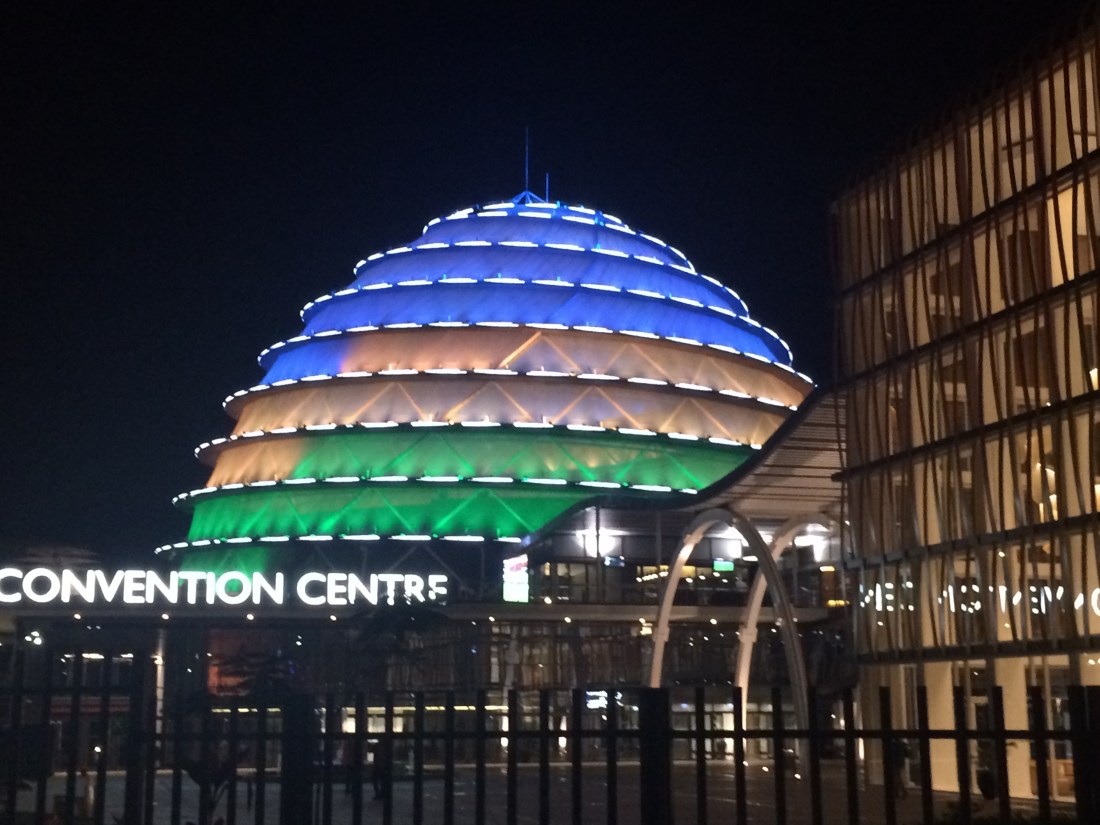
 Ruminations from Rwanda
Wow, it really sounds exciting and very real!
LikeLike
Thank you so much for sharing your experience Pat. It seems you have accomplished a lot in your first week! And I’ve learned many things about Rwanda from you. Look forward to more.
LikeLike
Muraho Pat. First time meeting you here friend,Wow!We are so happy to be following you.
Stay safe and healthy 😘
Kathy and Dave
LikeLiked by 1 person
Pat-
You are on your own Olympics! Gold medal reporting! Looking forward to more!
Gerri
LikeLike
Reading about everything you had to take care of in those few days makes me dizzy. Take care of yourself. Maria
LikeLike
Wow!! What an amazing experience! So glad to hear from you. Keeping my fingers crossed that you will be safe and continuing to pray for your safe and prosperous journey. God Bless You!!
Sent from my Verizon, Samsung Galaxy smartphone
a:hover { color: red; } a { text-decoration: none; color: #0088cc; } a.primaryactionlink:link, a.primaryactionlink:visited { background-color: #2585B2; color: #fff; } a.primaryactionlink:hover, a.primaryactionlink:active { background-color: #11729E !important; color: #fff !important; }
/* @media only screen and (max-device-width: 480px) { .post { min-width: 700px !important; } } */ WordPress.com
LikeLike
Sounds good. What a great adventure.
LikeLike
How happy I am you are continuing the work of your dreams! And I have already learned so much. If I had a farm, I would certainly have a herd of those cows so I could create beautiful decorations to celebrate them. Have a neighbor across the hall here in Lansdowne who makes her own yogurt from raw milk, so I was fascinated by the account that there was a whole cottage and yoga master dedicated to the yogurt production. When I hear of the luxury and possessions of the king, I wondered what the subjects did for food, dowries, and maintaining their lives within the community. I look forward to sharing your blog with Belkys and my neighbor. And, certainly look forward to future ruminations, xo h
LikeLike
Hey! Follow my Blog for more such posts!!
LikeLike